Facts
The petitioners (accused) challenged their conviction under Section 138 of the Negotiable Instruments (NI) Act in three complaint cases.
Source reference: p. 2The complainant alleged that after an agreement to sell a flat in 2001, the accused requested to utilize the rental income as a loan for their company (Vasu Tech Ltd.), issuing post-dated cheques, promissory notes, and acknowledgments as security.
Source reference: p. 3-4Eight cheques were eventually dishonored due to "Insufficient Funds".
Source reference: p. 5The Trial Court convicted the petitioners on 11.10.2012, sentencing Petitioner No. 1 to one-year imprisonment and a fine/compensation of ₹50 lakhs per case.
Source reference: p. 7The Appellate Court upheld the conviction on 30.09.2024 but modified the sentence to a consolidated compensation of ₹1 crore.
Source reference: p. 8The petitioners contended the transactions were actually cash loans and the documents were mere collateral security.
Source reference: p. 9Issues
Whether the petitioners successfully rebutted the statutory presumption under Sections 118 and 139 of the NI Act regarding the existence of a legally enforceable debt.
Source reference: p. 11/13Whether the revisional court should interfere with the concurrent findings of the lower courts in the absence of patent illegality or perversity.
Source reference: p. 11/20Whether the Appellate Court was justified in modifying the specific sentence/compensation structure imposed by the Trial Court.
Source reference: p. 21Law Applied
The court primarily applied Section 138 of the Negotiable Instruments Act, 1881, which defines the offense of cheque dishonor, and Section 139, which mandates a presumption that the holder of a cheque receives it for the discharge of a debt or liability.
Source reference: p. 14It relied on Dashrathbhai Trikambhai Patel v. Hitesh Mahendrabhai Patel (2023) to outline the essential ingredients of the offense.
Source reference: p. 14The court further applied Section 118 of the NI Act regarding the presumption of consideration.
Source reference: p. 11The principle that revisional jurisdiction is limited to examining the legality and propriety of findings rather than re-appreciating evidence.
Source reference: p. 11-12Reasoning
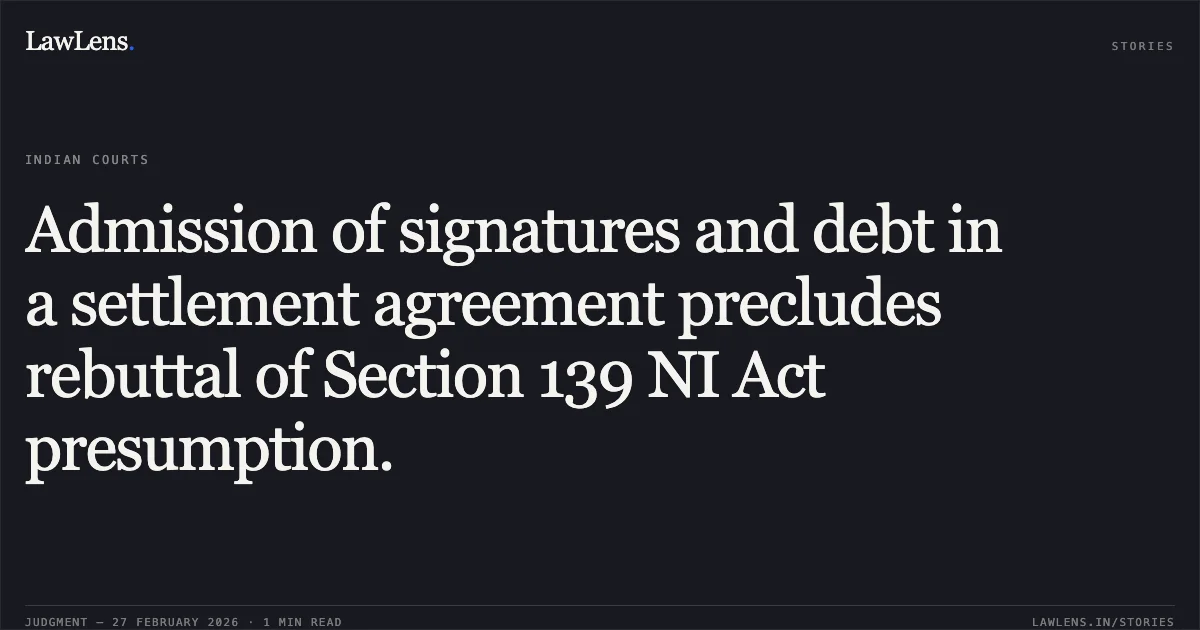
The Court observed that since Petitioner No. 1 admitted his signatures on the cheques, the statutory presumption under Section 139 stood triggered, shifting the burden of proof to the accused.
Source reference: p. 15The Court found the "security cheque" defense implausible because the petitioner admitted to the handwritten assignment of rent in the sale agreement and the encashment of initial consideration cheques.
Source reference: p. 17-18Critically, the petitioner admitted during cross-examination that a liability of ₹2 to ₹2.5 crores existed at the time of presentation.
Source reference: p. 18-19The Court also highlighted a 2009 Memorandum of Understanding (MOU) where the petitioner had expressly acknowledged the liability for all eight cheques to seek leniency in a previous sentencing.
Source reference: p. 19-20The Court ruled that the petitioner could not resile from these admissions, and the failure to reflect the alleged "cash loans" in books of accounts further weakened the defense.
Source reference: p. 16, 20Holding
The High Court dismissed the revision petitions, affirming the conviction of the petitioners.
The Court held that the petitioners failed to rebut the statutory presumption and that the complainant proved all ingredients of Section 138.
Source reference: p. 21However, the Court set aside the Appellate Court’s modification of the sentence, finding it lacked cogent reasoning, and restored the Trial Court's original order on sentence dated 31.10.2012, which required Petitioner No. 1 to pay ₹50 lakhs compensation in each of the three cases.
Source reference: p. 21Acts & Sections Cited
5 provisions across 2 statutes referred to in this judgment. Each provision opens on LawLens.
Code of Criminal Procedure, 19732
Negotiable Instruments Act, 18813
Original Court PDF
Dhruv Varma & Anr. v. J K Varma & Anr. (CRL.REV.P. 723/2014 & connected matters; 2026:DHC:XXXX)
Click to open original judgment
Original judgment, available to read, download and summarize on LawLens.in