Facts
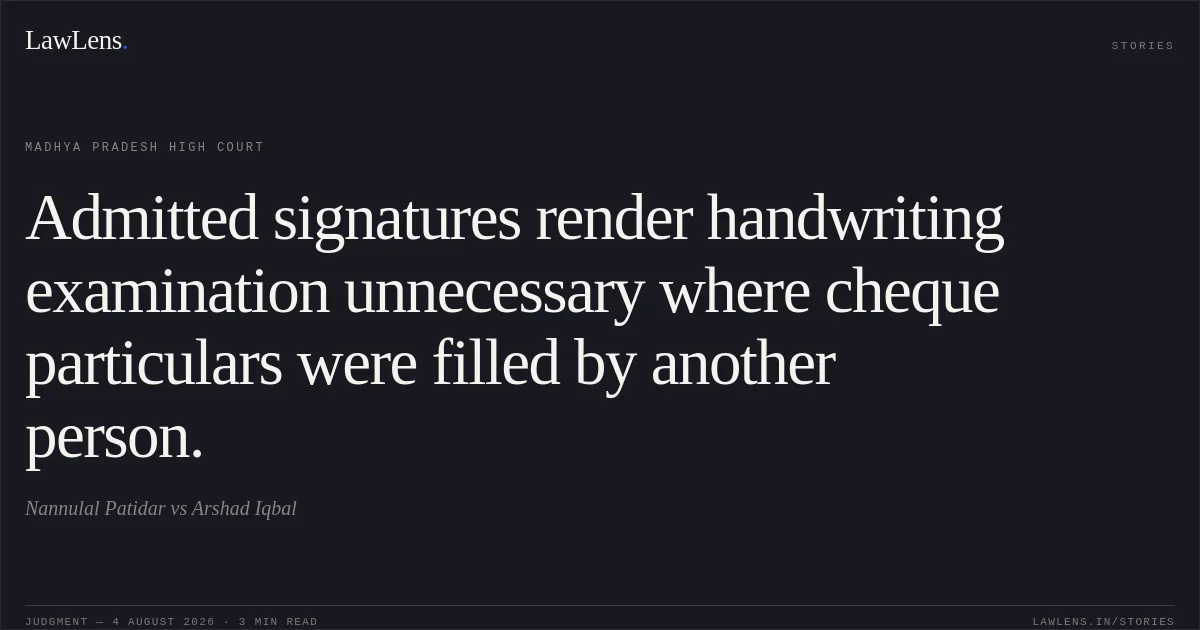
The petitioner challenged orders dated 08.04.2026 and 13.07.2026 passed by the Judicial Magistrate First Class, Bhopal, in RCT No. 9481/2019, rejecting his application to have the disputed cheque examined by a handwriting expert.
Source reference: para. 1The petitioner admitted his signatures on the cheque but contended that the remaining particulars had been filled in by another person after the cheque was allegedly stolen while he was working at a petrol pump operated by his son.
Source reference: para. 2During cross-examination, the defence suggested that the cheque had been handed over to the complainant as security; however, during defence evidence, the petitioner asserted that the cheque had been lost or stolen.
Source reference: paras. 5–6The cheque was dishonoured on 06.02.2019 and statutory notice was issued on 15.02.2019, whereas the alleged theft complaint was lodged only on 22.02.2021.
Source reference: para. 7Issues
Whether, when the drawer admits his signatures on the cheque, examination of the handwriting used to fill in the remaining particulars is necessary or material to the defence in proceedings under Section 138 of the Negotiable Instruments Act.
Source reference: paras. 4, 8Whether the petitioner was entitled to interference against the orders refusing handwriting examination, in the exercise of the High Court’s supervisory jurisdiction.
Source reference: paras. 9–10Whether the petitioner should be granted one further opportunity to advance final arguments despite the closure of that right by the Trial Court.
Source reference: para. 13Law Applied
The Court applied Section 138 of the Negotiable Instruments Act, 1881, under which a duly signed cheque may give rise to liability notwithstanding that its particulars were filled in by the holder or another authorised person; the mere fact that the handwriting on the cheque is not that of the drawer does not, by itself, invalidate the cheque or constitute a legally sustainable defence.
Source reference: paras. 4, 8The Court also applied the principle that interference with interlocutory orders concerning defence evidence is limited and is warranted only where the order suffers from patent perversity, manifest illegality, material irregularity, or causes failure of justice.
Source reference: para. 9No specific judicial precedent was cited in the judgment.
Source reference: no citationReasoning
Since the petitioner consistently admitted his signatures, the Court held that the identity of the person who filled in the cheque’s remaining particulars was not determinative of the Section 138 proceedings.
Source reference: paras. 4, 8The petitioner’s inconsistent stands—that the cheque was handed over as security, but later that it had been lost or stolen—undermined the credibility and necessity of the proposed expert examination.
Source reference: paras. 5–6The alleged theft complaint was lodged approximately two years after dishonour of the cheque and commencement of the proceedings, and the unexplained delay made the defence appear prima facie belated and doubtful.
Source reference: para. 7The Trial Court had therefore exercised its discretion properly, and the Revisional Court had rightly affirmed that decision; no jurisdictional error or perversity was shown warranting High Court interference.
Source reference: paras. 9–10Holding
The petition challenging rejection of the handwriting-examination application was dismissed for lack of merit.
The Trial Court was directed to proceed expeditiously and endeavour to conclude the 2019 complaint within 30 days of receiving the order, without being influenced by the observations made in the petition.
Source reference: para. 12Although the closure order dated 27.07.2026 was not challenged, the Court directed the Trial Court to grant the petitioner one further opportunity to advance final arguments on the next date; no adjournment was to be sought on that date.
Source reference: para. 13Acts & Sections Cited
1 provisions across 1 statute referred to in this judgment. Each provision opens on LawLens.
Negotiable Instruments Act, 18811
Original Court PDF
Nannulal PatidarvsArshad Iqbal
Click to open original judgment
Original judgment, available to read, download and summarize on LawLens.in