Facts
Jitendra Kumar, who was married to Asha, the elder daughter of deceased municipal employee Mohan Lal, claimed that Mohan Lal had adopted him through an adoption deed dated 01.11.2012. Mohan Lal died on 03.11.2012, and the deed was registered subsequently on 17.12.2012.
Source reference: paras. 1–2.5The deed described the appellant as Mohan Lal’s “adopted son-in-law” or God Jamai, rather than as his son. The appellant applied for compassionate appointment with the Nagar Palika, supported by representations and consent letters from Mohan Lal’s widow and daughters. The Nagar Palika rejected the application on 15.05.2013 for failure to produce the requisite legal documents. The appellant’s writ petition was dismissed by the learned Single Judge on 17.01.2025, leading to the present special appeal.
Source reference: paras. 1–2.5, 6–7Issues
1. Whether the adoption deed validly created an adoption under the Hindu Adoptions and Maintenance Act, 1956 (HAMA), particularly when it described the appellant as an “adopted son-in-law” and was registered after the adoptive father’s death?
Source reference: paras. 6–7.22. Whether the adoption was invalid under Section 10 of the HAMA because the appellant was married and above fifteen years of age, in the absence of proof of a valid custom or usage permitting such adoption?
Source reference: paras. 7.5–7.73. Whether the appellant was eligible for compassionate appointment under Rule 2(c) of the Rajasthan Compassionate Appointment of Dependents of Deceased Government Servants Rules, 1996, as the deceased employee’s adopted son or adopted son-in-law?
Source reference: paras. 8–8.1Law Applied
The Court applied Section 10 of the HAMA, which prohibits adoption of a person who is above fifteen years of age or married, unless a valid custom or usage applicable to the parties permits such adoption.
Source reference: para. 7.5Section 16 of the HAMA creates a rebuttable presumption regarding the validity of a registered adoption deed, but that presumption cannot validate a document that is ex facie contrary to mandatory statutory provisions or the basic legal requirements of adoption.
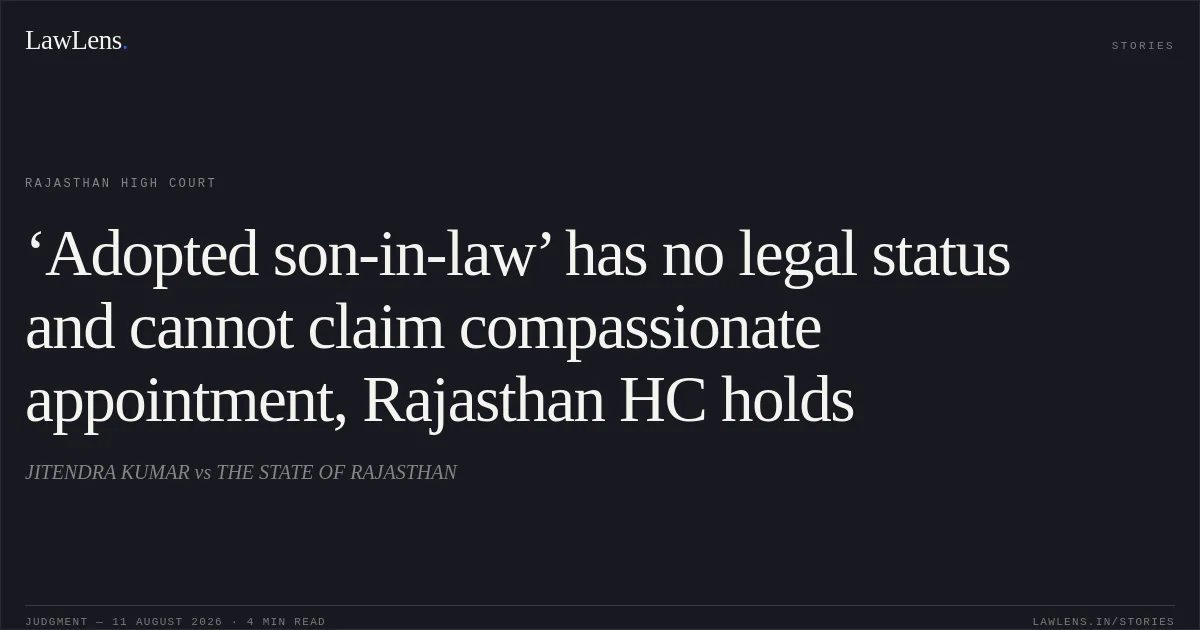
Source reference: para. 7.7The Court held that adoption is a legally regulated institution that creates the status of an adopted son or daughter; the law does not recognise an “adopted son-in-law” or “adoptive father-in-law” as a distinct legal status.
Source reference: paras. 7.1–7.2Rule 2(c) of the 1996 Rules exhaustively defines “dependent” for compassionate appointment and includes a spouse, legally adopted son or daughter, certain daughters, and specified relatives, but does not include a son-in-law or adopted son-in-law.
Source reference: para. 8.1Compassionate appointment is an exception to ordinary recruitment and is intended to provide immediate financial assistance to genuine dependants, not to operate as an alternative or back-door mode of public employment.
Source reference: para. 9.2The respondents also relied upon Atluri Brahmanandam (D) Thr. Lrs. v. Anne Sai Bapuji, AIR 2011 SC 545, and Kumari Vinita Sharma v. Union of India & Ors.
Source reference: para. 4.3Reasoning
The Court first examined the language of the deed and found that it expressly intended to make the appellant an “adopted son-in-law” (God Jamai), a status unknown to the law of adoption.
Source reference: paras. 7–7.1Even if the deed were liberally construed as intending to adopt the appellant as a son, the adoption remained legally untenable because the appellant was already married and over fifteen years of age, while neither the deed nor the pleadings pleaded or established any applicable custom permitting such adoption.
Source reference: para. 7.5Recognition of the appellant as an adopted son would also produce legally inconsistent consequences, including making him the brother of his own wife and disrupting the legal incidents of marriage, succession, and family relationships.
Source reference: paras. 7.3–7.4Accordingly, the registration of the deed after Mohan Lal’s death and the statutory presumption under Section 16 could not cure the deed’s fundamental defects.
Source reference: paras. 6, 7.7Independently, even treating the appellant as an adopted son-in-law, Rule 2(c) of the 1996 Rules did not include such a person within the exhaustive category of eligible dependants.
Source reference: paras. 8–8.1The recital in the deed referring to entitlement to compassionate appointment further suggested that the document had been created to secure public employment, contrary to the limited purpose of compassionate appointment.
Source reference: paras. 9–9.2Holding
The Division Bench held that the alleged adoption was legally unenforceable. On its plain terms, the deed attempted to create the unrecognised status of an “adopted son-in-law”; alternatively, if construed as an adoption of a son, it violated Section 10 of the HAMA and was unsupported by any pleaded or proved custom. Section 16’s presumption could not assist the appellant.
In any event, the appellant was not an eligible dependant under Rule 2(c) of the 1996 Rules, since neither a real nor an adopted son-in-law qualified for compassionate appointment.
Source reference: para. 10(III)The appeal was dismissed, the Single Judge’s judgment dated 17.01.2025 was upheld, and all pending applications, including the stay application, were disposed of.
Source reference: paras. 11–13Acts & Sections Cited
2 provisions across 1 statute referred to in this judgment. Each provision opens on LawLens.
Hindu Adoptions and Maintenance Act, 19562
Original Court PDF
JITENDRA KUMARvsTHE STATE OF RAJASTHAN
Click to open original judgment
Original judgment, available to read, download and summarize on LawLens.in