01Facts
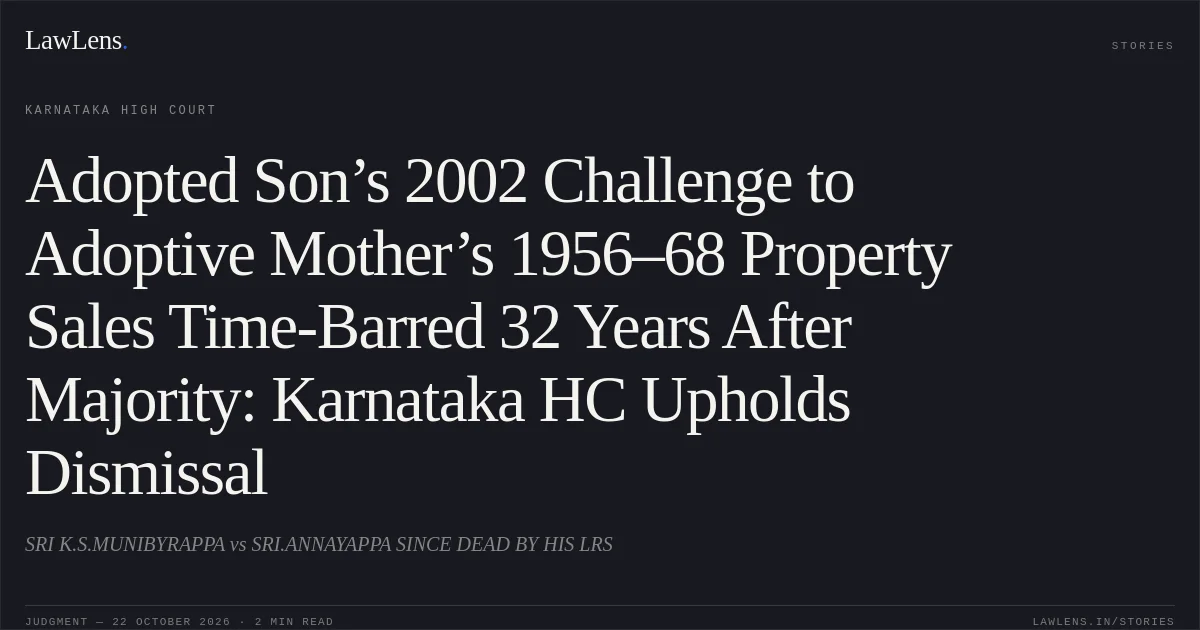
The plaintiff challenged sale deeds executed in 1956, 1965 and 1968 by his adoptive mother, Bayamma, alleging fraud, misrepresentation and undue influence.
¶ 3–5, 15, 18–19He claimed that his adoptive father had made a testamentary arrangement in his favour and that he was a minor when the transactions occurred.
¶ 3–5, 15, 18–19The plaintiff alleged that he learned of the fraud in December 2001 and January 2002, and filed suit on 10 June 2002 seeking declarations, possession and related reliefs.
¶ 3–5, 15, 18–19The Trial Court treated court-fee sufficiency and limitation as preliminary issues and dismissed the suit.
¶ 7–8The plaintiff challenged the limitation ruling in the regular first appeal and the court-fee ruling in the connected writ petition.
¶ 7–802Issues
i.Whether the Trial Court was justified in dismissing the suit as barred by limitation under Section 3 of the Limitation Act, 1963
¶ 1403Law Applied
Section 3 of the Limitation Act, 1963 imposes a mandatory duty on the court to dismiss a suit instituted beyond the prescribed period, whether or not limitation is pleaded as a defence.
¶ 26–28The Court considered Article 60, which prescribes three years from a ward attaining majority for a suit to set aside a transfer of property made by a guardian.
¶ 23–24It relied on Manindra Land and Building Corporation Ltd. v. Bhutnath Banerjee, AIR 1964 SC 1336, and Salgaocar and Bros. v. Board of Trustees of Port of Mormugao, (2005) 4 SCC 613, for the mandatory nature of Section 3, and cited Chhedi Lal Yadav v. Hari Kishore Yadav, (2018) 12 SCC 527, regarding the significance of protecting rights said to have crystallised over time.
¶ 28, 34The Court also stated that a plea of fraud does not, by itself, indefinitely postpone limitation; it must be assessed in the context of the specific pleadings and circumstances.
¶ 29, 32Provisions in the judgment · 3 · Linked ones open on LawLens
Code of Civil Procedure, 1908 Section 96
Limitation Act, 1963 Section 3Section 60
04Reasoning
The Court relied on the plaint’s chronology: the challenged deeds dated from 1956 to 1968, the plaintiff was born in 1951 and, according to the Court, attained majority in 1970, but did not sue until 2002.
¶ 18, 22, 29Applying Article 60, it held that even on the plaintiff’s case that the transfers occurred during his minority, the three-year period after attaining majority had expired.
¶ 19, 25, 29, 32–35It considered the pleaded discovery of fraud in 2001–2002 insufficient to defer limitation because the plaint did not meaningfully explain how knowledge of the old alienations arose only then; it also noted the long period of possession and the asserted third-party rights under registered instruments.
¶ 19, 25, 29, 32–35The Court therefore concluded that the Trial Court was entitled—and obliged under Section 3—to decide limitation without awaiting a full trial.
¶ 30, 3505Holding
The Court answered the limitation issue in the affirmative and dismissed the regular first appeal, affirming dismissal of the suit as time-barred.
¶ 38–40It did not separately determine court-fee sufficiency, observing that the objection would ordinarily require determination of any deficit and an opportunity to make it good, but that no remand was warranted after dismissal on limitation.
¶ 36 · Order, clauses (ii)–(iii)The connected writ petition challenging the court-fee ruling was dismissed as infructuous.
final order following para. 40Original Court PDF
SRI K S MUNIBYRAPPAvsSRI ANNAYAPPA SINCE DEAD BY HIS LRS
Click to open original judgment
Original judgment, available to read, download and summarize on LawLens.in