01Facts
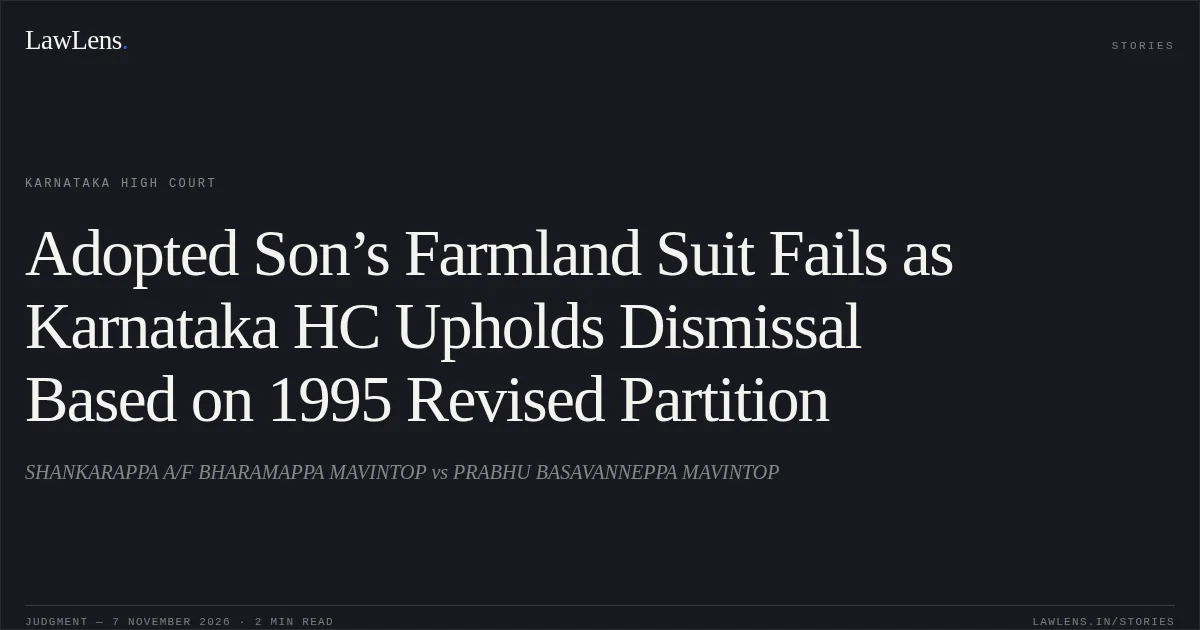
The plaintiff, claiming through his adoptive father Bharamappa, sought a declaration that the suit lands were ancestral properties allotted to Bharamappa in a 1965 partition and consequential injunction.
pp. 3–6He also challenged mutation entry M.E. No. 2798, which reflected a later alleged arrangement in favour of the defendants’ father, Basavanneppa.
pp. 3–6The defendants relied on a written memorandum of partition dated 31 January 1995, said to record a settlement under which portions of the lands were allotted to Basavanneppa.
pp. 15–16The trial court dismissed the suit, and the first appellate court affirmed that decision.
pp. 9–10The plaintiff appealed under Section 100 of the Code of Civil Procedure, 1908; the High Court framed a substantial question concerning reliance on the revised partition.
p. 1202Issues
i.1. Whether the courts below erred in relying on the revised partition dated 31 January 1995 to hold that the plaintiff had given up his share in the suit properties?
p. 12ii.2. Whether the plaintiff established his claimed ownership of the suit properties so as to obtain declaratory and injunctive relief?
pp. 17–1803Law Applied
The appeal was considered under Section 100 of the Code of Civil Procedure, 1908, which confines a second appeal to a substantial question of law.
p. 12The judgment identifies no specific statutory provision governing partition, registration, or admissibility, and cites no precedent.
It does not articulate a separate legal rule concerning the effect or admissibility of the revised partition document.
Provisions in the judgment · 1 · Linked ones open on LawLens
Code of Civil Procedure, 1908 Section 100
04Reasoning
The High Court noted that the courts below had considered the revised partition memorandum, marked as Ex. D1, and had found that the plaintiff failed to prove absolute ownership of the suit lands.
pp. 16–18It upheld their assessment and concluded that the appellant had not substantiated the grounds raised in the second appeal.
p. 18Although the appellant argued that the revised partition was unregistered, the judgment does not separately examine the legal effect of non-registration; its reasoning rests on affirming the lower courts’ evaluation of the evidence and the plaintiff’s failure to prove his claim.
p. 1805Holding
The High Court answered the substantial question of law against the appellant and dismissed RSA No. 5854 of 2013, confirming the judgments and decrees of the trial court and first appellate court.
pp. 18–19The parties were directed to bear their own costs.
pp. 18–19Original Court PDF
SHANKARAPPA A/F BHARAMAPPA MAVINTOPvsPRABHU BASAVANNEPPA MAVINTOP
Click to open original judgment
Original judgment, available to read, download and summarize on LawLens.in