01Facts
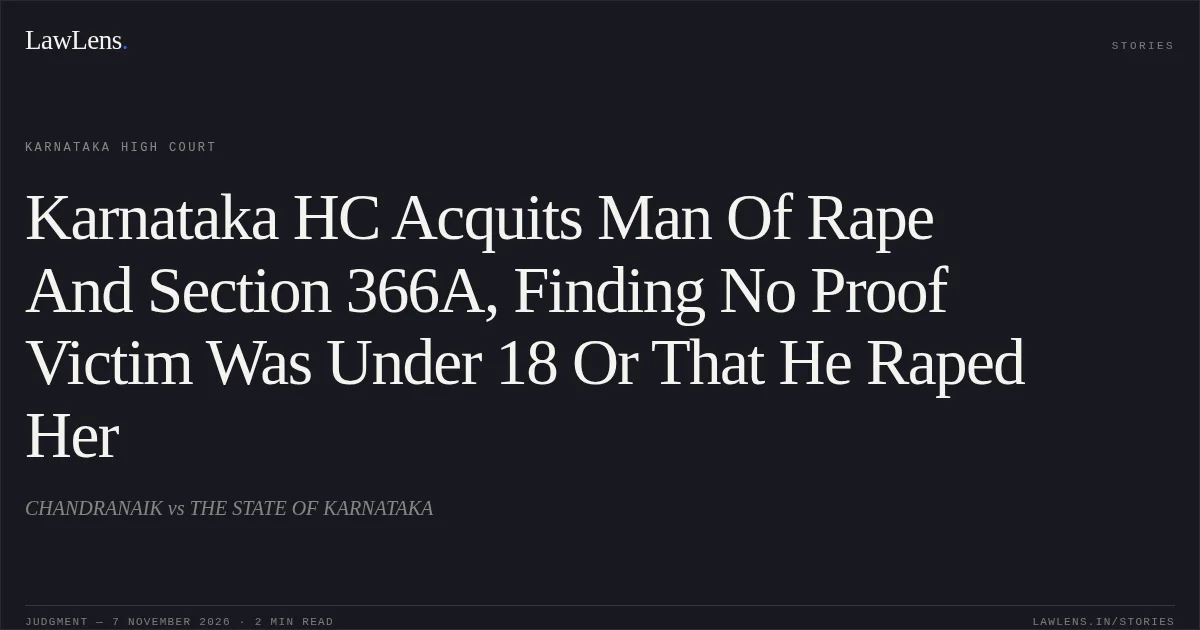
The appellant, Accused No. 1, was convicted by the Sessions Court under Sections 366A and 376 of the IPC and sentenced to imprisonment and fines; the other charges against him were acquitted
pp. 5–6 · ¶ 7The prosecution alleged that he took the complainant from her home, married her, and had sexual relations with her.
pp. 8–10 · ¶ 10, 13–1502Issues
i.Whether the appellant had established grounds to interfere with his convictions and sentences under Sections 366A and 376 of the IPC
p. 8 · ¶ 10ii.Whether the prosecution proved that the complainant was under eighteen and that the elements of Section 366A were satisfied
pp. 12–15 · ¶ 18–21iii.Whether the evidence was sufficient to sustain the conviction under Section 376 of the IPC
pp. 16–20 · ¶ 22–3003Law Applied
Section 366A of the IPC requires proof that a girl under eighteen was induced to go from a place or do an act, with the requisite intent or knowledge that she would be forced or seduced to illicit intercourse; the Court stated that the contemplated intercourse must be with a person other than the accused who induced her
pp. 12–13 · ¶ 18Section 375 of the IPC defines rape by specified forms of penetration and circumstances in which the act constitutes rape, including absence of consent and consent obtained under the circumstances specified in the section
pp. 16–17 · ¶ 22The Court also noted that Section 198 of the CrPC bars cognizance of an offence under Section 494 of the IPC on a police report, though the trial court had acquitted the accused of that offence
pp. 11–12 · ¶ 17Provisions in the judgment · 14 · Linked ones open on LawLens
Code of Criminal Procedure, 1973 Section 374Section 313Section 198Section 2
Indian Penal Code, 1860 9 provisions
Section 366Section 376Section 417Section 324Section 506Section 494Section 34Section 504Section 375Probation of Offenders Act, 1958 Section 4
04Reasoning
The Court held that the prosecution had not reliably proved the complainant’s age to be below eighteen: although school documents indicated a date of birth that would place her below eighteen, the issuing officials were not examined, while the medical evidence placed her age between eighteen and twenty-one
pp. 13–15 · ¶ 19–20It also found no evidence that the appellant induced her to go somewhere with the intent or knowledge required by Section 366A
p. 15 · ¶ 21As to Section 376, the Court found no legally sufficient evidence of rape, noting the absence of supporting evidence in the medical certificate and the investigating officer’s failure to charge the appellant under that section, despite the trial court framing a charge
pp. 19–20 · ¶ 29–3005Holding
The High Court answered the appeal issue in the affirmative, allowed the appeal, set aside the conviction and sentence, and acquitted the appellant of the offences under Sections 366A and 376 of the IPC
p. 21 · ¶ 30–31It directed the trial court to refund any fine deposited and ordered the appellant’s bail bond cancelled
p. 21 · ¶ 31Original Court PDF
CHANDRANAIKvsTHE STATE OF KARNATAKA
Click to open original judgment
Original judgment, available to read, download and summarize on LawLens.in