01Facts
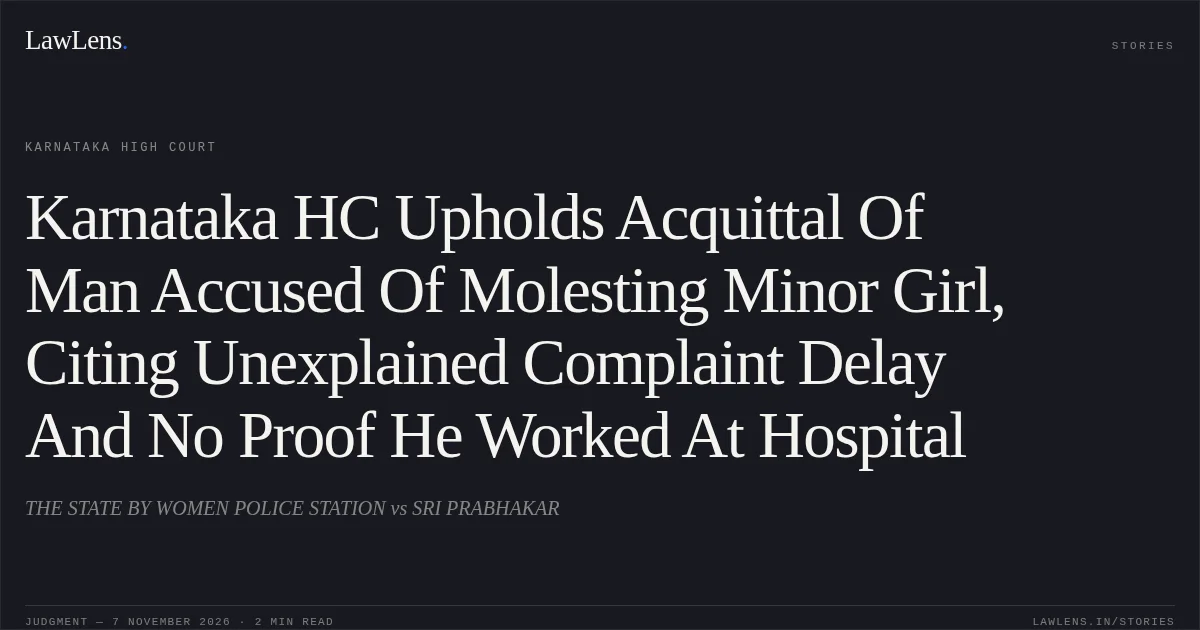
The prosecution alleged that, on 8 February 2013, the accused—said to be a hospital ward-boy—held the hand of the 11-year-old victim, hugged her, and touched her private part while she was at the hospital with her mother.
¶ 3–5The victim’s father was informed, and a complaint was lodged the following day.
¶ 3–5The trial court acquitted the accused of offences under Sections 354 and 506 of the IPC and Section 8 of the POCSO Act. The State appealed against the acquittal.
¶ 3–5, 2502Issues
i.Whether the State had established grounds to interfere with the trial court’s judgment of acquittal
¶ 16ii.What order should follow
¶ 1603Law Applied
The appeal was brought under Sections 378(1) and (3) of the CrPC against an acquittal for offences charged under Sections 354 and 506 of the IPC and Section 8 of the POCSO Act.
appeal heading · ¶ 1, 3The judgment notes that the amicus relied on Constable 907 Surendra Singh v. State of Uttarakhand, Babu Sahebgouda Rudragoudar v. State of Karnataka, Chandrappa v. State of Karnataka, and H.D. Sundara v. State of Karnataka concerning appellate review of acquittals; it does not set out a specific doctrinal test from those authorities.
¶ 14–16, 26The State also relied on the presumption under Section 29 of the POCSO Act, but the appellate court did not separately articulate or apply a rule concerning that presumption.
¶ 12Provisions in the judgment · 6 · Linked ones open on LawLens
Code of Criminal Procedure, 1973 Section 378Section 313
Indian Penal Code, 1860 Section 354Section 506
Protection of Children from Sexual Offences Act, 2012 Section 8Section 29
04Reasoning
The court assessed the prosecution evidence and the trial court’s reasons for acquittal.
¶ 19–26Although the victim identified the accused in court, the prosecution did not establish how his name was identified in the complaint, produce evidence that he was employed at the hospital on the relevant date, or conduct a test identification parade.
¶ 19–26The alleged eyewitness/inpatient, PW6, did not support the prosecution, and the prosecution did not examine relevant hospital personnel.
¶ 19–26The court also noted the unexplained delay in lodging the complaint and transmitting the FIR, as well as discrepancies concerning the location of the incident.
¶ 19–26On the full record, it found no legal or factual error warranting appellate interference.
¶ 2605Holding
The court answered the issue of interference in the negative and dismissed the State’s appeal, leaving the acquittal in force.
¶ 17, 26–27It directed the Registry to pay the amicus curiae Rs. 10,000 for his services.
¶ 26–27Original Court PDF
THE STATE BY WOMEN POLICE STATIONvsSRI PRABHAKAR
Click to open original judgment
Original judgment, available to read, download and summarize on LawLens.in