01Facts
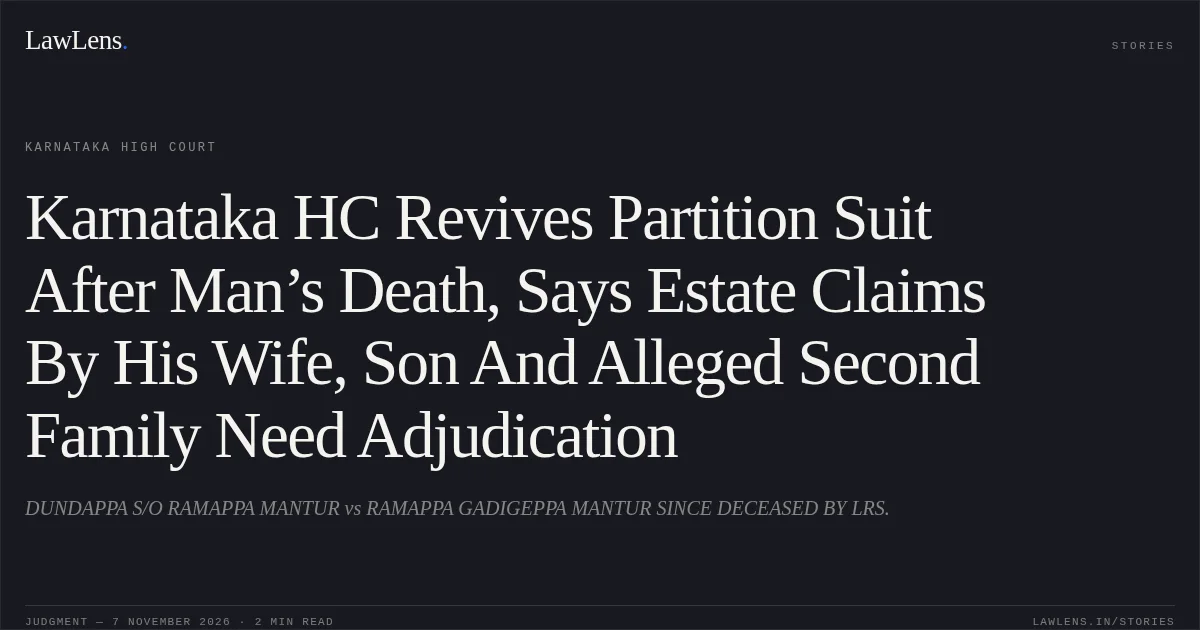
The petitioners, the son and wife of the original defendant, filed a partition suit claiming a 2/3 share in the suit properties.
pp. 3–6 · ¶ 3–6After the defendant died, they asserted that they were his only legal heirs.
pp. 3–6 · ¶ 3–6The other defendants, who claimed to be his second wife and children, sought dismissal of the suit on the ground that no relief had been claimed against them.
pp. 3–6 · ¶ 3–6The petitioners applied under Order VI Rule 17 CPC to amend the plaint, but the Trial Court allowed the defendants’ memo and dismissed the suit as not maintainable, while rejecting the amendment application.
pp. 3–6 · ¶ 3–6In the writ petition, the petitioners did not press their amendment application.
pp. 5–6 · ¶ 8, 1102Issues
i.1. Whether the Trial Court was justified in dismissing the suit on the defendants’ memo merely because the plaintiffs had not sought specific relief against them.
pp. 7–9 · ¶ 12–18ii.2. Whether the application under Order VI Rule 17 CPC seeking amendment of the plaint warranted interference after the petitioners stated that they would not press it.
pp. 6–7 · ¶ 8, 1103Law Applied
Order VI Rule 17 CPC governs amendment of pleadings; here, the petitioners’ amendment application was not pressed, so its rejection was left undisturbed.
p. 7 · ¶ 11The Court also referred to Revanasiddappa and Another v. Mallikarjun and Others, (2023) 10 SCC 1, concerning the rights of children born from void or voidable marriages in the property of their parents, subject to Section 16 of the Hindu Marriage Act, 1955 and the nature of the property.
p. 5, 8 · ¶ 7, 16The Court held that a suit concerning competing claims to a deceased person’s estate should not be dismissed solely because no specific relief was claimed against the surviving defendants, without considering whether the cause of action survived and whether the parties’ rights required adjudication.
pp. 7–9 · ¶ 13–17Provisions in the judgment · 2 · Linked ones open on LawLens
Code of Civil Procedure, 1908 Section 151
Hindu Marriage Act, 1955 Section 16
04Reasoning
The plaintiffs claimed through the deceased defendant, while the other defendants also asserted relationships with him and claims to his estate.
pp. 7–8 · ¶ 14–16Those competing claims raised questions of relationship and entitlement that required adjudication and could affect the parties’ rights in the suit properties.
pp. 7–8 · ¶ 14–16The Trial Court had relied on the absence of relief against the other defendants and the plaintiffs’ failure to object to the memo, but had not considered whether the cause of action survived.
pp. 7–9 · ¶ 13–18The High Court therefore found dismissal on that basis unsustainable.
pp. 7–9 · ¶ 13–18It did not decide the parties’ relationships, shares, or the ultimate applicability of Revanasiddappa; those matters were left for the Trial Court.
pp. 7–9 · ¶ 13–1805Holding
The writ petition was partly allowed.
p. 9 · ¶ 19The order allowing the defendants’ memo and dismissing the suit was set aside, and the suit was restored to its original file for adjudication of the parties’ respective rights and shares in accordance with law, uninfluenced by the High Court’s observations.
p. 9 · ¶ 19The rejection of the petitioners’ Order VI Rule 17 CPC application was sustained.
p. 9 · ¶ 19Original Court PDF
DUNDAPPA S/O RAMAPPA MANTURvsRAMAPPA GADIGEPPA MANTUR SINCE DECEASED BY LRS.
Click to open original judgment
Original judgment, available to read, download and summarize on LawLens.in