Facts
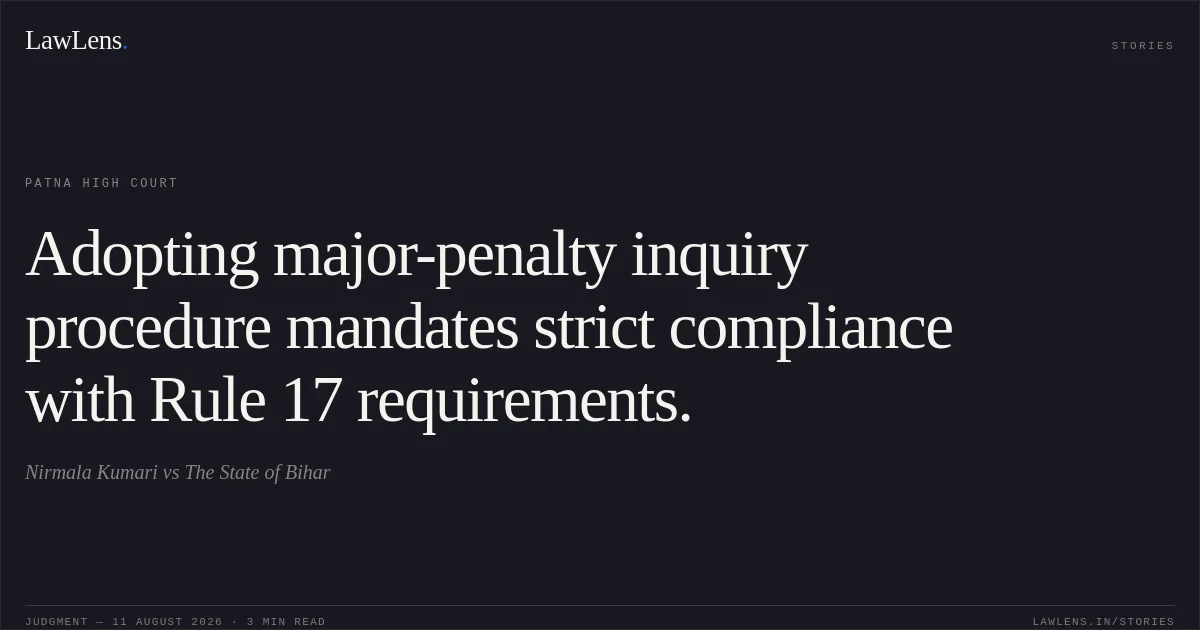
The petitioner, a police officer, challenged the disciplinary order contained in Memo No. 3621 dated 8 June 2021, whereby she was awarded the punishment of censure and stoppage of two increments without cumulative effect under Rule 14 of the Bihar Government Servants (Classification, Control & Appeal) Rules, 2005 (“Bihar CCA Rules”).
Source reference: p.1–2She also challenged the order dated 21 October 2021, by which her memorial was rejected.
Source reference: p.2The petitioner contended that although the punishment imposed was minor, the disciplinary authority had initiated a formal departmental enquiry by issuing a charge memo and appointing an Enquiry Officer.
Source reference: p.2–3The State argued that the punishment was minor and that strict procedural safeguards applicable to major penalties were unnecessary. It also contended that the enquiry was conducted properly, witnesses were cross-examined, and there was no violation of natural justice.
Source reference: p.3–4Issues
1. Whether, after initiating a formal departmental enquiry under the procedure applicable to major penalties, the disciplinary authority was required to strictly comply with Rule 17(3)–(23) of the Bihar CCA Rules, notwithstanding that the eventual punishment was minor?
Source reference: para. 3, paras. 6–72. Whether the disciplinary authority’s failure to properly consider the petitioner’s reply to the second show-cause notice vitiated the punishment order?
Source reference: para. 3, para. 8Law Applied
The Court applied Rule 19 of the Bihar CCA Rules, 2005, governing the procedure for imposing minor penalties. Rule 19 permits imposition of minor penalties after informing the government servant of the proposed action and considering the representation; however, where the disciplinary authority considers an enquiry necessary, the enquiry must be conducted in the manner prescribed by Rule 17(3)–(23).
Source reference: p.4–6Rule 19 also requires consideration of the employee’s representation and the enquiry record, recording of findings on each imputation, and a reasoned order.
Source reference: p.4–6The Court further relied on Rule 18, which requires consideration of the delinquent employee’s response after completion of the enquiry and issuance of the second show-cause notice.
Source reference: para. 8The governing principle was that once the authority elects to follow the formal major-penalty procedure, it must comply with that procedure strictly, even if the final punishment is minor.
Source reference: paras. 6–7Reasoning
The Court held that Rule 19 does not ordinarily require issuance of a charge memo for imposing a minor penalty. However, in the present case, the authorities had issued a charge memo and conducted a disciplinary enquiry through an Enquiry Officer, thereby adopting the procedure contemplated by Rule 17(3)–(23).
Source reference: paras. 6–7That procedural choice attracted the obligation of strict compliance with the applicable safeguards.
Source reference: paras. 6–7The Court further found that the petitioner had raised several points in her reply to the second show-cause notice, but the disciplinary authority had not dealt with them adequately and had merely made a one-line observation.
Source reference: para. 8Such non-consideration was held to be impermissible for a quasi-judicial authority and amounted to a violation of the governing rule.
Source reference: para. 8The Court therefore found the punishment order procedurally defective, irrespective of the minor nature of the punishment.
Source reference: no citationHolding
The High Court allowed the writ petition and quashed both the disciplinary order dated 8 June 2021, Memo No. 3621, and the revisional order dated 21 October 2021, Memo No. 8185.
The matter was remanded to the disciplinary authority for a fresh decision after properly considering the petitioner’s reply to the second show-cause notice.
Source reference: para. 10The fresh decision was directed to be taken within 90 days from the date of production of the judgment.
Source reference: para. 10Original Court PDF
Nirmala KumarivsThe State of Bihar
Click to open original judgment
Original judgment, available to read, download and summarize on LawLens.in