Facts
The appellant engaged the respondent, an advocate enrolled with the Bar Council of Maharashtra and Goa, during 2013–2014. She alleged that she had shared confidential and sensitive information with him concerning her allegations of attempted sexual assault by a senior police official.
Source reference: para. 6.1–6.3A legal notice was issued to the police official through the respondent’s office; the parties disputed whether it had been authorised by the appellant.
Source reference: para. 6.1–6.3The appellant subsequently lodged an FIR against the police official, in which the respondent was named as acting under the official’s influence.
Source reference: para. 6.4On 5 August 2014, the respondent gave interviews broadcast on “Aaj Tak” and “Zee News”, during which conversations and alleged messaging exchanges between him and the appellant were aired.
Source reference: para. 6.6The appellant contended that the respondent disclosed confidential information, identified her, and made derogatory public remarks concerning her complaint.
Source reference: para. 6.6She filed a complaint under Section 35 of the Advocates Act, 1961, alleging professional misconduct.
Source reference: para. 6.8The Disciplinary Committee of the Bar Council of India held that the respondent had committed professional misconduct by issuing the legal notice without authority, disclosing confidential information, and making derogatory public remarks.
Source reference: para. 6.12It directed removal of his name from the roll of advocates for two years, restrained him from practising or holding himself out as an advocate during that period, and imposed monetary directions of ₹3,00,000 to the appellant and ₹2,00,000 to the Bar Council of India Welfare Fund.
Source reference: para. 6.12The appellant sought enhancement of the punishment, while the respondent challenged the finding of misconduct and alleged denial of a fair hearing.
Source reference: paras. 6.13, 13Issues
Whether the respondent was denied a reasonable opportunity of being heard before the Disciplinary Committee, thereby vitiating the disciplinary order?
Source reference: paras. 13–14Whether the respondent’s disclosure of confidential communications and his public statements concerning the appellant constituted professional misconduct under Section 35 of the Advocates Act, 1961?
Source reference: paras. 13, 15–19Whether the punishment imposed by the Disciplinary Committee was so inadequate as to warrant enhancement, including permanent removal from the roll and compensation to the appellant?
Source reference: para. 20Law Applied
Section 35 of the Advocates Act, 1961 authorises disciplinary action for professional misconduct by an advocate, including reprimand, suspension from practice, or removal of the advocate’s name from the State roll.
Source reference: para. 6.8The court applied the professional and ethical rule that an advocate must preserve the confidentiality of information received from a client and cannot use privileged or confidential communications against that client, even after the professional relationship has ended or the client becomes adverse to the advocate.
Source reference: paras. 17–18The court further applied the principles of natural justice and fair hearing, while holding that a party who participated in the proceedings, filed a written statement, was represented by counsel, and took part in recording evidence could not ordinarily claim that the proceedings were conducted in his absence.
Source reference: para. 14A party seeking enhancement of relief must approach the court with candour and clean hands; suppression or incomplete disclosure may justify refusal of such discretionary relief.
Source reference: para. 20Reasoning
The respondent’s objection regarding non-service of the final hearing notice was rejected because the record showed his continuing knowledge of the disciplinary proceedings, appearance through counsel, filing of pleadings, and participation in the evidence.
Source reference: para. 14On the substantive issue, the respondent did not deny giving the televised interview; instead, he sought to justify it on the grounds that the appellant had named him in the FIR, that he was no longer her advocate, and that he was responding to media accusations.
Source reference: paras. 15–17The court held that these circumstances did not authorise him to disclose communications received during the engagement, release recorded conversations, or publicly characterise the appellant’s complaint as false and publicity-driven.
Source reference: paras. 17–18His available remedies included placing his version before the investigating agency or pursuing a defamation action, but not exposing confidential client information through television media.
Source reference: paras. 17–18This finding independently sustained the disciplinary punishment.
Source reference: para. 19The appellant’s claim for enhanced punishment was also rejected.
Source reference: para. 20The court found that she had not fully disclosed her own conduct, including discussions with the respondent concerning ways to “trap” the police official, her voluntary appearance before the media, and her failure to challenge the police official’s discharge.
Source reference: para. 20In view of this lack of candour, she was not entitled to discretionary enhancement of the punishment or the substantial compensation sought.
Source reference: para. 20Holding
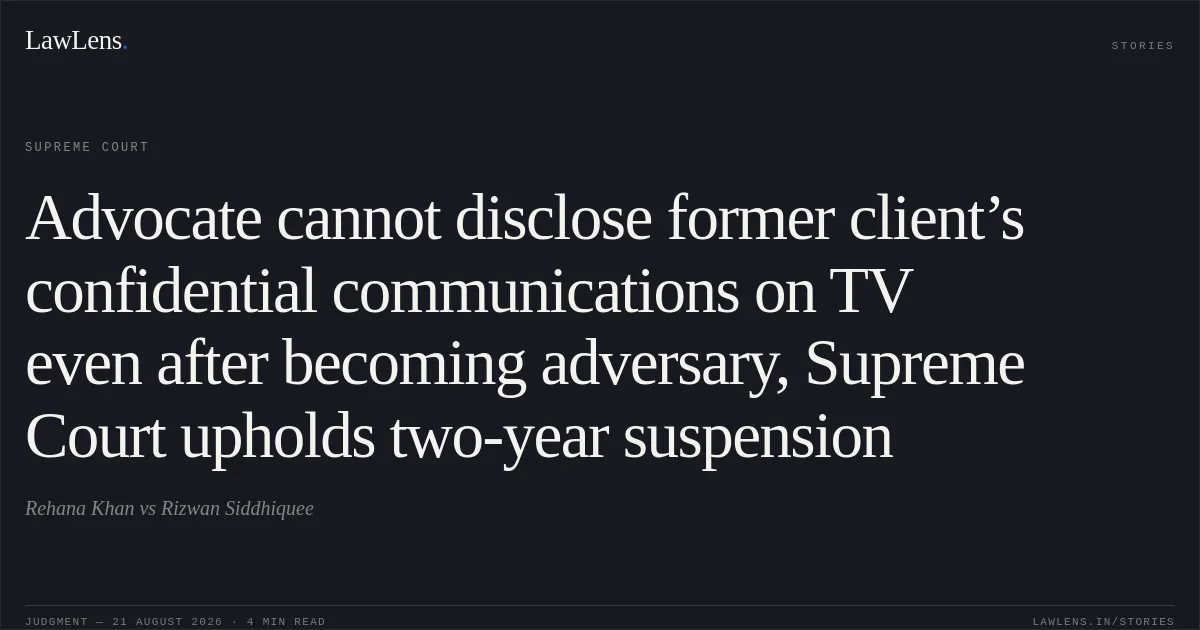
The Supreme Court held that the respondent’s televised disclosure of confidential communications and derogatory public statements concerning the appellant constituted professional misconduct under Section 35 of the Advocates Act, 1961.
His challenge to the disciplinary proceedings and punishment was rejected, and the order of the Disciplinary Committee dated 11 August 2025 was upheld.
Source reference: paras. 19, 22The appellant’s prayer for permanent removal of the respondent from the roll and compensation of ₹2 crore was refused because of her material omissions and lack of candour.
Source reference: para. 20Civil Appeal No. 12256 of 2025, Civil Appeal No. 7959 of 2026, and Transfer Case (Civil) No. 30 of 2026 were dismissed.
Source reference: paras. 22–23In addition, each party was directed to pay ₹5,00,000 as costs to the Supreme Court Legal Services Committee within four weeks.
Source reference: paras. 22–23Acts & Sections Cited
3 provisions across 2 statutes referred to in this judgment. Each provision opens on LawLens.
Indian Penal Code, 18602
Advocates Act, 19611
Original Court PDF
Rehana KhanvsRizwan Siddhiquee
Click to open original judgment
Original judgment, available to read, download and summarize on LawLens.in