Facts
The appellant’s husband, Chandrakant Thakkar, died instantaneously on November 28, 2015, after falling from Train No. 12834 (Ahmedabad-Howrah Mail) between Khandbada and Khatgaon
Source reference: para. 2The appellant filed a claim petition under the Railway Claims Tribunal Act, 1987, seeking Rs. 4,00,000/- compensation
Source reference: para. 2The Railway Claims Tribunal (RCT) and the High Court of Madhya Pradesh dismissed the claim, holding that while the death was an "untoward incident," the deceased was not proved to be a "bona fide passenger" because no ticket was recovered from his person and there were minor inconsistencies regarding the date of travel in the appellant's testimony
Source reference: para. 3Issues
1. Whether the absence of a physical ticket on the person of the deceased is sufficient to negate a claim for compensation under Section 124A of the Railways Act, 1989
Source reference: para. 6, 92. Whether the appellant discharged the initial burden of proof to establish the deceased as a bona fide passenger
Source reference: para. 9, 19Law Applied
The court applied Section 124A of the Railways Act, 1989, which provides for "no-fault liability" for death or injury resulting from an "untoward incident," including accidental falling from a train
Source reference: paras. 5-6It relied on Union of India v. Prabhakaran Vijaya Kumar, establishing that Section 124A is a beneficial piece of legislation requiring liberal and purposive interpretation
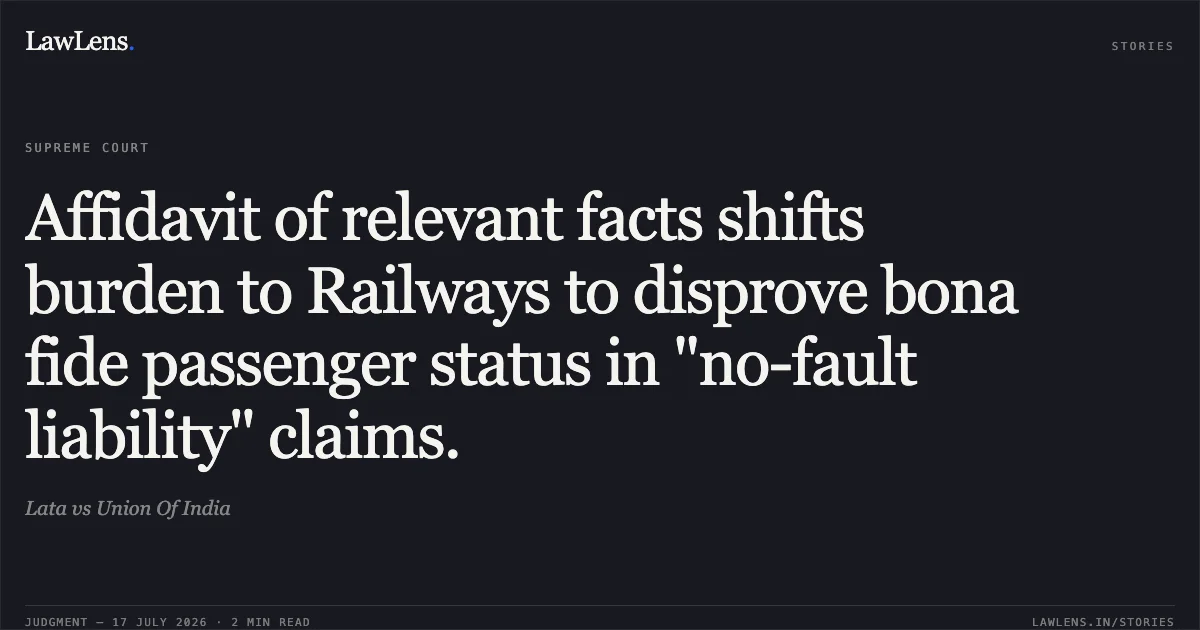
Source reference: para. 7.1Regarding the burden of proof, the court applied the principle from Union of India v. Rina Devi, which holds that the mere absence of a ticket does not negative a claim; the initial burden is discharged if the claimant files an affidavit of relevant facts, shifting the burden to the Railways to prove otherwise
Source reference: para. 9Reasoning
The court reasoned that the Railways Act is a welfare statute intended to provide expeditious relief without requiring proof of negligence
Source reference: para. 6It criticized the lower forums for adopting a restrictive and technical approach regarding the missing ticket, noting that the deceased’s luggage (containing the ticket) was lost during the accident
Source reference: paras. 9, 14The Court found that the appellant had successfully discharged her initial burden by filing an affidavit stating the deceased purchased a ticket for business travel
Source reference: para. 19It further observed that under the Indian Railway Commercial Manual, the Railways has a duty to prevent ticketless travel at entry points; thus, if a person is on a train, there is a preponderance of probability that they entered legally
Source reference: paras. 13-14Minor inconsistencies in the widow's testimony regarding the date were deemed insufficient to overlook the factum of death in an untoward incident
Source reference: para. 3, 19Holding
The Supreme Court allowed the appeal and set aside the orders of the RCT and the High Court
It held that the deceased was a bona fide passenger and that the claimant was entitled to compensation
Source reference: paras. 19-20The Court awarded compensation of Rs. 8,00,000/- (as per the amended 1997 Rules and 2016 Notification) to be paid within four weeks, failing which interest at 8% per annum would apply from the date of the claim petition
Source reference: paras. 20-21Acts & Sections Cited
10 provisions across 2 statutes referred to in this judgment. Each provision opens on LawLens.
Railways Act, 1989
Railway Protection Force Act, 19571
Original Court PDF
LatavsUnion Of India
Click to open original judgment
Original judgment, available to read, download and summarize on LawLens.in