Facts
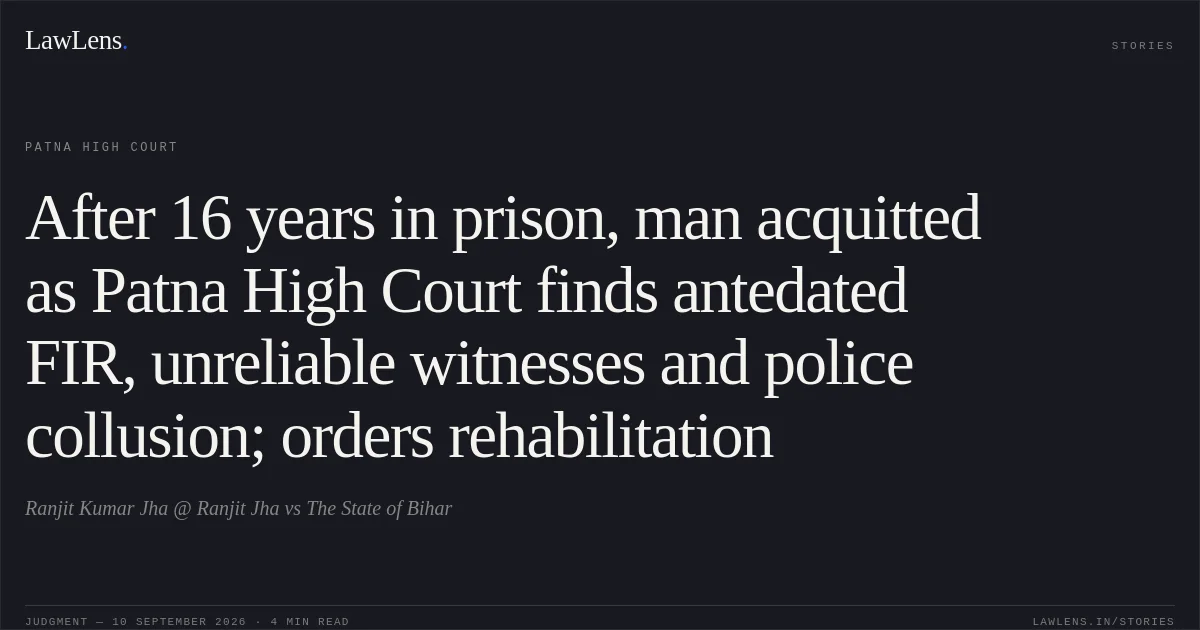
The appellant was convicted by the Additional Sessions Judge, Fast Track Court-II, Samastipur, under Section 302 of the Indian Penal Code and Sections 25(1-B)A and 27 of the Arms Act for allegedly shooting Pawan Kumar Jha on 5 October 2000 near Boritar Pul, Udapatti. He was sentenced to life imprisonment under Section 302 IPC and concurrent sentences under the Arms Act
Source reference: paras. 1–5The prosecution relied principally on the informant, Chandra Kumar Jha (PW-6), and other witnesses who claimed to have seen the appellant firing at the deceased or fleeing from the scene after the firing. A country-made pistol, cartridge, bicycle and slipper were allegedly recovered near the body
Source reference: paras. 22–25The appellant denied the allegations under Section 313 CrPC and led no defence evidence
Source reference: paras. 7–8Issues
Whether the prosecution proved the appellant’s identity and participation in the murder beyond reasonable doubt on the basis of the alleged eyewitness and circumstance evidence?
Source reference: paras. 24–46Whether the delayed transmission of the FIR, absence of relevant particulars in the inquest and post-mortem documents, and the possibility of an ante-timed FIR rendered the prosecution case unreliable?
Source reference: paras. 36–38, 55–57Whether the alleged recovery of the pistol, cartridge, bicycle and slipper was reliable and sufficiently connected with the murder and the appellant?
Source reference: paras. 32–35, 49–51, 56Whether the appellant’s conviction under Section 302 IPC and Sections 25(1-B)A and 27 of the Arms Act could be sustained despite the material contradictions, inimical witnesses and defective investigation?
Source reference: paras. 47–57Whether the appellant was entitled to directions concerning delayed consideration of premature release, medical treatment and rehabilitation after prolonged incarceration?
Source reference: paras. 60–72Law Applied
The Court applied Section 302 IPC concerning punishment for murder and Sections 25(1-B)A and 27 of the Arms Act concerning unlawful possession and use of firearms
Source reference: para. 1The prosecution was required to establish the appellant’s guilt beyond reasonable doubt, and evidence of interested or inimical witnesses could not be accepted without reliable corroboration where material inconsistencies existed
Source reference: paras. 35, 42–46, 54–57The Court relied on Meharaj Singh (L/Nk.) v. State of U.P., (1994) 5 SCC 188, and Chotkau v. State of U.P., (2023) 6 SCC 742, for the principle that prompt registration and transmission of the FIR, and reference to the FIR in the inquest materials, operate as important safeguards against embellishment and ante-timing
Source reference: para. 37It also referred to Sharad Birdhichand Sarda v. State of Maharashtra, (1984) 4 SCC 116, regarding the significance of putting all incriminating circumstances to the accused under Section 313 CrPC
Source reference: para. 17In relation to prison administration and premature release, the Court applied Section 432 CrPC, now Section 473 BNSS, and Rule 481 of the Bihar Prison Manual, recognising the prisoner’s right to have an eligible premature-release case considered within a reasonable time
Source reference: paras. 68–71It further relied on State of Gujarat v. Kishanbhai, (2014) 5 SCC 108, concerning administrative examination of investigative negligence, and Daudayal v. State of Rajasthan, 2026 INSC 599, concerning compensation and protection of personal liberty against bureaucratic delay
Source reference: paras. 59, 67–72Reasoning
The Court found that the prosecution evidence did not establish the appellant’s guilt beyond reasonable doubt. The informant’s claim that he witnessed the appellant firing was contradicted by the Investigating Officer, who stated that this fact had not been disclosed during investigation
Source reference: paras. 24–28The alleged eyewitnesses gave materially inconsistent accounts regarding who reached the scene first, the time taken to reach the spot, the presence of the informant and the direction in which the appellant allegedly fled
Source reference: paras. 40–46Several witnesses were inimical to the appellant because of an earlier murder case involving their family members, while no independent witness was examined despite the claim that 10–20 persons had gathered at the scene
Source reference: paras. 35, 42, 46The Court also found that the torch allegedly used to identify the appellant was neither produced nor seized, and the place of occurrence was a lonely area without an established source of light
Source reference: paras. 41, 54–56The four-day delay in transmitting the FIR to the Magistrate, the absence of a case number and time on the inquest report, the absence of relevant FIR particulars in the post-mortem materials, and the unexplained delay in sending the dead body for post-mortem created a serious possibility that the FIR had been ante-timed
Source reference: paras. 36–38, 55The alleged recovery evidence was also unreliable: the bicycle bore the name “Md. Shamim,” which was not investigated; the seizure witnesses were not independent; the weapon was not promptly produced; and no ballistic or forensic evidence connected the recovered pistol or cartridge with the bullet extracted from the deceased
Source reference: paras. 32–35, 49–51These cumulative defects destroyed the prosecution’s case and made the conviction unsafe
Source reference: paras. 54–57Holding
The appeal was allowed. The judgment of conviction dated 29 October 2009 and order of sentence dated 6 November 2009 were set aside, and the appellant was acquitted of the offences under Section 302 IPC and Sections 25(1-B)A and 27 of the Arms Act
The Court directed the Director General of Police, Bihar, to examine administratively the alleged negligence of the police officers involved and submit an action-taken report
Source reference: para. 59Although the Court recognised that the appellant’s premature-release proposal had been delayed despite his eligibility after completing the requisite custody period, it directed the State to undertake his medical treatment and rehabilitation rather than award monetary compensation
Source reference: paras. 66–72The State was directed to arrange a medical examination, continued treatment and medicines, and a rehabilitation plan through the District Magistrate, Samastipur and the District Legal Services Authority, Samastipur, with all expenses borne by the State
Source reference: para. 72The Patna High Court Legal Services Committee was also directed to pay Rs. 25,000 to the appointed counsel
Source reference: para. 74Acts & Sections Cited
3 provisions across 2 statutes referred to in this judgment. Each provision opens on LawLens.
Indian Penal Code, 18601
Arms Act, 19592
Original Court PDF
Ranjit Kumar Jha @ Ranjit JhavsThe State of Bihar
Click to open original judgment
Original judgment, available to read, download and summarize on LawLens.in