Facts
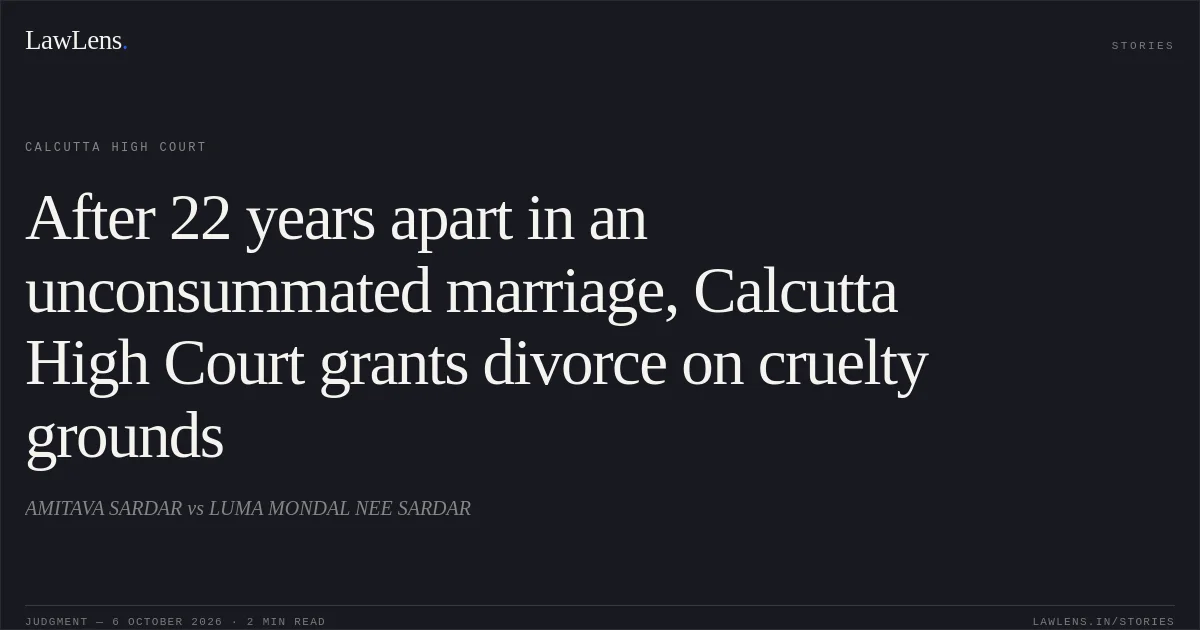
The parties married under the Special Marriage Act, 1954, on April 12, 2004, and began living separately after approximately one month, apart from a brief period when a court order required them to stay together.
Source reference: para. 1–2, 13–20, 30–32The appellant petitioned for divorce under Section 27(1)(b) and (d), alleging that the marriage had not been consummated.
Source reference: para. 2The respondent denied his account but pleaded that the appellant had never cohabited with her; in cross-examination, she admitted there had been no cohabitation since the marriage.
Source reference: para. 13–20The trial court dismissed the petition, and the appellant appealed.
Source reference: para. 30–32Issues
1. Whether the parties’ admitted non-cohabitation and non-consummation, in the circumstances of this case, established cruelty warranting divorce under the Special Marriage Act, 1954.
Source reference: para. 21–22, 30–342. Whether the appellant was entitled to permanent alimony and, if so, in what amount and on what payment terms.
Source reference: para. 35–37Law Applied
Section 27(1)(b) and (d) of the Special Marriage Act, 1954, were invoked as the statutory grounds for divorce; the Court determined the appeal on cruelty arising from denial of conjugal relations and non-consummation.
Source reference: para. 2, 14, 33–34Section 34 of the Act requires the Court to make efforts to bring about reconciliation and prevent marital breakdown; the Court noted that mediation and its own settlement efforts had failed.
Source reference: para. 23–26In Samar Ghosh v. Jaya Ghosh, (2007) 4 SCC 511, the Supreme Court identified illustrative circumstances that may constitute mental cruelty, including a unilateral refusal to have intercourse for a considerable period without physical incapacity or valid reason; it also noted that long separation may indicate that the marital bond is beyond repair.
Source reference: para. 27–28The Court followed Rakesh Raman v. Kavita, (2023) 17 SCC 433, on long separation as cruelty, while assessing whether the facts here met the cruelty standard.
Source reference: para. 7, 29, 33Reasoning
The Court found that the respondent’s written statement and cross-examination established that the parties had not cohabited and that the marriage was unconsummated.
Source reference: para. 18, 20–21Although the parties gave conflicting accounts of which spouse had refused cohabitation, the record disclosed no valid reason or incapacity preventing consummation, and the parties had voluntarily withdrawn from each other’s society.
Source reference: para. 30–31Given their prolonged separation, the absence of children, and the failure of reconciliation efforts, the Court held that the denial of conjugal relations and non-consummation amounted to cruelty in the circumstances.
Source reference: para. 23–26, 32–34It fixed permanent alimony at Rs. 10 lakhs, taking account of the appellant’s assets and the respondent’s gainful employment.
Source reference: para. 37Holding
The High Court allowed the appeal and held that the appellant was entitled to divorce on the ground of cruelty arising from denial of conjugal rights and non-consummation of the marriage.
It awarded the respondent permanent alimony of Rs. 10 lakhs, payable in four monthly instalments commencing November 15, 2026; in the event of default, the respondent may execute the award.
Source reference: para. 37The appeal was disposed of.
Source reference: para. 38Acts & Sections Cited
2 provisions across 1 statute referred to in this judgment. Each provision opens on LawLens.
Special Marriage Act, 19542
Original Court PDF
AMITAVA SARDARvsLUMA MONDAL NEE SARDAR
Click to open original judgment
Original judgment, available to read, download and summarize on LawLens.in