Facts
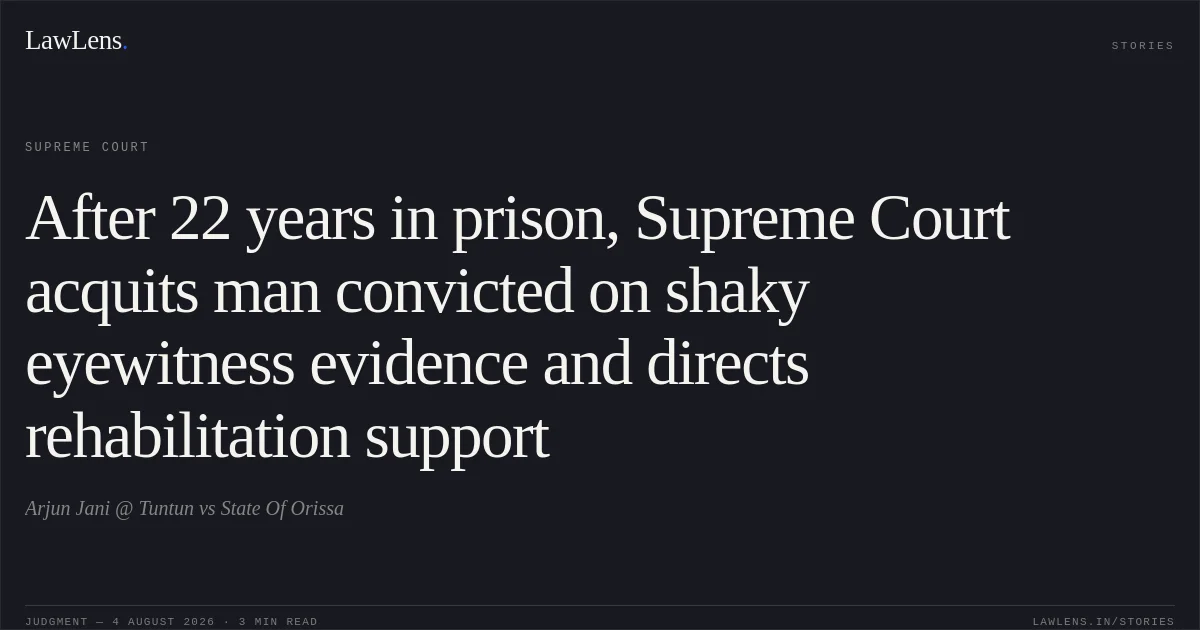
The appellant was convicted under Section 302 of the Indian Penal Code for the murder of one of three women found dead in a locality in Odisha and was sentenced to life imprisonment. His jail appeal was initially dismissed after the High Court refused to condone a delay of 3157 days in filing it, although he had already undergone approximately 12 years of imprisonment at that stage.
Source reference: p.2, para.2The Supreme Court subsequently condoned the delay of 3703 days and entertained the appeal after the appellant had spent approximately 22 years in custody.
Source reference: p.2–3, para.4The prosecution case principally rested on the testimony of PW3, who claimed to have witnessed the appellant striking one deceased, Ratanai, at night. The prosecution also relied on res gestae evidence, an alleged confession, and recovery of stones and a brick. The appellant’s confession was allegedly made after arrest, and one recovery witness stated that the police had beaten him to extract it.
Source reference: p.7–8, paras.12–13The recovery evidence was inconsistent, and no blood or other incriminating material was detected on the recovered objects.
Source reference: p.8, para.13Issues
Whether the delay in filing the appellant’s jail appeal ought to have been condoned, considering his imprisonment, marginalised background, and limited access to legal assistance?
Source reference: p.2–3, paras.2–4Whether the conviction under Section 302 IPC could be sustained solely on the testimony of PW3, in light of the inconsistencies and improbabilities in her evidence?
Source reference: p.8–10, paras.14–17Whether the alleged confession and recovery evidence provided legally reliable corroboration for the prosecution case?
Source reference: p.7–8, paras.12–13Whether the prosecution had proved the appellant’s guilt beyond reasonable doubt?
Source reference: p.9–10, para.17Law Applied
The Court applied Section 302 IPC, which prescribes punishment for murder.
Source reference: no citationIt relied on the principle that an eyewitness’s testimony may by itself sustain a conviction, but only when it is credible, consistent, probable, and inspires the confidence of the Court; serious discrepancies creating reasonable doubt require acquittal.
Source reference: p.8–9, para.14The Court applied Sections 25 and 27 of the Indian Evidence Act, 1872, holding that a confession made to the police is inadmissible under Section 25, while recovery evidence under Section 27 must be supported by reliable circumstances connecting the recovered objects with the offence.
Source reference: p.7–8, paras.12–13It also considered the significance of contradictions and omissions in witness statements recorded under Section 161 of the Code of Criminal Procedure, 1973.
Source reference: p.6–7, para.10In relation to delay, the Court adopted a liberal and proactive approach where a convicted and imprisoned person seeks access to an appellate remedy affecting personal liberty, particularly in the context of a jail appeal and inadequate access to legal assistance.
Source reference: p.2–3, paras.2–4Reasoning
The Court found that PW3’s testimony was not sufficiently reliable to sustain the conviction. Her account contained material inconsistencies regarding when and how she communicated the incident, whether she witnessed the assault from inside her house, and why she did not see the other bodies while fleeing to PW4’s house.
Source reference: p.5–7, paras.9–11Her version was also inconsistent with PW7’s account of what PW3 allegedly narrated the next morning, and important details in PW4’s evidence were absent from her Section 161 statement.
Source reference: p.6–7, paras.9–10The Court further noted that the Investigating Officer did not prepare a sketch of the scene, did not explain how the appellant was identified and arrested, and relied on a confession that was inadmissible under Section 25 of the Evidence Act.
Source reference: p.7–8, para.12The recovery evidence was materially contradictory: the Investigating Officer stated that the objects were recovered from bushes pursuant to the appellant’s disclosure, whereas other witnesses stated that they were lying in plain view near the bodies; no bloodstains or forensic connection to the offence were found.
Source reference: p.8, para.13In these circumstances, the sole eyewitness account raised a serious and reasonable doubt, and the prosecution failed to establish guilt beyond reasonable doubt.
Source reference: p.9–10, paras.14–17Holding
The Supreme Court held that the appellant’s conviction could not be sustained because the eyewitness testimony was shaky and highly improbable, while the confession and recovery evidence did not provide reliable corroboration.
It therefore allowed the appeal, set aside the trial court’s judgment of conviction, and acquitted the appellant.
Source reference: p.10, para.17The personal bond of ₹10,000 executed pursuant to the earlier bail order was cancelled.
Source reference: p.10, para.17The Court directed the District Legal Services Authority, Koraput, to attempt the appellant’s rehabilitation or resettlement, with assistance from the District Administration and District Collector.
Source reference: p.11, para.19All pending applications were disposed of.
Source reference: p.11, paras.20–21Original Court PDF
Arjun Jani @ TuntunvsState Of Orissa
Click to open original judgment
Original judgment, available to read, download and summarize on LawLens.in