01Facts
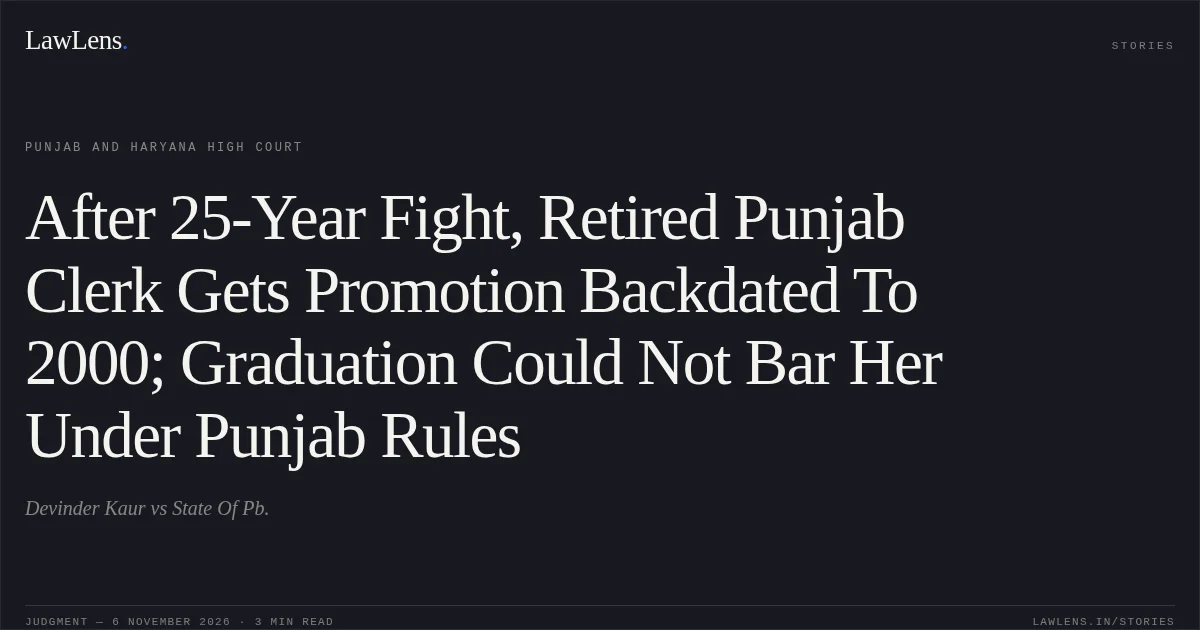
Devinder Kaur was appointed as a Clerk-cum-Steno Typist in 1994 and claimed seniority over private respondents who joined in 1995 and 1997.
¶ 2–5The respondents were promoted as Senior Assistants in 2000 and 2001, and one was subsequently promoted as Superintendent Grade-II.
¶ 2–5Kaur challenged the promotions, contending that she was excluded on the basis of a graduation requirement not prescribed for promotion under the applicable rules.
¶ 2–5During the proceedings, she was promoted as Senior Assistant in 2008 and retired in 2022.
¶ 2–5The Court heard the two petitions together because they raised substantially similar questions.
p. 2 · ¶ 102Issues
i.Whether, in the absence of specific service rules, the respondents could promote junior employees using an undefined and non-uniform criterion without fairly considering the petitioner’s eligibility and claim for promotion.
p. 6 · ¶ 15ii.Whether graduation could lawfully be imposed as an additional eligibility condition for promotion to Senior Assistant when the applicable rules prescribed it for direct appointment but not promotion.
pp. 7–11 · ¶ 20–3003Law Applied
The Punjab Civil Services (General and Common Conditions of Service) Rules, 1994 applied in the absence of demonstrated special rules governing the relevant posts; Rule 1(3) extends the Rules to covered Punjab State services.
p. 6 · ¶ 17 · p. 7 · ¶ 18–19Rule 144A distinguishes direct appointment—which requires a bachelor’s degree—from promotion of Clerks meeting the prescribed experience requirement; graduation cannot be added as a promotional qualification where the rule does not prescribe it.
pp. 7–9 · ¶ 20–23Rule 8 addresses inter se seniority by reference to continuous service within a cadre.
pp. 12–14 · ¶ 33–34Under Sant Ram Sharma v. State of Rajasthan, AIR 1967 SC 1910, executive instructions may fill gaps in statutory rules but cannot amend or contradict them.
p. 11 · ¶ 27Nathi Devi v. Radha Devi Gupta, (2005) 2 SCC 271, requires clear statutory language to be given its ordinary meaning.
pp. 9–10 · ¶ 23The right to fair consideration for promotion forms part of equality in public employment under Articles 14 and 16, as recognised in Ajit Singh (II) v. State of Punjab, (1999) 7 SCC 209.
p. 12 · ¶ 31Public authorities must also act consistently with governing selection norms and constitutional equality: R.D. Shetty v. International Airport Authority of India, (1979) 3 SCC 489.
p. 17 · ¶ 4304Reasoning
The Court found that the petitioner met the applicable experience requirement and that Rule 144A did not require graduation for promotion.
pp. 10–12 · ¶ 24–30The communications inviting applications could regulate selection procedure but could not introduce graduation as an additional substantive eligibility condition; using it to exclude the petitioner was therefore inconsistent with the governing Rules.
pp. 10–12 · ¶ 24–30The promotions were described as promotions in the contemporaneous record, and the respondents did not establish a lawful, uniform framework that justified excluding the petitioner.
pp. 14–16 · ¶ 36–39Nor did their assertion of separate cadres resolve the issue: the respondents failed to demonstrate the service-structure basis for that distinction or explain its effect on promotional eligibility.
pp. 12–17 · ¶ 33–42Having invited employees from District Forums to compete for vacancies, the Commission was required to apply a fair and transparent process.
pp. 12–17 · ¶ 33–42The Court accordingly held that the petitioner’s right to fair consideration had been denied, although distinct cadres could preclude a claim based solely on comparative length of service.
pp. 17–18 · ¶ 44–4605Holding
The Court held the promotions of the private respondents unsustainable insofar as they resulted in the petitioner being denied lawful consideration, and allowed both writ petitions.
pp. 18–19 · ¶ 47–48, 53It directed that the petitioner be granted deemed promotion as Senior Assistant from 21 January 2000 and notional promotion as Superintendent Grade-II from 13 February 2001, with consequential pay fixation and revision of retiral and pensionary benefits.
p. 19 · ¶ 49–50The respondents were directed to complete implementation within six weeks; interest at 8% per annum was ordered on consequential benefits, with 12% per annum applying to unpaid amounts after expiry of that period.
pp. 19–20 · ¶ 51–52The private respondents’ past service was not to be disturbed, and no recovery was to be made from them.
p. 18 · ¶ 48Original Court PDF
Devinder KaurvsState Of Pb.
Click to open original judgment
Original judgment, available to read, download and summarize on LawLens.in