Facts
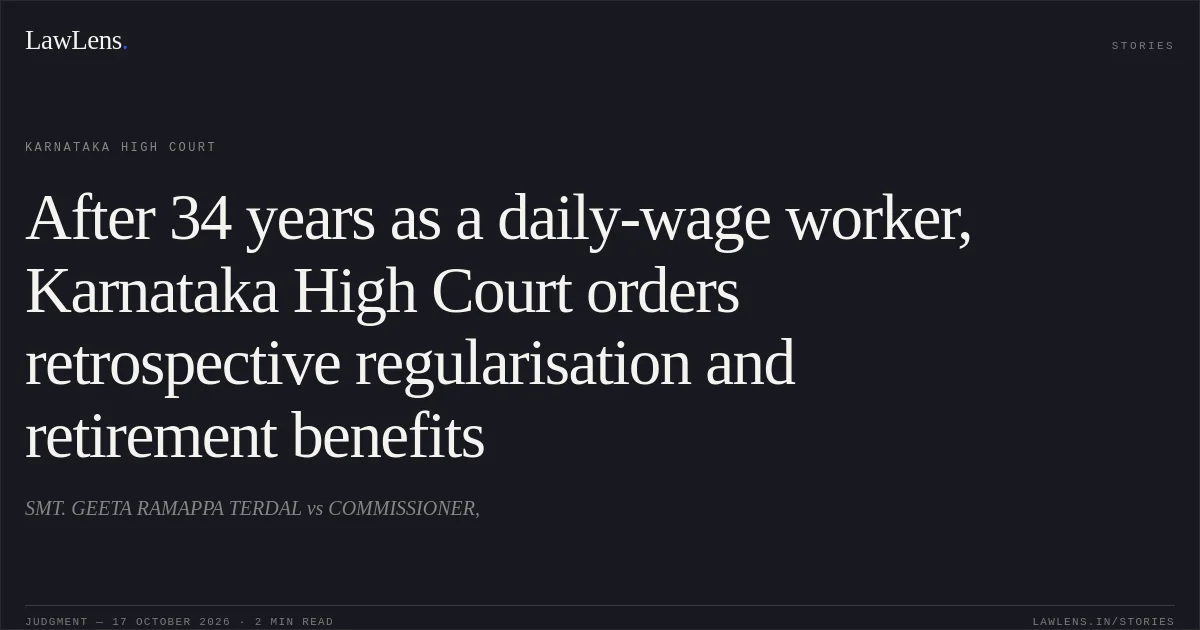
The appellant’s case was that she entered municipal service in 1988 through a process initiated via the Employment Exchange, against a sanctioned vacancy, and thereafter served for approximately 34 years on daily wages.
Source reference: p. 4–7The Municipality recommended her for regularization, and 12 of 26 employees whose names were forwarded for consideration were regularized, but she was not.
Source reference: p. 13–17After she superannuated in June 2022, she sought regularization and consequential benefits by writ petition. The Single Judge dismissed the petition solely because she had retired; she appealed.
Source reference: p. 7–8Issues
1. Whether superannuation during the pendency of a claim for regularization extinguishes the employee’s right to have that claim considered.
Source reference: p. 18–21, 66–672. Whether, in light of the appellant’s mode of appointment, length of service, sanctioned vacancy, recommendations, and the regularization of similarly situated employees, she was entitled to regularization and consequential benefits.
Source reference: p. 20–21, 73–76Law Applied
The Court applied the Constitution Bench rule in Secretary, State of Karnataka v. Umadevi (3), (2006) 4 SCC 1, particularly paragraph 53, which permits a one-time consideration for regularization of duly qualified employees who worked for ten years or more in sanctioned posts without court or tribunal protection.
Source reference: p. 21–24It relied on State of Karnataka v. M.L. Kesari, (2010) 9 SCC 247, clarifying that eligible employees do not lose the right to consideration merely because the one-time exercise was omitted or incompletely conducted.
Source reference: p. 25–26, 36–38The Court also relied on Amarendra Kumar Mohapatra, Sheo Narain Nagar, Narendra Kumar Tiwari, Prem Singh, Jaggo, Dharam Singh and Sukhendu Bhattacharjee for the distinction between illegal and irregular appointments, the relevance of long service, and the prohibition on mechanically invoking Umadevi to deny relief or treat similarly situated employees unequally.
Source reference: p. 24–50, 63–69Article 14 requires equal treatment of employees who are similarly situated, absent a rational basis for differential treatment.
Source reference: p. 38–40, 68–69Reasoning
The Court held that the Single Judge erred by treating retirement as a bar without examining the merits of the claim.
Source reference: p. 73–76The appellant’s entry was not shown to be a backdoor appointment: it followed an Employment Exchange process and was against a sanctioned vacancy. She had served continuously for decades, her employer had recommended regularization, and other employees from the same exercise had been regularized. The State identified no valid distinction justifying her exclusion.
Source reference: p. 73–76Applying Umadevi and its subsequent interpretation, the Court concluded that superannuation did not extinguish a claim that had arisen during service, and that the appellant’s circumstances warranted direct relief rather than a further administrative reconsideration.
Source reference: p. 66–67, 70–77Holding
The appeal was allowed and the Single Judge’s order set aside.
The Court directed regularization in the cadre in which the appellant was working at superannuation, effective from the date she completed ten years of service, which the order specified as 11 February 1998.
Source reference: p. 77–78It directed notional continuity for pay fixation and other admissible service benefits, and required the entire period of service to be counted for pension, gratuity and other retiral benefits. The respondents were ordered to implement the directions within eight weeks; on non-compliance, the appellant would additionally be entitled to arrears quantified at 50% of the salary entitlement flowing from regularization.
Source reference: p. 78–79Acts & Sections Cited
1 provisions across 1 statute referred to in this judgment. Each provision opens on LawLens.
KARNATAKA HIGH COURT ACT, 19611
Original Court PDF
SMT. GEETA RAMAPPA TERDALvsCOMMISSIONER,
Click to open original judgment
Original judgment, available to read, download and summarize on LawLens.in