01Facts
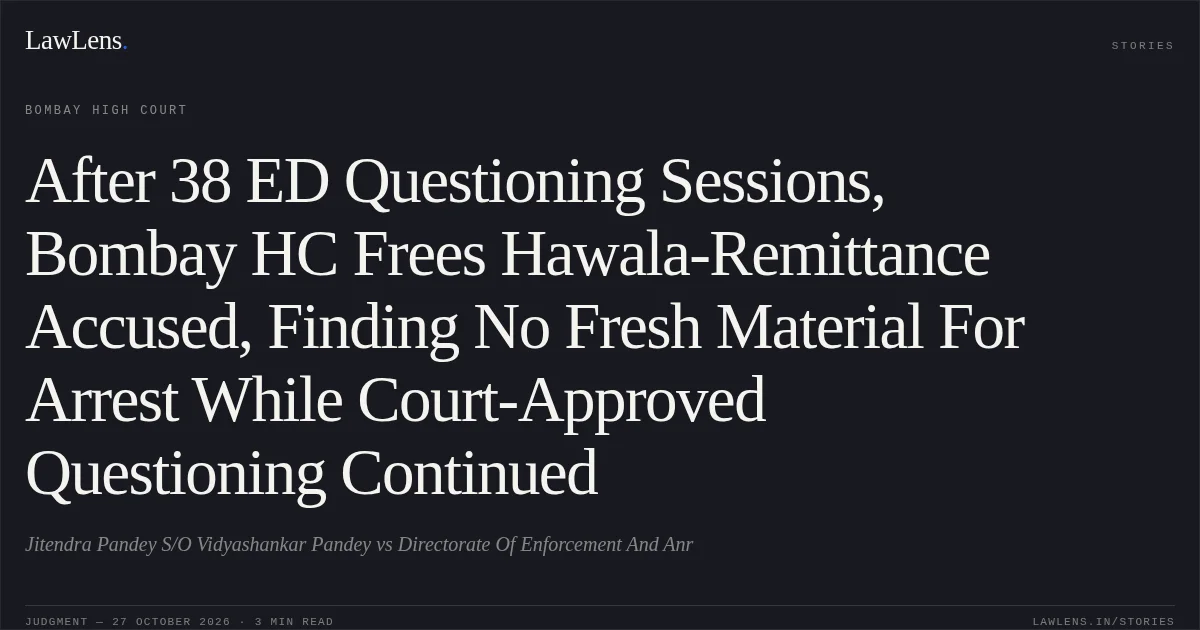
An ECIR was registered against the Petitioner in connection with alleged fraudulent foreign remittances and related predicate offences.
¶ 3.1–3.4The ED alleged that he controlled shell entities and mule bank accounts, used forged documents to remit funds abroad, and laundered proceeds of crime.
¶ 3.1–3.4After searches and repeated questioning, the Petitioner was arrested on 23 June 2026 and remanded to ED custody; subsequent remand orders were made on 29 June and 4 July 2026.
¶ 3.1–3.4He challenged the arrest and remand orders, contending that he had cooperated and that no fresh incriminating material had emerged before his arrest.
¶ 3.1–3.4The High Court noted that the Petitioner’s statements had been recorded repeatedly and that the ED accepted there was no new material between 22 May and 23 June 2026.
¶ 3.1–3.4, 7–8, 18 · pp. 3, 8, 14–1502Issues
i.Whether the Petitioner’s arrest under Section 19(1) of the PMLA was lawful where the ED had already sought judicial permission to question him under Section 50 on the basis of the material in its possession, but no fresh incriminating material or supervening circumstance arose before the arrest.
¶ 8, 18–23ii.Whether the remand orders founded on that arrest should be set aside and the Petitioner released.
¶ 8, 30–3203Law Applied
Section 19(1) of the PMLA permits an authorised officer to arrest a person only where, on the basis of material in the officer’s possession, the officer has recorded in writing reasons to believe that the person is guilty of an offence under the Act, and the grounds of arrest must be communicated.
¶ 9 · p. 10Section 50(2) and (3) empowers authorised officers to summon and examine persons and require production of records; proceedings under those provisions are deemed judicial proceedings under Section 50(4).
¶ 12–13, 19 · p. 11, 16Applying *Arvind Kejriwal v. Directorate of Enforcement*, *Radhika Agarwal v. Union of India* and *Deepak Singh v. Directorate of Enforcement*, the Court recognised that arrest under a special statute is subject to judicial review for compliance with statutory and constitutional safeguards, while the sufficiency of the material is generally not for the Court to assess at the investigative stage.
¶ 22, 24–29 · pp. 18–25The Court also adopted the principle that old material cannot, without fresh material or supervening circumstances, justify a new arrest where the agency has already elected to pursue further questioning on that material.
¶ 22, 24–29 · pp. 18–25Provisions in the judgment · 14 · Linked ones open on LawLens
Bharatiya Nagarik Suraksha Sanhita, 2023 Section 528Section 529
Prevention of Money-Laundering Act, 2002 Section 2Section 17Section 19Section 50
Indian Penal Code, 1860 Section 34Section 193Section 228Section 409Section 420Section 467Section 468
Code of Criminal Procedure, 1973 Section 173
04Reasoning
The ED had sought permission under Section 50 to confront the Petitioner with material already in its possession and record further statements; the Special Court had allowed that request.
¶ 18–23 · pp. 14–19The High Court found that the Petitioner had appeared for questioning on numerous occasions and that no new incriminating material had emerged between his last pre-arrest statement and his arrest.
¶ 18–23 · pp. 14–19In those circumstances, the ED could not abandon the questioning process it had sought and rely on the same material to arrest him, absent a fresh incriminating circumstance or supervening exigency.
¶ 18–23, 28–30 · pp. 14–19, 23–26The Court considered the arrest, on the facts, an improper exercise of the power under Section 19(1), rather than a measure justified by the gravity of the allegations or a general need to facilitate investigation.
¶ 18–23, 28–30 · pp. 14–19, 23–2605Holding
The Court allowed the petition, declared the Petitioner’s arrest illegal and violative of Section 19(1) of the PMLA and Articles 14 and 21 of the Constitution, and quashed the remand orders dated 23 June, 29 June and 4 July 2026, together with any subsequent remand orders.
¶ 30–35 · pp. 26–27It directed the Petitioner’s immediate release and declined the ED’s request to stay the order.
¶ 30–35 · pp. 26–27Original Court PDF
Jitendra Pandey S/O Vidyashankar PandeyvsDirectorate Of Enforcement And Anr
Click to open original judgment
Original judgment, available to read, download and summarize on LawLens.in