Facts
The petitioners were acquitted by the Judicial Magistrate First Class on 22 October 2008 of charges that included an offence under Section 353 IPC.
Source reference: p.2–4When the complaint was filed in August 2005, Section 353 IPC was cognizable and bailable; an amendment effective 23 June 2006 made it non-bailable.
Source reference: p.2–4The State filed an appeal under Section 378(1)(a) CrPC before the Sessions Court on 10 February 2009.
Source reference: p.2–4The petitioners challenged its maintainability, contending that the offence’s status when committed required the State to appeal to the High Court.
Source reference: p.2–4The Sessions Judge rejected their application on 10 June 2011, prompting this petition under Article 227
Source reference: p.2–4Issues
1. Whether the amended Section 378(1)(a) CrPC applied to an appeal filed after 23 June 2006 against an acquittal for an offence that was bailable when committed, thereby making the Sessions Court the proper forum
Source reference: p.3–4, 15–172. Whether an appeal under Section 378(1)(a) CrPC required leave of the High Court under Section 378(3) CrPC
Source reference: p.16–18Law Applied
Section 378(1)(a), as amended by the Criminal Procedure Code (Amendment) Act, 2005, empowers the District Magistrate to direct an appeal to the Sessions Court against a Magistrate’s acquittal in respect of a cognizable and non-bailable offence; Section 378(1)(b) provides for appeals to the High Court in cases outside clause (a), while Section 378(3)’s leave requirement applies to appeals to the High Court
Source reference: p.6–7, 16–18The Court treated the forum of appeal as procedural, distinguishing it from the substantive right of appeal, and relied on Maria Cristina De Souza Sodder v. Amria Zurana Pereira Pinto for the principle that a change of appellate forum is procedural
Source reference: p.8–9It also relied on State of Maharashtra v. Hanmant Prabhakar Waidande and the Bombay High Court Division Bench ruling in State of Maharashtra v. Vijay Waman Patil, which addressed the application of amended Section 378 to appeals filed before the amendment took effect
Source reference: p.8–14Reasoning
The appeal was filed in February 2009, after amended Section 378 came into force.
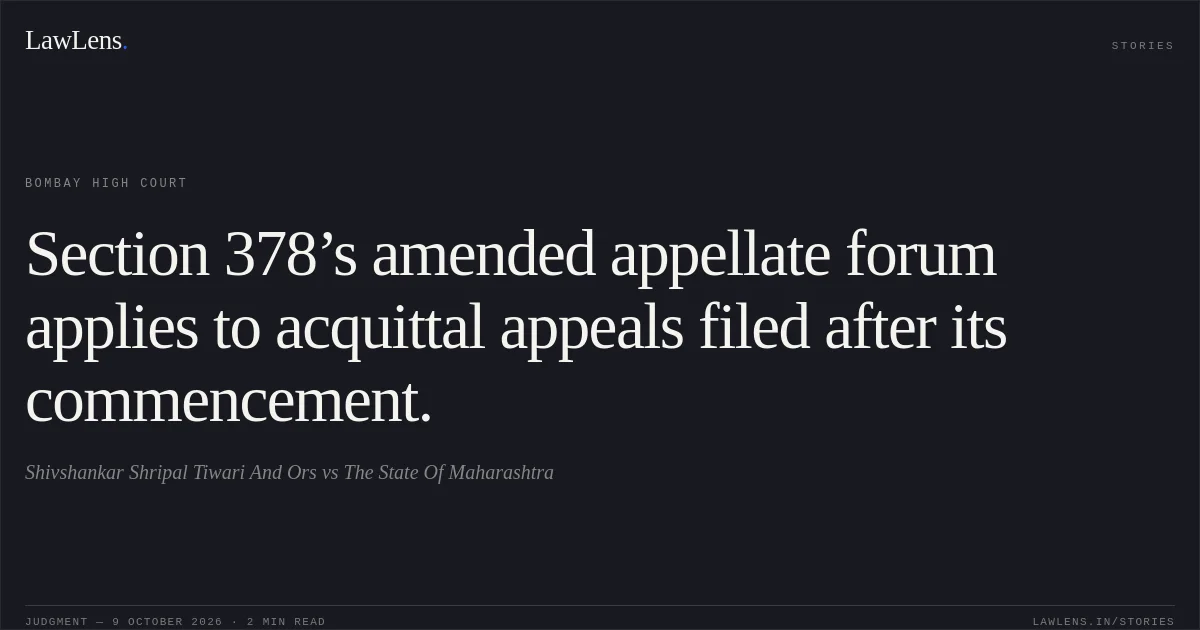
Source reference: p.15–18The Court held that the amendment changed the forum, not the substantive right to challenge an acquittal, and applied the amended provision to appeals filed after its commencement.
Source reference: p.15–18Since the acquittal concerned a cognizable and non-bailable offence under the law applicable when the appeal was filed, Section 378(1)(a) placed the appeal before the Sessions Court.
Source reference: p.15–18The Court further concluded that the High Court leave requirement in Section 378(3) did not apply to an appeal under clause (a), which is distinct from an appeal to the High Court under clause (b)
Source reference: p.15–18Holding
The Court held that the State’s appeal before the Sessions Court was maintainable and that no High Court leave was required under Section 378(3) CrPC.
It dismissed the petition and requested the Additional Sessions Judge to dispose of the appeal expeditiously
Source reference: p.18–19Acts & Sections Cited
6 provisions across 3 statutes referred to in this judgment. Each provision opens on LawLens.
Indian Penal Code, 18604
Code of Criminal Procedure, 19731
General Clauses Act, 18971
Original Court PDF
Shivshankar Shripal Tiwari And OrsvsThe State Of Maharashtra
Click to open original judgment
Original judgment, available to read, download and summarize on LawLens.in