01Facts
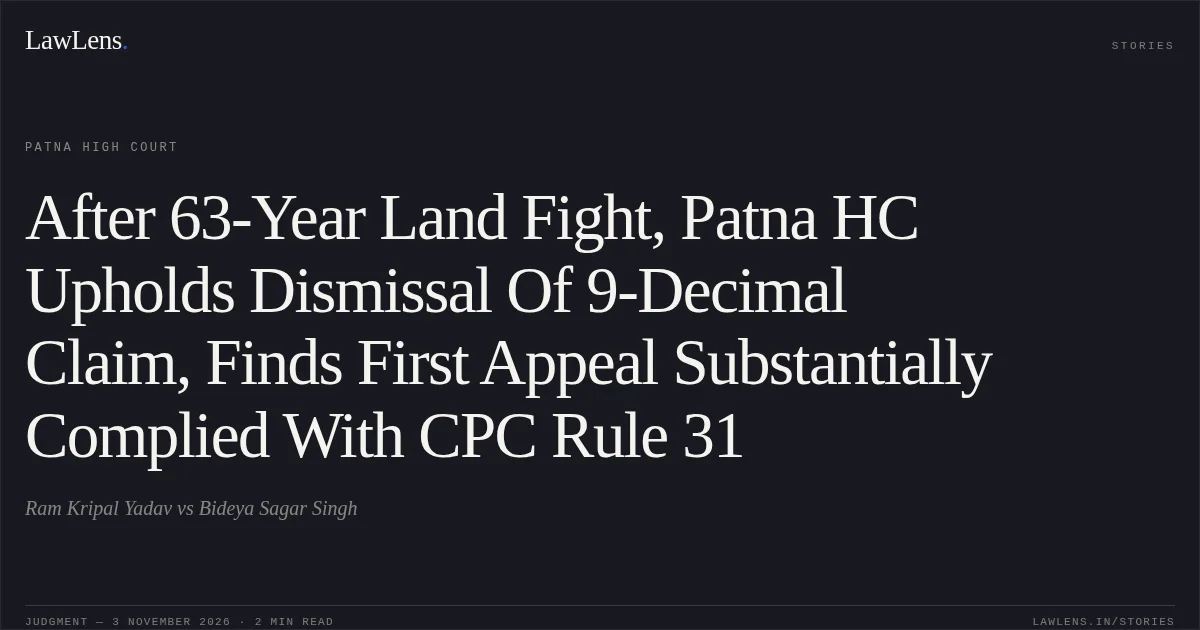
The plaintiffs claimed title to and possession of 9 decimals of land, alleging that after the land vested in the State of Bihar, it was settled in their favour in 1956.
The defendants asserted that the land had previously been settled by the ex-landlord in favour of their predecessors.
The trial court dismissed the suit, and the first appellate court affirmed that decision.
pp. 30–36In the second appeal, the appellants challenged the appellate judgment, principally contending that the first appellate court had failed to formulate points for determination and had not adequately considered the evidence, contrary to Order XLI Rule 31 CPC.
pp. 5–802Issues
i.Whether the first appellate court substantially complied with Order XLI Rule 31 CPC despite the appellants’ contention that it failed to formulate points for determination and give reasoned findings
p. 5 · ¶ 4 · pp. 36–38 · ¶ 21–23ii.Whether the first appellate judgment was so perfunctory as to warrant interference in second appeal
p. 5 · ¶ 403Law Applied
Order XLI Rule 31 CPC requires an appellate judgment to state the points for determination, the decision on each point, reasons for the decisions, and—where the decree is reversed or varied—the relief granted.
p. 13 · ¶ 9A first appeal is a valuable right involving rehearing on facts and law, and the appellate court must demonstrate conscious consideration of the issues, evidence, and parties’ contentions through reasoned findings (*Santosh Hazari v. Purushottam Tiwari*, (2001) 3 SCC 179; *C. Venkata Swamy v. H.N. Shivanna*, (2018) 1 SCC 604).
pp. 14–20 · ¶ 10However, non-compliance with the Rule does not automatically invalidate a judgment where its requirements have been substantially met; the Rule should not be applied so technically as to defeat substantial justice (*Parvathi Nairthi v. Laxmi Nairthy*, 2026 (4) PLJR SC 75).
p. 29 · ¶ 15 · pp. 29–30 · ¶ 16Provisions in the judgment · 7 · Linked ones open on LawLens
Bengal, Agra and Assam Civil Courts Act, 1887 Section 19Section 20Section 21Section 22
Code of Civil Procedure, 1908 Section 96Section 100Section 101
04Reasoning
The High Court examined the first appellate judgment as a whole and found that it addressed the parties’ rival cases and the material issues concerning the alleged State settlement, the land’s status at vesting, and the parties’ title claims.
pp. 30–36 · ¶ 16–20It concluded that the appellate court had identified the substance of the questions for decision, considered the evidence and recorded findings with reasons in paragraphs 5–10 of its judgment.
pp. 36–38 · ¶ 21–23Although the points might not have been set out in the precise form urged by the appellants, their substance was discernible; the omission therefore did not amount to a failure of the appellate duty under Order XLI Rule 31 CPC.
pp. 36–38 · ¶ 21–2305Holding
The Court answered the substantial question of law against the appellants, holding that the first appellate judgment substantially complied with Order XLI Rule 31 CPC and was not so deficient as to justify interference.
p. 38 · ¶ 23–24The second appeal was dismissed.
p. 38 · ¶ 24Original Court PDF
Ram Kripal YadavvsBideya Sagar Singh
Click to open original judgment
Original judgment, available to read, download and summarize on LawLens.in