Facts
A 17-year-old girl was reported missing on 9 October 2012 and was found dead the following day in bushes near Mannasanka. The post-mortem indicated rape and death by strangulation
Source reference: paras. 3–8Santhosh Rao was arrested and prosecuted under Sections 376, 302 and 201 of the Indian Penal Code, 1860. The investigation was successively conducted by the Belthangady Police, the Karnataka CID and the CBI, all of which attributed the crime to him and gave a clean chit to three persons suspected by the victim’s family
Source reference: paras. 9–16During trial, the Sessions Court noted serious investigative lapses, including failure to secure CCTV footage, failure to examine material witnesses, improper preservation of the vaginal swab, non-recovery of the victim’s belongings and failure to investigate the suspected persons
Source reference: paras. 27–36, 40Santhosh Rao was acquitted on 16 June 2023 because there was no reliable evidence connecting him with the crime
Source reference: paras. 20–22, 43The victim’s father thereafter sought a de novo/reinvestigation under Articles 226 and 227 of the Constitution and Section 482 of the Code of Criminal Procedure, 1973. The High Court acknowledged that the acquittal raised the question of the real perpetrator but refused reinvestigation on the ground that relevant evidence might no longer be available
Source reference: paras. 23–26, 45–46The victim’s mother pursued the appeal after the father’s death.
Source reference: no citationIssues
1. Whether, in exceptional circumstances demonstrating a tainted, inadequate or deliberately defective investigation, a constitutional court may direct a de novo or reinvestigation notwithstanding the filing of charge-sheets, completion of trial and acquittal of the accused
Source reference: paras. 50–572. Whether the investigative deficiencies in the present case justified transferring the matter to a newly constituted Special Investigation Team
Source reference: paras. 47–49, 59–603. Whether the acquitted accused could be subjected to further investigation or prosecution after acquittal
Source reference: para. 61(v)Law Applied
The Court held that although Section 173(8) CrPC ordinarily permits only further investigation after submission of a police report, a constitutional court exercising jurisdiction under Articles 226 and 227 may direct fresh, de novo or reinvestigation in exceptional cases to prevent miscarriage of justice
Source reference: paras. 51–57Under Neetu Kumar Nagaich v. State of Rajasthan, (2020) 16 SCC 777, Babubhai v. State of Gujarat, (2010) 12 SCC 254, Bharati Tamang v. Union of India, (2013) 15 SCC 578, Pooja Pal v. Union of India, (2016) 3 SCC 135, Dharam Pal v. State of Haryana, (2016) 4 SCC 160, and Zahira Habibulla H. Sheikh v. State of Gujarat, (2004) 4 SCC 158, fair investigation is a component of the Article 21 guarantee; courts may order reinvestigation where the investigation was not objective, was conducted to shield the real offenders, or would otherwise result in failure of justice
Source reference: paras. 51–58The victim is not a stranger to the criminal process, and constitutional courts may constitute an independent SIT where necessary to discover the truth
Source reference: paras. 55–58Article 20(2) of the Constitution and Section 300 CrPC protect an accused who has been acquitted from being tried or prosecuted a second time.
Source reference: para. 61(v)Reasoning
The Court found that the acquittal did not merely reflect failure to prove the prosecution case; it exposed fundamental defects in the investigation. The agencies failed to investigate the persons repeatedly named by witnesses and the victim’s family, omitted material witnesses, failed to collect CCTV footage and mobile tower data, did not properly examine the scene, and allowed the vaginal swab to become unfit for DNA analysis
Source reference: paras. 27–36, 40, 59The evidence also substantially undermined the prosecution case against Santhosh Rao: he was not shown to have been present near the scene, his injuries were consistent with assault by members of the public, his clothing lacked incriminating stains, and the medical evidence concerning phimosis created further doubt
Source reference: paras. 30–35, 125–142 of the Sessions Court judgment as reproduced by the Supreme CourtThe High Court’s assumption that the passage of time made further investigation futile was erroneous because material witnesses remained traceable and hairs of other persons were available on the victim’s clothing for possible DNA comparison
Source reference: paras. 47–49These circumstances demonstrated an investigation so deficient and potentially shielding of the real offenders that judicial non-interference would perpetuate injustice. However, the Court preserved Santhosh Rao’s acquittal and directed that he not be subjected to further investigation or prosecution.
Source reference: para. 61(v)Holding
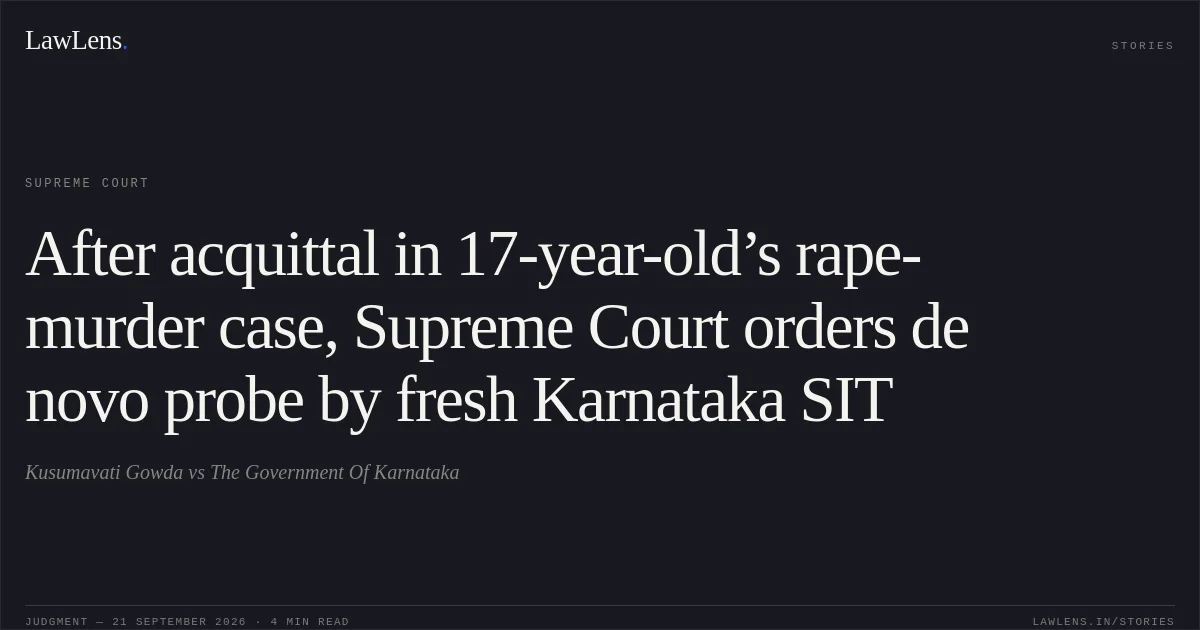
The appeal was allowed. The High Court’s order dated 30 August 2024 dismissing the writ petition was set aside, and a de novo investigation into Crime No. 250/2012, later registered by the CBI as RC.2(S)/2014/CBI/SCB/Chennai, was directed
The State of Karnataka was ordered to constitute a Special Investigation Team headed by a senior police officer and comprising efficient investigators conversant with modern investigative technology. No officer associated with the earlier Belthangady Police, CID or CBI investigations could be included in the SIT
Source reference: para. 61(iii)–(iv)The SIT was directed not to investigate or prosecute Santhosh Rao, whose acquittal attracted Article 20(2) and Section 300 CrPC, and was required to complete the fresh investigation and file its report within three months.
Source reference: para. 61(v)–(vii)Acts & Sections Cited
8 provisions across 2 statutes referred to in this judgment. Each provision opens on LawLens.
Indian Penal Code, 18603
Code of Criminal Procedure, 19735
Original Court PDF
Kusumavati GowdavsThe Government Of Karnataka
Click to open original judgment
Original judgment, available to read, download and summarize on LawLens.in