Facts
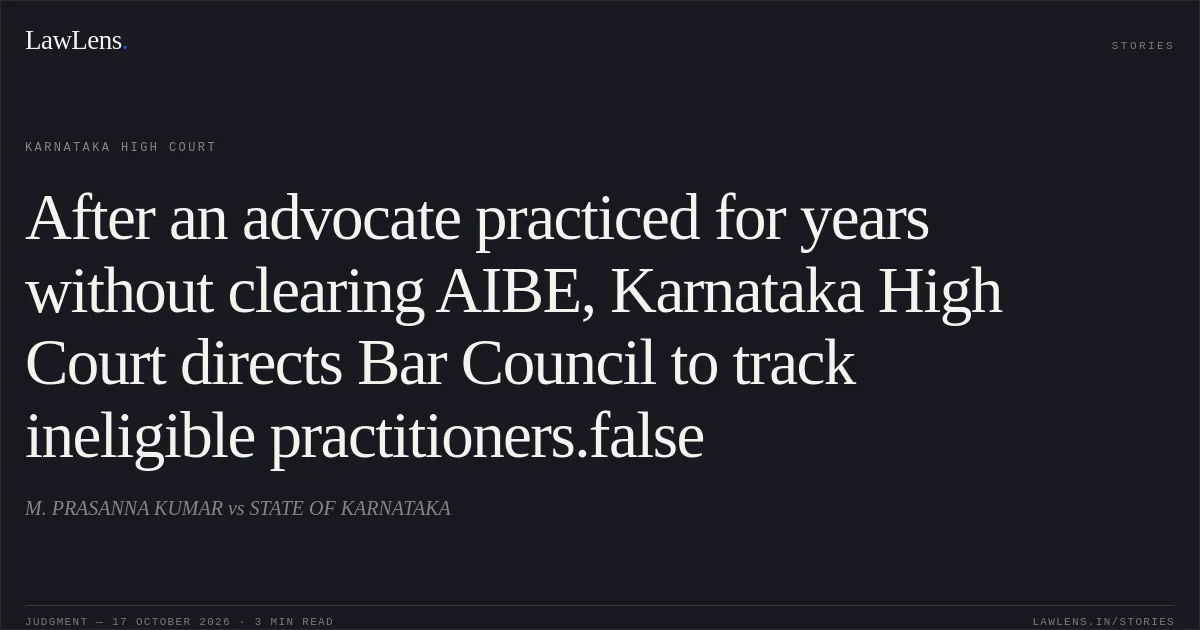
Respondent No. 2, an advocate, filed a private complaint alleging that the petitioner, enrolled with the Karnataka State Bar Council in 2011, practised without passing the All India Bar Examination (AIBE), and thereby committed offences under Sections 419, 420, 120-B and 511 of the IPC and Section 45 of the Advocates Act.
Source reference: para. 3–5The Magistrate recorded that cognizance was taken and also referred the matter to the police for investigation under Section 156(3) CrPC.
Source reference: para. 3–5The police had earlier issued a non-cognizable report after the complainant approached them.
Source reference: para. 5The petitioner admitted that he continued practising without passing the AIBE and passed it in 2021; he sought to quash the proceedings under Section 482 CrPC, contending, among other things, that the matter was disciplinary in nature and that the complaint disclosed no criminal offence.
Source reference: para. 6–9, 14–15Issues
Whether a complainant may invoke criminal jurisdiction under the IPC and Section 45 of the Advocates Act against an advocate alleged to have practised without passing the AIBE.
Source reference: para. 10(i)Whether the complainant had locus standi to institute the criminal complaint without first approaching the Bar Council.
Source reference: para. 10(ii)Whether the High Court should exercise its inherent jurisdiction under Section 482 CrPC to quash the proceedings.
Source reference: para. 10(iii)Law Applied
Section 45 of the Advocates Act provides for punishment of a person who practises in court or before an authority when not entitled to do so; disciplinary proceedings for professional misconduct under Sections 6(1)(c) and 35 operate separately from criminal jurisdiction.
Source reference: para. 18, 26The Court treated the AIBE Rules, 2010, as requiring an enrolled advocate to pass the examination within the prescribed period to continue practising, with practice rights suspended upon failure to qualify.
Source reference: para. 14, 16, 22Under the general principle discussed in A.R. Antulay v. Ramdas Sriniwas Nayak, anyone may set the criminal law in motion unless a statute provides otherwise.
Source reference: para. 17The Court also relied on Supreme Court Bar Association v. Union of India for the principle that disciplinary and court jurisdictions may coexist independently, and on Bar Council of India v. Bonnie Foi Law College concerning the Bar Council of India’s authority to prescribe conditions governing the right to practise.
Source reference: para. 19, 20The Court held that the Bar Council’s disciplinary mechanism does not, by itself, exclude criminal jurisdiction where the alleged conduct may independently constitute an offence.
Source reference: para. 26Reasoning
The Court found that the complaint alleged, and the petitioner did not dispute, that he practised for years after enrolling in 2011 without passing the AIBE until 2021.
Source reference: para. 14–15It rejected the contention that only the Bar Council could address the matter: the complainant could set the criminal law in motion, and Section 45 could be considered independently of any disciplinary process.
Source reference: para. 17, 23, 26The Court did not determine whether the allegations ultimately established cheating or the other IPC offences; it held that their ingredients were matters for investigation.
Source reference: no citationAlthough the Magistrate’s order appeared procedurally inconsistent in recording that cognizance was taken before referring the matter under Section 156(3) CrPC, the matter had in substance been referred for investigation, and that procedural issue did not warrant quashing the proceedings.
Source reference: para. 5, 26Holding
The High Court dismissed the petition and permitted the jurisdictional police to investigate and submit their report to the Trial Court expeditiously.
It also directed the Karnataka State Bar Council to establish mechanisms to identify advocates practising without the required qualification, maintain and verify enrolment and AIBE records, provide an opportunity to explain discrepancies, and report compliance to the Court within 45 days.
Source reference: para. 28(3)(i)–(xi)Acts & Sections Cited
17 provisions across 3 statutes referred to in this judgment. Each provision opens on LawLens.
Code of Criminal Procedure, 19734
Indian Penal Code, 18604
Original Court PDF
M. PRASANNA KUMARvsSTATE OF KARNATAKA
Click to open original judgment
Original judgment, available to read, download and summarize on LawLens.in