Facts
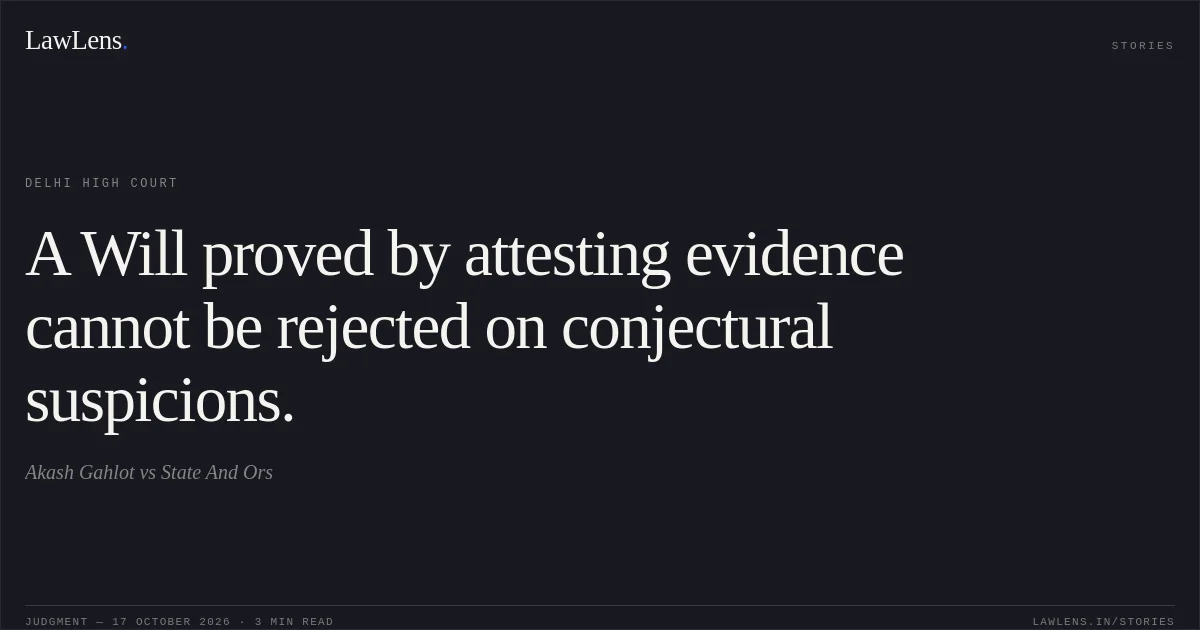
Akash Gahlot, through his father and natural guardian, petitioned for probate of a registered Will dated 7 October 1999, by which his grandmother, Smt. Shanti Devi, bequeathed her share in movable and immovable property to him.
Source reference: p. 1–7The respondents challenged the Will’s genuineness and the testatrix’s capacity, while some also disputed her title to the agricultural land. The Probate Court dismissed the petition, citing suspicious circumstances including a date discrepancy in the Will, the alleged presence of a person at execution, delayed production of the original, and the non-examination of the appellant and his father. Gahlot appealed under Section 299 of the Indian Succession Act, 1925.
Source reference: p. 1–7Issues
1. Whether the Will dated 7 October 1999 was duly executed and proved as the testatrix’s genuine last Will, despite the circumstances treated as suspicious by the Probate Court
Source reference: p. 5–7, 17–182. Whether the probate proceedings could determine the parties’ competing claims to title in the agricultural land
Source reference: p. 17Law Applied
Sections 59 and 61 of the Indian Succession Act, 1925 require testamentary capacity and a Will free from fraud, coercion or disabling importunity; Section 63 prescribes execution and attestation by two witnesses, and Section 68 of the Indian Evidence Act, 1872 requires at least one available attesting witness to prove execution.
Source reference: p. 9–10Under H. Venkatachala Iyengar v. B.N. Thimmajamma, the propounder must prove due execution, testamentary capacity and the testator’s understanding of the Will; legitimate suspicious circumstances must be satisfactorily dispelled.
Source reference: p. 10–14Indu Bala Bose v. Manindra Chandra Bose and Shivakumar v. Sharanabasppa clarify that suspicion must be real and germane, not conjectural, and that exclusion of heirs or other circumstances must be assessed in context.
Source reference: p. 14–16Probate proceedings determine the Will’s genuineness, not title to the property; title disputes remain for appropriate proceedings under Chiranjilal Shrilal Goenka v. Jasjit Singh.
Source reference: p. 17Reasoning
The Court accepted the attesting witness’s direct evidence that the testatrix instructed preparation of the Will, had its contents explained to her in Hindi, signed and affixed her thumb impression before the witnesses, and presented it for registration. The Sub-Registrar’s evidence corroborated presentation and registration on 7 October 1999.
Source reference: p. 18–27The discrepant date on the second page was plausibly explained as a typing error; the unexplained presence of another person did not establish that the father procured or dictated the Will. The health allegations lacked medical evidence of incapacity at execution, and physical infirmity alone did not establish lack of testamentary capacity.
Source reference: p. 18–27Exclusion of other heirs, delayed production of the original, and the appellant’s and his father’s non-examination were considered cumulatively but did not outweigh the attesting witness’s evidence and corroboration of registration.
Source reference: p. 18–27The separate dispute over the testatrix’s title to the agricultural land was outside the probate court’s remit.
Source reference: p. 17Holding
The Court held that the Will was duly proved and that the circumstances relied on by the Probate Court did not justify rejecting it.
It allowed the appeal and set aside the dismissal. Probate or letters of administration are to issue to the appellant for the Will dated 7 October 1999, subject to filing the requisite court fees and an administrative bond with one surety. The parties’ title claims remain open for determination in appropriate proceedings.
Source reference: p. 27–28Acts & Sections Cited
6 provisions across 2 statutes referred to in this judgment. Each provision opens on LawLens.
Indian Succession Act, 19255
Code of Civil Procedure, 19081
Original Court PDF
Akash GahlotvsState And Ors
Click to open original judgment
Original judgment, available to read, download and summarize on LawLens.in