01Facts
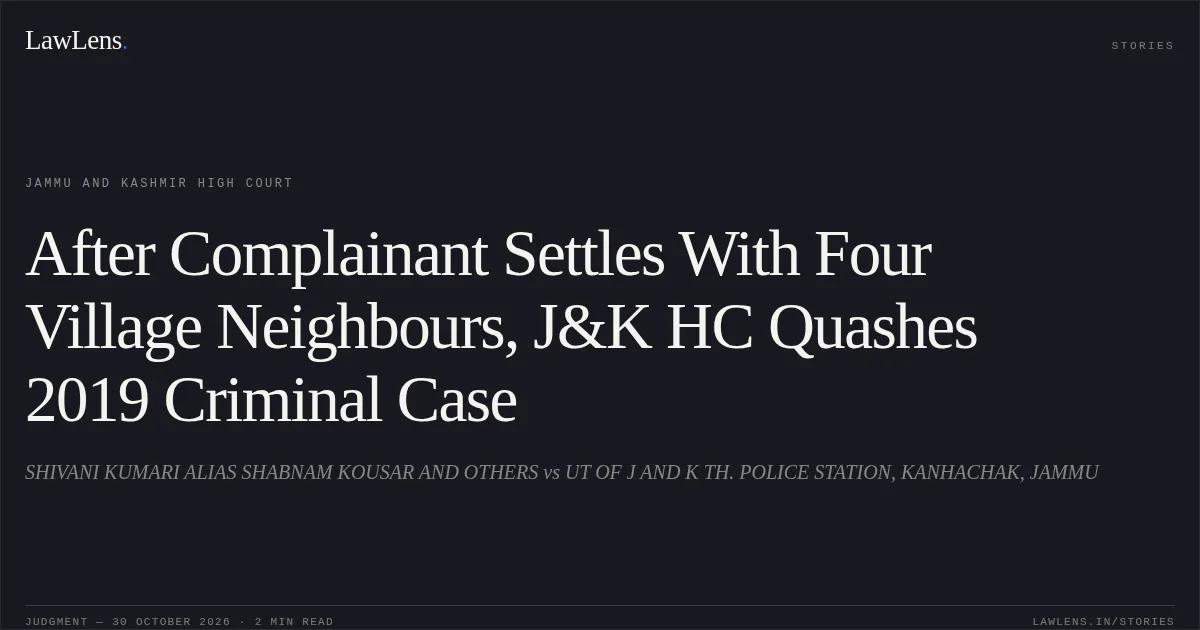
Petitioner No. 1 lodged FIR No. 0092/2019 against petitioners Nos. 2–4 and two other persons, alleging offences under Sections 451, 354, 323 and 147 RPC.
¶ 1–4The investigation resulted in Challan No. 77/2019, pending before the City Judge, Jammu.
¶ 1–4During the proceedings, petitioner No. 1 and petitioners Nos. 2–4 entered into a written compromise.
¶ 1–4Their statements were recorded before the Registrar Judicial, and petitioner No. 1 stated that she had no objection to quashing the FIR and consequential proceedings.
¶ 1–402Issues
i.1. Whether the High Court could quash the FIR and consequential challan under Section 528 BNSS on the basis of the parties’ compromise.
¶ 1, 5ii.2. Whether, having regard to the nature of the alleged offences and the settlement, continuation of the criminal proceedings would serve a useful purpose.
¶ 5–703Law Applied
The Court exercised its inherent jurisdiction under Section 528 of the Bharatiya Nagarik Suraksha Sanhita, 2023.
¶ 1, 5Relying on Narinder Singh v. State of Punjab, (2014) 6 SCC 466, it applied the principle that compromise-based quashing is generally inappropriate for heinous or serious offences having a substantial societal impact, but may be appropriate in cases with a predominantly private character where the parties have settled their dispute.
¶ 1, 5The Court must consider the nature of the offence, the likelihood of conviction, and whether continuing the proceedings would cause oppression, prejudice or injustice.
¶ 1, 5Provisions in the judgment · 5 · Linked ones open on LawLens
Bharatiya Nagarik Suraksha Sanhita, 2023 Section 528
Indian Penal Code, 1860 Section 451Section 354Section 323Section 147
04Reasoning
The Court treated the alleged offences as not heinous in nature and considered the complainant’s recorded statement confirming the settlement and her lack of objection to quashing.
¶ 4, 6–7In light of the compromise and the parties’ resolved dispute, it found the prospects of conviction bleak and concluded that continuing the prosecution would serve no useful purpose and would risk injustice and abuse of the court’s process.
¶ 6–705Holding
The Court answered the issues in favour of quashing.
¶ 8It allowed the petition and quashed Challan/Final Report No. 77/2019, arising from FIR No. 0092/2019 under Sections 451, 354, 323 and 147 RPC, pending before the City Judge, Jammu.
¶ 8The petition was disposed of accordingly.
¶ 9Original Court PDF
SHIVANI KUMARI ALIAS SHABNAM KOUSAR AND OTHERSvsUT OF J AND K TH. POLICE STATION, KANHACHAK, JAMMU
Click to open original judgment
Original judgment, available to read, download and summarize on LawLens.in