01Facts
Land measuring 95 kanals, inherited by Vasu Dev, Rattno Devi and Shanti Devi in equal shares, remained unpartitioned.
¶ 2–5, 13–14Sada Nand, Vasu Dev’s son, claimed tenancy over portions belonging to Rattno Devi and Shanti Devi.
¶ 2–5, 13–14Revenue entries recorded him as a protected tenant, and mutations under Sections 4 and 8 of the J&K Agrarian Reforms Act were attested in his favour; Shanti Devi also entered into a private agreement under Section 12 in respect of her share.
¶ 2–5, 13–14On appeal by Rattno Devi’s successors, the Joint Agrarian Reforms Commissioner set aside the relevant mutations.
¶ 6–7The Special Tribunal partly allowed Sada Nand’s revision, preserving his rights over Shanti Devi’s share but directing that 27 kanals and 3 marlas belonging to Rattno Devi’s successors go to them.
¶ 6–7Following remand by the Supreme Court, the writ court again dismissed Sada Nand’s petition.
¶ 8–10His successors challenged that decision in this appeal.
¶ 8–1002Issues
i.Whether Sada Nand, as a co-owner of unpartitioned land, could claim tenancy over the shares of Rattno Devi and her successors and obtain mutations under Sections 4 and 8 of the Act.
¶ 13–17ii.Whether the private agreement under Section 12 entitled Sada Nand to ownership rights over Shanti Devi’s share.
¶ 14iii.Whether the appeal before the Joint Agrarian Reforms Commissioner was time-barred.
¶ 18–1903Law Applied
Under the J&K Agrarian Reforms Act, Sections 4 and 8 provide for the relevant agrarian-reform processes concerning land and conferment of ownership rights, while Section 12 recognises a private agreement through which ownership rights may be conferred; Section 7 provides for resumption of land.
¶ 5, 14–15The governing co-ownership principle is that, while a holding remains unpartitioned, each co-owner is deemed to possess every part of it, and possession by one co-owner is possession by all; accordingly, a co-owner cannot claim to be a tenant of another co-owner over that joint holding.
¶ 14, 17The Court also noted that delay in the respondents’ appeal had been condoned by the Joint Agrarian Reforms Commissioner after an application asserting that the mutations were made without notice.
¶ 18–19Provisions in the judgment · 4
Jammu and Kashmir Agrarian Reforms Act, 1976 Section 4Section 7Section 8Section 12
04Reasoning
The record contained no evidence or revenue entry establishing partition, and the appellants had raised the partition contention for the first time in the appeal.
¶ 13–17The land therefore remained joint, making Sada Nand’s cultivation insufficient to establish tenancy against Rattno Devi or her successors; the mutations in his favour could not stand as to their share.
¶ 13–17Shanti Devi’s share was different: she had entered into a Section 12 agreement, the levy had been received, and her successors had not challenged the resulting conferment of ownership rights, which had therefore attained finality.
¶ 14The limitation objection also failed because delay had been condoned and the mutation orders did not record the respondents’ presence or bear their signatures or thumb impressions.
¶ 18–1905Holding
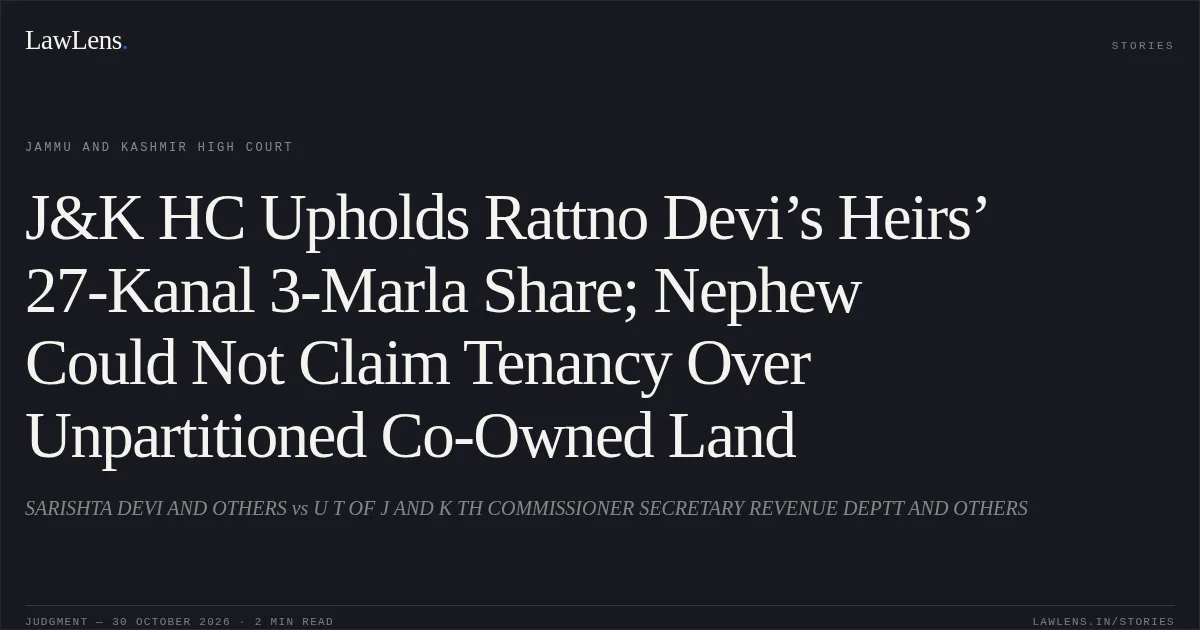
The Court held that Sada Nand could not claim tenancy over the unpartitioned share of Rattno Devi and her successors, but his ownership rights over Shanti Devi’s share under the Section 12 agreement remained undisturbed.
¶ 14–20It rejected the limitation challenge, found no ground to interfere with the writ court’s judgment, and dismissed the intra-court appeal.
¶ 14–20Original Court PDF
SARISHTA DEVI AND OTHERSvsU T OF J AND K TH COMMISSIONER SECRETARY REVENUE DEPTT AND OTHERS
Click to open original judgment
Original judgment, available to read, download and summarize on LawLens.in