01Facts
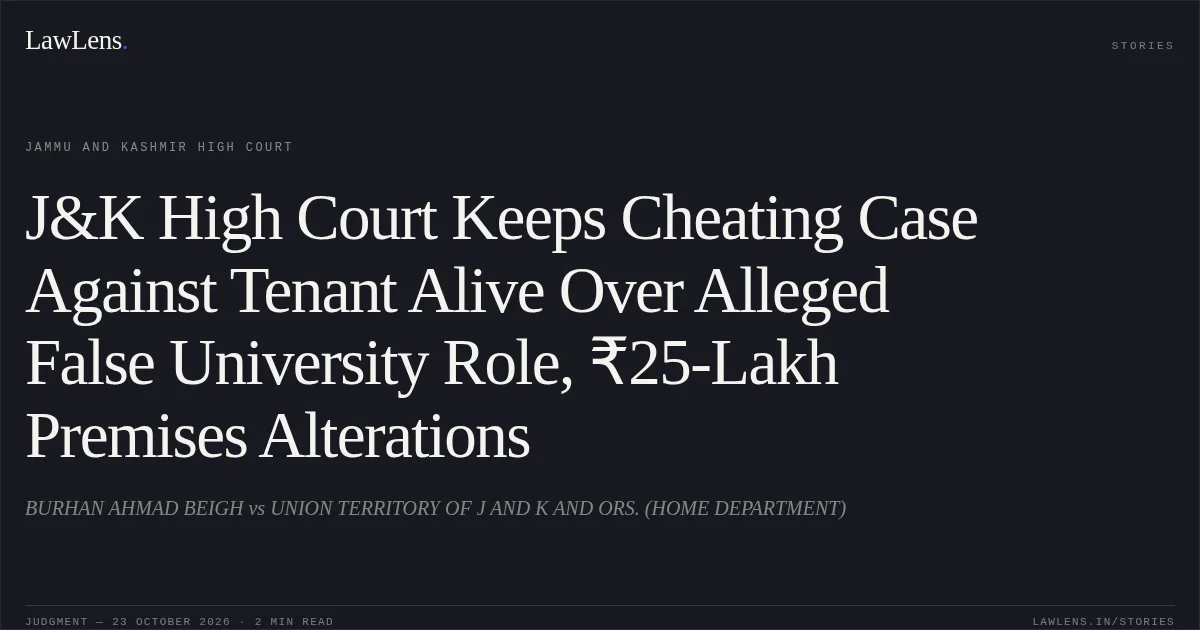
Respondent No. 5 alleged that the petitioner falsely represented himself as an Assistant General Manager of AMITY University and said he required premises for university-related and company business.
¶ 2–4, 12–13Relying on the representations, respondent No. 5 allegedly undertook alterations to the building; the petitioner ultimately took a tenancy of approximately 4,000 square feet but allegedly failed to pay rent and retained the premises under lock and key.
¶ 2–4, 12–13An FIR was registered under Sections 419 and 420 RPC, and a charge-sheet was filed.
¶ 4–5The petitioner sought quashing of the FIR, charge-sheet and consequential proceedings, contending that the dispute was contractual and civil in nature.
¶ 4–502Issues
i.Whether the allegations, taken at face value, prima facie disclosed the offences alleged under Sections 419 and 420 RPC, or amounted only to a subsequent breach of contract
¶ 11–15ii.Whether the availability of a civil remedy, and the petitioner’s contention that the prosecution was brought to exert pressure, warranted quashing under the Court’s inherent jurisdiction
¶ 10–11, 24–2503Law Applied
The Court applied the principles governing the exercise of inherent jurisdiction under Section 482 Cr.P.C.: quashing is to be exercised sparingly, and proceedings may be quashed where the allegations, even if accepted in their entirety, do not disclose the essential ingredients of an offence or where continuation would constitute an abuse of process.
¶ 10–11, 18A civil remedy does not, by itself, bar criminal proceedings where the allegations also prima facie disclose an offence.
¶ 22In a cheating allegation, dishonest or fraudulent intention must be assessed in light of the alleged representations and the circumstances at the inception of the transaction; a mere subsequent breach, without more, is insufficient.
¶ 7, 14The Court considered the petitioner’s cited authorities, including Naresh Aneja @ Naresh Kumar Aneja v. State of Uttar Pradesh, Anukul Singh v. State of Uttar Pradesh and Another, and V. Ganesan v. State, as applying settled quashing principles, but distinguished them on their facts.
¶ 16–22Provisions in the judgment · 4 · Linked ones open on LawLens
Code of Criminal Procedure, 1973 Section 156Section 482
Indian Penal Code, 1860 Section 354Section 506
04Reasoning
The complaint and investigation material alleged more than non-payment of rent: the petitioner was said to have made false representations about his status and intended use of the premises, inducing respondent No. 5 to hand over possession and incur substantial alteration costs.
¶ 12–14The Court held that these allegations, if taken at face value, required examination of whether dishonest intention existed at the outset and could not be treated at the quashing stage as merely a later contractual default.
¶ 14–15Because the allegations prima facie disclosed the offences invoked, disputed facts and evidentiary merits were left for the trial court; the civil nature of the tenancy dispute did not, on its own, justify quashing.
¶ 20–2405Holding
The Court dismissed the petition, finding no basis to quash the FIR, charge-sheet or consequential proceedings.
¶ 25It left the petitioner at liberty to raise available factual and legal pleas, including at discharge, and directed the trial court to proceed independently without being influenced by the High Court’s observations.
¶ 24–26Original Court PDF
BURHAN AHMAD BEIGHvsUNION TERRITORY OF J AND K AND ORS. (HOME DEPARTMENT)
Click to open original judgment
Original judgment, available to read, download and summarize on LawLens.in