01Facts
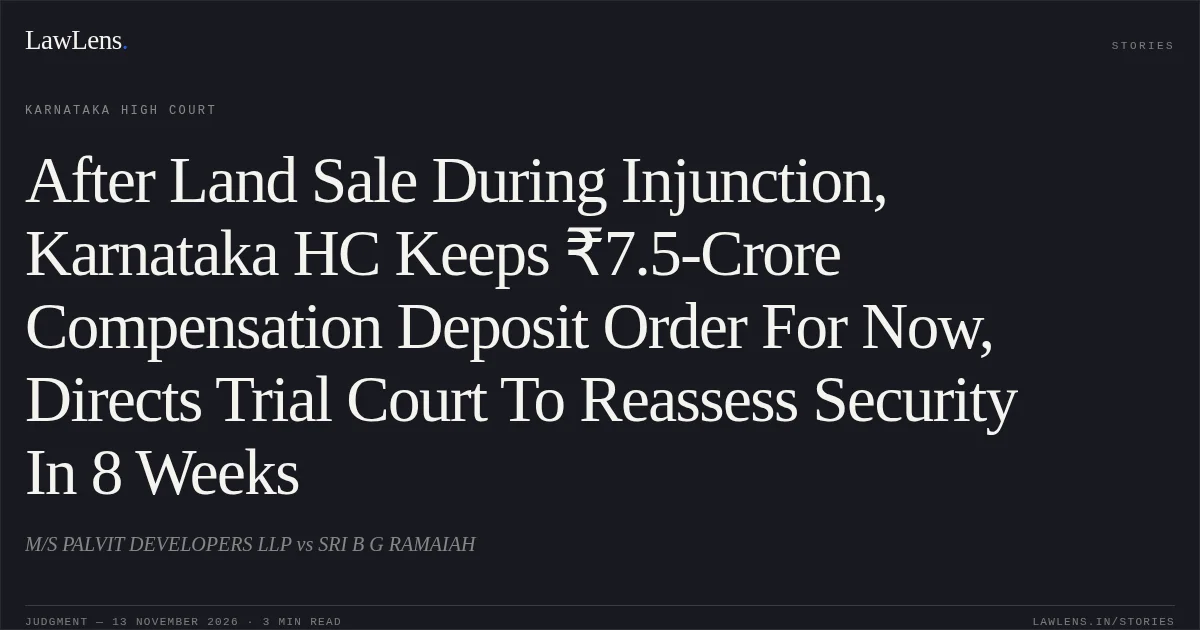
Respondent No. 1 filed a 2012 suit for specific performance based on an agreement of sale dated 5 October 2007. An injunction restraining the vendors from alienating the suit property was in force when the petitioner, defendant No. 16, purchased it by registered sale deed dated 26 March 2022. The property was later acquired, and the petitioner received ₹7.5 crore in compensation.
pp. 5–6, 52–56The plaintiff sought an order under Section 151 CPC requiring the petitioner to deposit that amount. The trial court allowed the application and directed deposit within 20 days.
pp. 5–6The petitioner challenged that order under Articles 226 and 227, arguing, among other things, that the plaintiff had neither established entitlement under the agreement nor pleaded a claim for compensation under Section 21 of the Specific Relief Act. The High Court noted that the plaintiff had not amended the plaint to claim compensation.
pp. 7–12, 59–6202Issues
i.1. Whether the trial court could direct the petitioner to deposit the acquisition compensation under Section 151 CPC when the plaintiff’s entitlement under the agreement remained unadjudicated and no claim for compensation had been pleaded.
pp. 59–65ii.2. Whether, in light of the sale during the subsistence of an injunction, the compensation could nevertheless be preserved as an interim protective measure pending adjudication.
pp. 52–55, 65–6803Law Applied
Section 21(5) of the Specific Relief Act bars an award of compensation unless it is claimed in the plaint, while its proviso permits amendment to include such a claim on just terms; acquisition during the suit may make specific performance impossible but does not itself establish the plaintiff’s entitlement to compensation.
pp. 56–61Under Section 54 of the Transfer of Property Act, an agreement for sale does not itself create an interest in the property; Section 52 makes a pendente lite transfer subject to the outcome of the litigation, and a transfer made in breach of an injunction cannot be allowed to defeat the court’s process.
pp. 52–55, 61Section 151 CPC may support protective directions to preserve the effectiveness of proceedings, but it cannot be used to grant substantive relief in advance or to bypass the safeguards governing pre-judgment security; Raman Tech. & Process Engg. Co. v. Solanki Traders was relied on for that restraint.
pp. 64–66The principle in Delhi Development Authority v. Skipper Construction Co. (P) Ltd. supports appropriate remedial measures to prevent a party from retaining an advantage obtained by defeating a court order, but does not automatically entitle the plaintiff to the fund.
pp. 66–67Provisions in the judgment · 19 · Linked ones open on LawLens
Code of Civil Procedure, 1908 Section 9Section 80Section 94Section 151
Indian Contract Act, 1872 Section 73Section 74
Indian Trust Act, 1882 Section 80Section 91
Registration Act, 1908 Section 17Section 21Section 49
Right to Fair Compensation and Transparency in Land Acquisition, Rehabilitation and Resettlement Act, 2013 Section 64Section 76
Specific Relief Act, 1963 Section 19Section 21Section 28
Transfer of Property Act, 1882 Section 40Section 52Section 54
04Reasoning
The High Court held that the plaintiff had no established right to the acquisition compensation: the agreement’s enforceability and the plaintiff’s entitlement remained for trial, and no Section 21 compensation claim had been pleaded. The acquisition award could not simply be treated as belonging to the plaintiff because it concerned the same property.
pp. 57–62However, the petitioner acquired the property while an express injunction against alienation was in force, and the subsequent acquisition had replaced the property with an identifiable fund. That circumstance distinguished the application from an ordinary request to secure an unadjudicated money claim and justified considering preservation to protect the court’s process.
pp. 65–67Because ordering the entire amount to be deposited indefinitely could go beyond necessary protection, the trial court was directed to reconsider the extent and continuation of security, taking account of the absent compensation claim, any steps to amend the plaint, the potential claim, and alternative security.
pp. 67–6905Holding
The High Court disposed of the writ petition without determining the plaintiff’s entitlement to compensation. It held that the deposit direction was protective only and did not decide ownership of, or entitlement to, the compensation.
p. 68The trial court must reconsider the extent and continuation of security within eight weeks after hearing the parties; any amount already deposited is to remain in a fixed deposit in a nationalised bank pending that decision. The trial court may maintain, vary, or vacate the security by a reasoned order and must decide the suit independently and expeditiously.
pp. 68–70Original Court PDF
M/S PALVIT DEVELOPERS LLPvsSRI B G RAMAIAH
Click to open original judgment
Original judgment, available to read, download and summarize on LawLens.in