01Facts
The plaintiff initially brought a suit for permanent injunction and obtained a temporary injunction against the original defendants.
pp. 4–7, 11, 16–17During the suit, those defendants sold part of the suit property to defendant Nos. 5–8, who were later impleaded.
pp. 4–7, 11, 16–17The plaintiff amended the plaint to seek a declaration of ownership and recovery of possession, as well as other reliefs
pp. 4–7, 11, 16–17The purchasers applied under Order XXXIX Rule 4 read with Section 151 CPC to vacate the injunction; the trial court rejected their application.
pp. 7–12They appealed, contending that they were in possession under a registered sale deed and had obtained permissions and commenced construction
pp. 7–12The High Court considered the appeal against the rejection of that application
pp. 14–1502Issues
i.1. Whether the trial court’s order rejecting the purchasers’ application under Order XXXIX Rule 4 CPC to vacate the temporary injunction called for appellate interference
p. 14 · ¶ 10ii.2. Whether, in deciding whether the injunction should continue, the court had properly considered possession, balance of convenience, irreparable injury, and the hardship to the parties
pp. 15–17 · ¶ 12–1403Law Applied
The Court applied Order XXXIX Rules 1 and 2 CPC, governing temporary injunctions, and Order XXXIX Rule 4 CPC, under which an injunction may be discharged, varied, or set aside; it also referred to Section 151 CPC
pp. 7–8In determining whether interim relief was justified, the court must consider a prima facie case, balance of convenience, and irreparable injury, while assessing the comparative hardship to the parties
p. 16 · ¶ 13The Court also referred to Section 52 of the Transfer of Property Act in connection with pendente lite transfers, but left the parties’ substantive rights and the effect of the sale for trial
pp. 9–10, 17–18No precedent was cited.
Provisions in the judgment · 2 · Linked ones open on LawLens
Code of Civil Procedure, 1908 Section 151
Transfer of Property Act, 1882 Section 52
04Reasoning
The plaintiff’s amended claim for recovery of possession indicated that he was not in possession, while the purchasers were in possession and had proceeded with construction after obtaining a sanctioned plan and necessary permissions
pp. 15–17 · ¶ 12–14, 16The trial court had not adequately considered those circumstances or the balance of convenience, irreparable injury, and comparative hardship when rejecting the purchasers’ application
p. 17 · ¶ 14The purchasers’ title and the plaintiff’s claim remained matters for trial; accordingly, the Court did not decide their merits
pp. 17–18 · ¶ 15–16It considered that the plaintiff’s interests could be protected by requiring the purchasers to claim no equity from construction and, if the plaintiff succeeded and so required, to demolish the structure at their own cost
pp. 18–19 · ¶ 16 and order05Holding
The appeal was allowed, and the trial court’s order rejecting I.A. No. 6 was set aside.
pp. 18–19, order, cls. (i)–(iii)The temporary injunction granted on the plaintiff’s application under Order XXXIX Rules 1 and 2 CPC was also set aside
pp. 18–19, order, cls. (i)–(iii)The Court expressed no opinion on the merits, directed that the purchasers claim no equity from any construction and, if the plaintiff succeeded and required it, demolish the structure at their own cost; it also directed the trial court to endeavour to dispose of the suit within one year
pp. 19–20, order, cls. (iv)–(vii)Original Court PDF
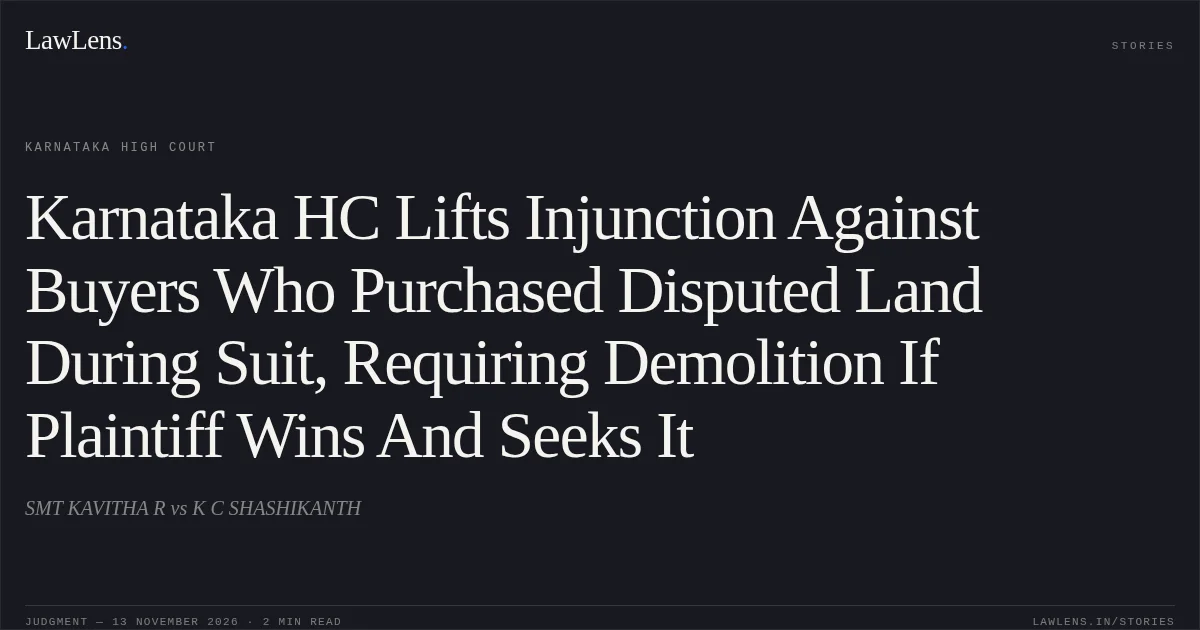
SMT KAVITHA RvsK C SHASHIKANTH
Click to open original judgment
Original judgment, available to read, download and summarize on LawLens.in