01Facts
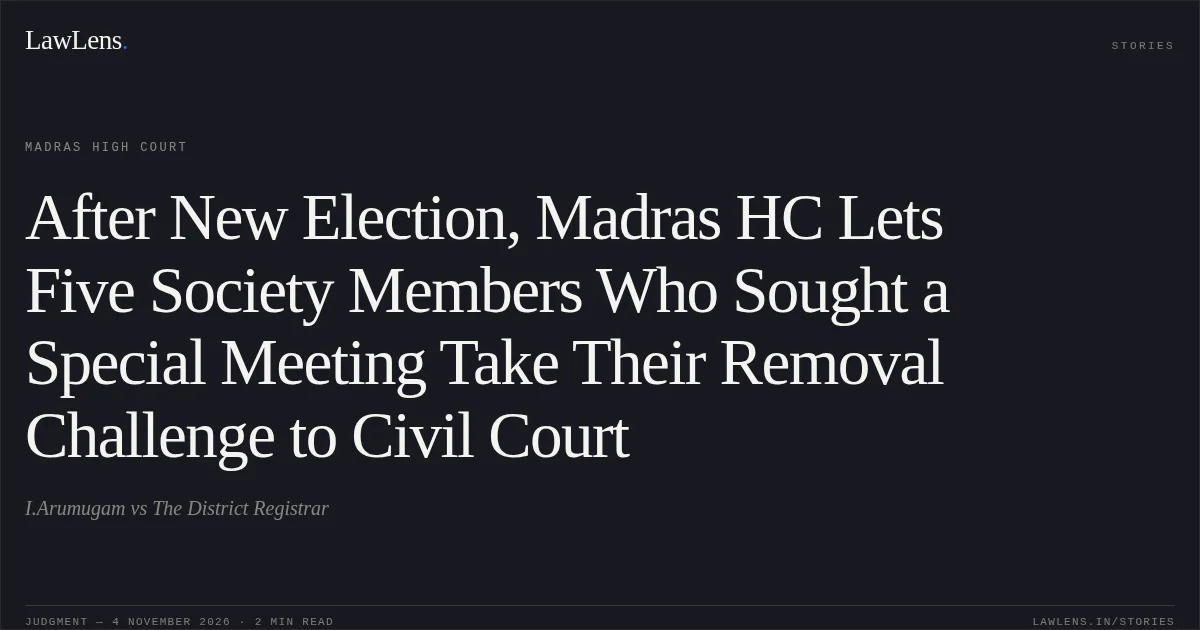
The petitioners, members of the second respondent Society, sought an Extraordinary General Body Meeting, relying on a requisition signed by 248 members and the Society’s By-law 28.
pp. 3–6They alleged that the Society refused to convene the meeting and subsequently removed them from membership by orders dated 7 February 2024, without properly considering their explanations and contrary to By-law 30.
pp. 3–6They sought to quash the removal orders and obtain a direction to conduct an election.
pp. 3–6The respondents stated that the petitioners had been removed for misconduct and that the Registrar had recorded the removals in Form 6.
pp. 6–7They also submitted that an election for the 2025–2028 term had been held and Form 7 accepted.
pp. 6–702Issues
i.1. Whether the removal of the petitioners from the Society’s membership should be quashed on the grounds raised, including alleged non-compliance with the Society’s by-laws.
pp. 5–6ii.2. Whether the Court should direct the Society to conduct an election when the petitioners sought that relief, but a subsequent election had already been held and recorded.
p. 2, 703Law Applied
The petitioners relied on Section 28 of the Tamil Nadu Societies Registration Act, 1975, read with By-law 28, concerning a members’ requisition for an Extraordinary General Body Meeting.
p. 4They also relied on By-law 30, which they contended required removal for misconduct to be considered at a General Body Meeting.
p. 6The Court did not decide the interpretation or application of these provisions.
p. 8It referred to Section 14 of the Limitation Act, 1963, directing that the period spent pursuing the writ petitions be excluded by the Civil Court when considering limitation.
p. 8Provisions in the judgment · 1 · Linked ones open on LawLens
Limitation Act, 1963 Section 14
04Reasoning
The Court did not determine whether the membership removals were valid or whether the Society had complied with its by-laws.
pp. 7–8It noted that the removals had been recorded by the Registrar and that an election for 2025–2028 had since been conducted, with Form 7 accepted.
pp. 7–8Given these subsequent developments, the Court considered the appropriate course to be for the petitioners to pursue their remedies before the competent Civil Court, rather than grant the requested writ relief.
p. 805Holding
The writ petitions were disposed of without adjudicating the merits of the removal or election disputes.
p. 8The petitioners were granted liberty to approach the appropriate Civil Court, which was directed to exclude, under Section 14 of the Limitation Act, the period spent pursuing the writ petitions.
p. 8No costs were awarded, and the connected miscellaneous petitions were closed.
p. 8Original Court PDF
I.ArumugamvsThe District Registrar
Click to open original judgment
Original judgment, available to read, download and summarize on LawLens.in