01Facts
The appellant was convicted under Sections 323/34, 308/34, 504 and 506 IPC and sentenced to imprisonment, including four years’ rigorous imprisonment for the offence under Section 308/34 IPC.
¶ 2In appeal, he did not challenge his conviction or sentence on the merits and sought only the benefit of Section 4 of the Probation of Offenders Act, 1958.
¶ 3The probation officer reported that he had no other criminal involvement, worked as a manual labourer, had normal financial and social circumstances, and had not attracted complaints from neighbours; the jail report recorded that he had been incarcerated for two months and fifteen days.
¶ 4The prosecution alleged an assault with a spade, but the court noted that the allegation of an assault on the complainant’s husband’s head was unsupported by evidence and that none of the injuries was proved grievous.
¶ 5–602Issues
i.Whether the appellant, having confined his appeal to the question of sentence, should be released on probation under Section 4 of the Probation of Offenders Act, 1958.
¶ 3, 7, 11–12ii.Whether, given the time elapsed since conviction and the appellant’s conduct during that period, a further period of probation was necessary.
¶ 1303Law Applied
Section 4 of the Probation of Offenders Act, 1958 empowers a court to release a person found guilty of an offence not punishable with death or imprisonment for life on probation of good conduct, having regard to the circumstances of the case, the nature of the offence and the offender’s character; the court must consider any probation officer’s report.
¶ 7Under Section 11, the High Court may exercise that power when a case comes before it on appeal.
¶ 10Sunita Devi v. State of Bihar, 2024 SCC OnLine SC 984, emphasises that courts must consider the applicable probation provisions before deciding sentence.
¶ 8Chellammal v. State, 2025 SCC OnLine SC 870, holds that although probation is not an offender’s right, courts must consider its applicability where Section 4 may apply, and give reasons if they decline to grant it.
¶ 9Provisions in the judgment · 11 · Linked ones open on LawLens
Code of Criminal Procedure, 1973 Section 374Section 360
Indian Penal Code, 1860 Section 323Section 34Section 308Section 504Section 506
Probation of Offenders Act, 1958 Section 3Section 4Section 6Section 11
04Reasoning
The appellant’s offences were eligible for consideration under Section 4, and the court found the allegations and proved injuries sufficiently limited to permit probation.
¶ 6, 12The appellant was a first offender, the State did not identify any other criminal case, and the probation report described no adverse conduct or circumstances.
¶ 4, 11Further, more than a decade had elapsed since sentence without any reported reoffending—well beyond Section 4’s maximum three-year probation period—so the court considered a further probation period unnecessary.
¶ 1305Holding
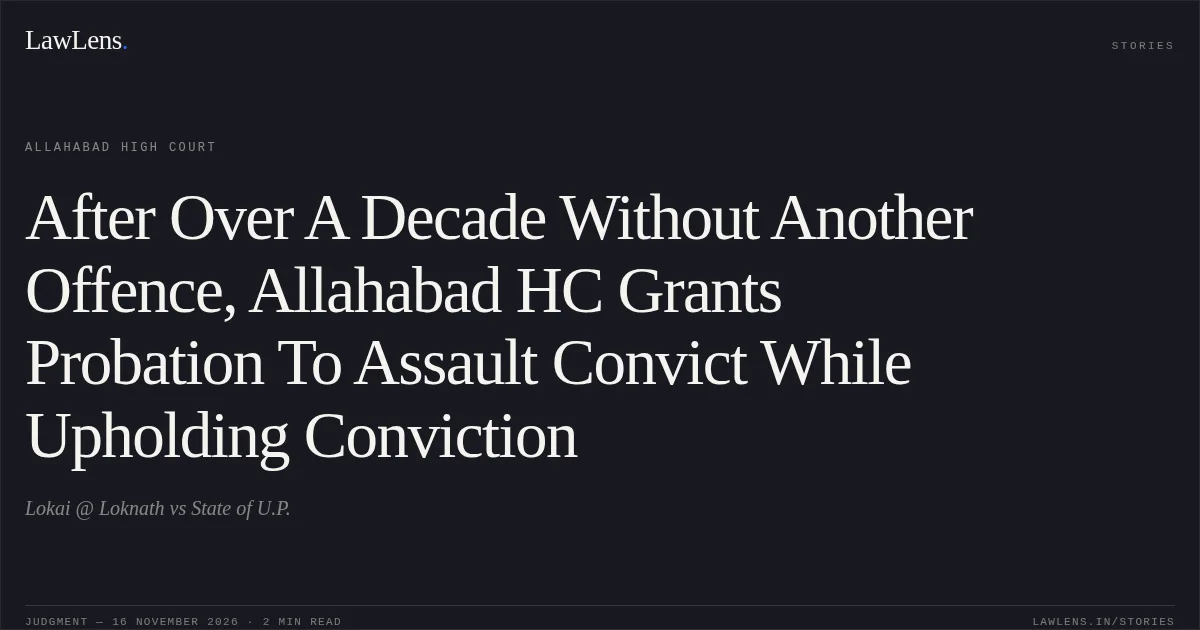
The High Court disposed of the appeal by upholding the appellant’s conviction and granting him the benefit of the Probation of Offenders Act, 1958, without imposing any further period of probation.
¶ 13–14It directed the appellant to deposit the fine within two weeks.
¶ 14Original Court PDF
Lokai @ LoknathvsState of U.P.
Click to open original judgment
Original judgment, available to read, download and summarize on LawLens.in