01Facts
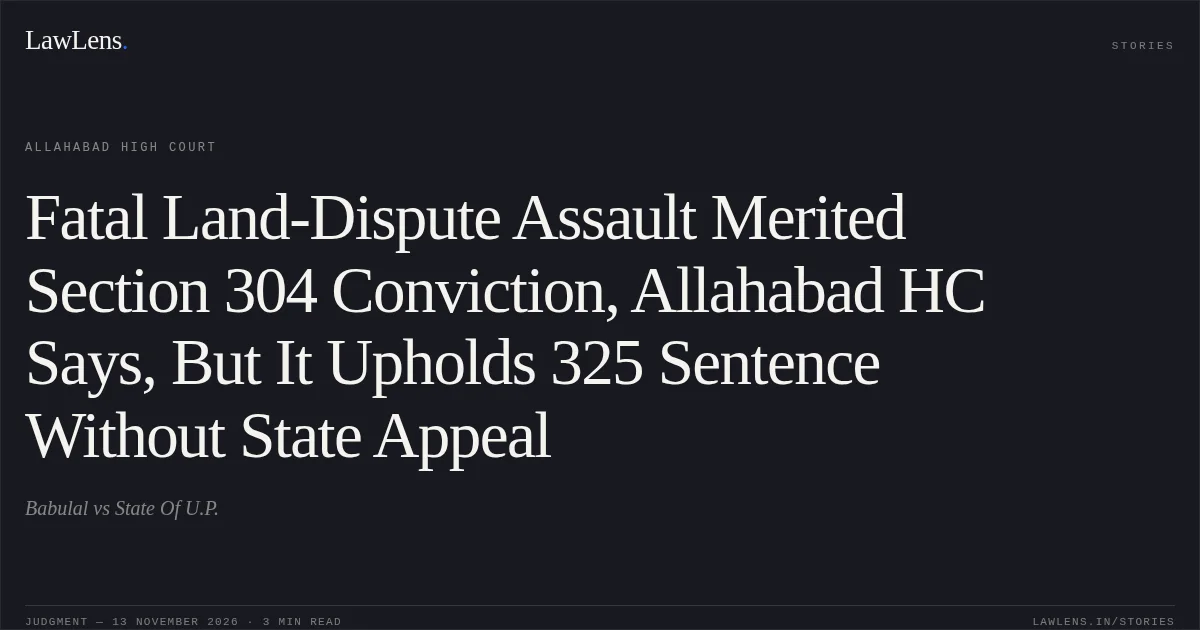
A land and construction dispute led to an assault on 15 February 1983, in which Chunku, Smt. Tituli and Bhadauwa were injured; Bhadauwa later died from his injuries.
¶ 5–9The Sessions Court convicted the accused under Sections 325 and 323 IPC, sentencing them to five years’ rigorous imprisonment under Section 325 and six months’ rigorous imprisonment under Section 323, with sentences to run concurrently.
¶ 5–9The accused appealed. During the appeals, Ghasitawa @ Ghasita died, and the appeal abated as to him; the appeals continued for Babulal, Ramdas and Ramlal.
¶ 3–402Issues
i.1. Whether the evidence, including the injured witness’s testimony and medical evidence, established the surviving appellants’ participation and supported their convictions under Sections 325 and 323 IPC
¶ 16–34, 45, 50–51ii.2. Whether the alleged injuries to the accused or the discrepancies in the prosecution evidence created reasonable doubt about the prosecution case
¶ 19–22, 31–32iii.3. Whether the surviving appellants were entitled to probation on account of their age
¶ 47–49iv.4. Whether the Court could enhance or alter the convictions to a graver offence in the absence of an appeal or revision seeking enhancement
¶ 36, 40–4403Law Applied
Section 34 IPC imposes joint liability where an accused participates in an act done in furtherance of the common intention of all; individual attribution of each injury is not essential where joint participation and common intention are established.
¶ 33–34The testimony of an injured witness ordinarily carries particular evidentiary weight because it confirms the witness’s presence at the occurrence, and relationship to a party alone does not justify rejecting testimony.
¶ 18–22A statement under Section 313 CrPC is not substantive evidence, though an admission or explanation may be considered alongside the other evidence.
¶ 30The Court also referred to Virsa Singh v. State of Punjab, concerning the elements of Section 300 “thirdly,” and State of A.P. v. Rayavarapu Punnayya, concerning cumulatively sufficient injuries.
¶ 37–39The Court considered that altering the conviction or sentence to enhance the appellants’ liability required appropriate proceedings and compliance with the safeguards governing enhancement.
¶ 40, 43–44Advanced age does not, by itself, entitle an accused to probation; the nature and circumstances of the offence must also be considered.
¶ 48–49Provisions in the judgment · 9 · Linked ones open on LawLens
Indian Penal Code, 1860 Section 34Section 300Section 302Section 304Section 323Section 325
Code of Criminal Procedure, 1973 Section 313Section 394Section 428
04Reasoning
The Court relied on the prompt FIR, the injured witness’s account, and the medical evidence—including fractures of the deceased’s parietal and temporal bones—to find the surviving appellants’ participation in the assault established beyond reasonable doubt; it treated variations about individual blows as immaterial and found that the alleged injuries to the accused did not undermine the prosecution case.
¶ 16–19, 23–32, 34, 50Although it observed that the serious injuries warranted closer consideration of a graver offence, it declined to enhance or alter the convictions because the State or victim had filed no enhancement appeal or revision, and the case was already more than four decades old.
¶ 36, 40–44It rejected probation, finding the death and serious injuries caused in the assault outweighed the appellants’ reliance on their age.
¶ 47–4905Holding
The Court dismissed both appeals insofar as they concerned Babulal, Ramdas and Ramlal, affirmed their convictions and sentences under Sections 325 and 323 IPC, and rejected their request for probation.
¶ 45–53It directed them to surrender within ten days to serve the remaining sentence, allowed set-off for custody already undergone under Section 428 CrPC, and directed transmission of the judgment and trial record to the court concerned.
¶ 54–57The appeal stood abated as to Ghasitawa @ Ghasita.
¶ 3Original Court PDF
BabulalvsState Of U.P.
Click to open original judgment
Original judgment, available to read, download and summarize on LawLens.in