01Facts
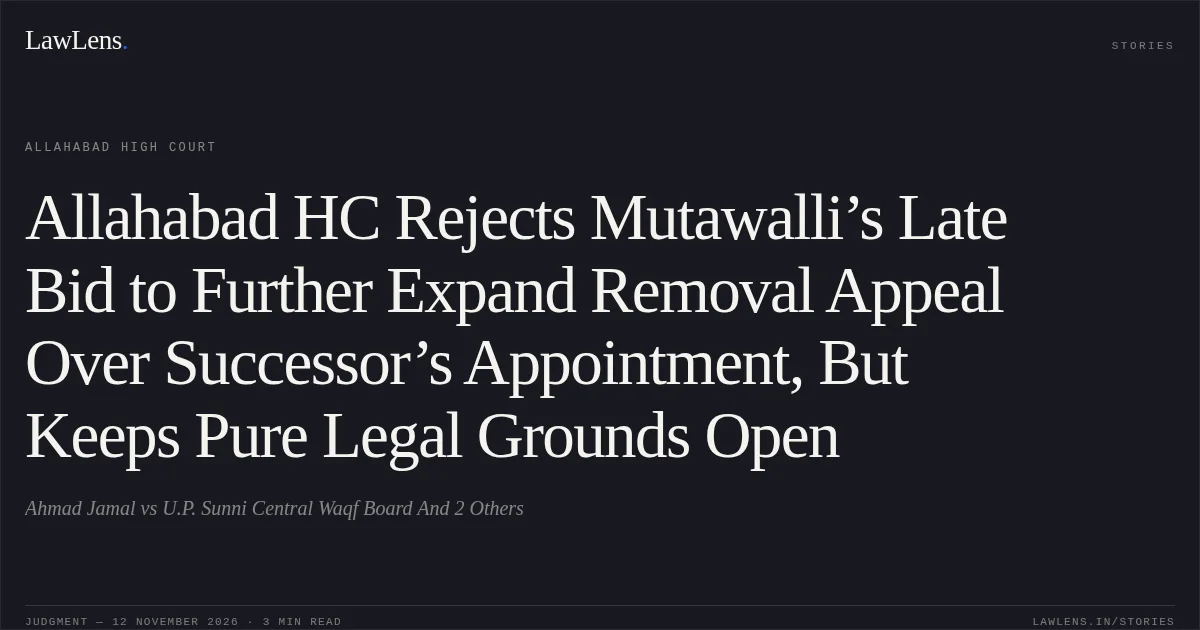
The appellant challenged the Waqf Board’s order removing him as Mutawalli.
¶ 9–18During the appeal, respondent No. 3 was appointed Mutawalli, and the appellant obtained permission in 2022 to amend his memorandum to raise matters concerning that appointment and the appointee’s eligibility.
¶ 9–18After the Tribunal dismissed the appeal and the High Court remanded it for fresh adjudication, the appellant sought a further amendment in 2026, including additional grounds about notice, the Chairman’s authority to make the appointment, and consequential relief.
¶ 9–18The Tribunal rejected the application, finding the existing pleadings sufficient and the further amendments unnecessary; the appellant appealed that rejection under Section 83(9) of the Act.
¶ 9–1802Issues
i.1. Whether an appellate forum, including a Waqf Tribunal, may permit amendment of a memorandum of appeal and what principles govern that discretion
¶ 21.1ii.2. Whether, after a remand directing fresh adjudication within a specified period, an appellant may seek to add factual grounds that were already known before the remand, and what considerations govern that request
¶ 21.2iii.3. Whether the Tribunal was justified in rejecting the appellant’s further amendment application, Paper No. ka-104
¶ 21.303Law Applied
Order VI Rule 17 CPC permits amendment where necessary to determine the real questions in controversy; Section 107(2) CPC gives appellate courts, subject to statutory conditions and limitations, procedural powers corresponding to those of courts of original jurisdiction, while Order XLI Rule 2 governs the grounds on which an appellant may be heard and the consideration of additional grounds.
¶ 25–28, 45–47The court applied the principles in Revajeetu Builders & Developers v. Narayanaswamy & Sons and Life Insurance Corporation of India v. Sanjeev Builders Private Limited: necessity, bona fides, effect on the nature of the case, prejudice, and whether the existing record permits adjudication are relevant considerations.
¶ 29It also relied on State of Maharashtra v. Hindustan Construction Company Ltd. on amendment of a memorandum of appeal, and Smt. Munni Devi v. Smt. Shashikala Pandey on the relevance of due diligence without mechanically applying Order VI Rule 17’s proviso to appellate or revisional proceedings.
¶ 30–31Under Asif Ansari v. Himanshu Sharma, refusal to amend does not necessarily prevent a party from advancing a pure question of law arising from the existing pleadings and record.
¶ 32The remand’s terms control the scope of fresh proceedings; a time-bound direction is relevant but is not, by itself, an absolute bar to a necessary amendment.
¶ 50–53Provisions in the judgment · 8 · Linked ones open on LawLens
Technology Development Board Act, 1995 Section 83Section 64Section 14Section 22Section 32Section 54Section 63
Code of Civil Procedure, 1908 Section 107
04Reasoning
The Court found that the earlier amendment had already placed respondent No. 3’s appointment and the appellant’s objections concerning lineage and eligibility before the Tribunal.
¶ 58–60The appellant therefore had to explain why the additional factual grounds, known at that time, had not been included and demonstrate why they were necessary to decide the appeal within the remand’s scope.
¶ 58–60The proposed particulars about notices were not shown to be necessary given the existing natural-justice and non-service grounds; the relevance of the later Section 54 notice was not established; and an independent challenge to the subsequent appointment could not be added merely because it concerned the same office.
¶ 61–64The Tribunal’s decision to accept further objections from respondent No. 3 did not give the appellant an automatic right to amend, although he had to receive a fair opportunity to meet any relevant new plea.
¶ 65–66The Court concluded that the existing pleadings were adequate and that the proposed additions were not shown to be indispensable or their refusal prejudicial.
¶ 68It clarified that pure legal submissions arising from the existing record could still be advanced, and that the Tribunal could consider framing or reformulating issues where the existing pleadings disclose the factual foundation.
¶ 69–7305Holding
The appeal was dismissed, and the Tribunal’s order rejecting Paper No. ka-104 was left undisturbed.
¶ 71–72The appellant may advance legal submissions, including pure questions of law, arising from the existing pleadings and record, subject to the remand’s scope; the Tribunal may consider appropriate issues on the existing pleadings, but no fresh factual case may be introduced.
¶ 72–73The Tribunal was directed to endeavour to conclude the remanded appeal, preferably within three months of production of a certified copy of the judgment; no opinion was expressed on the merits of the removal or subsequent appointment.
¶ 74Original Court PDF
Ahmad JamalvsU.P. Sunni Central Waqf Board And 2 Others
Click to open original judgment
Original judgment, available to read, download and summarize on LawLens.in