01Facts
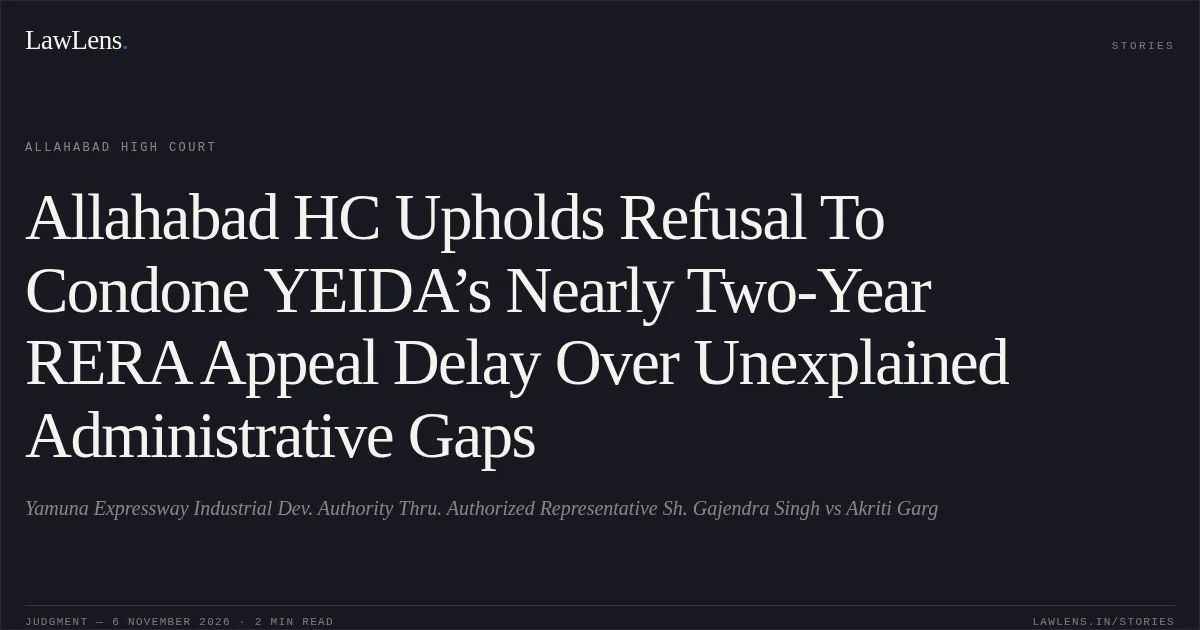
The appellant-authority challenged the U.P. Real Estate Appellate Tribunal’s order dated 27 May 2026, which rejected its application to condone delay and consequently dismissed its appeal against a U.P. Real Estate Regulatory Authority order dated 2 November 2022.
¶ 2The Regulatory Authority’s order was uploaded on 23 November 2022; limitation expired on 23 January 2023, but the authority filed its appeal on 7 January 2025.
¶ 7The authority attributed the delay to internal file movement, administrative approvals and procedural difficulties, and submitted that the delay was neither deliberate nor intentional.
¶ 3, 8–12The Tribunal found the explanation casual and inadequate.
¶ 1302Issues
i.Whether the appellant furnished a satisfactory and bona fide explanation establishing sufficient cause for the substantial delay in filing its appeal before the Appellate Tribunal.
¶ 6–12ii.Whether the Tribunal’s refusal to condone the delay raised a substantial question of law warranting interference under Section 58 of the Real Estate (Regulation and Development) Act, 2016.
¶ 20, 22–2303Law Applied
Section 58 of the Real Estate (Regulation and Development) Act, 2016 provides for an appeal to the High Court on one or more grounds specified in Section 100 of the Code of Civil Procedure, 1908; the High Court’s jurisdiction is therefore confined to examining whether a substantial question of law arises.
¶ 22Condonation of delay calls for a liberal, pragmatic and justice-oriented approach, but the applicant must still establish “sufficient cause” through a bona fide and adequately supported explanation, assessed in light of its conduct and diligence.
¶ 14, 16In Shivamma (Dead) by LRs. v. Karnataka Housing Board, 2025 SCC OnLine SC 1969, the Supreme Court held that administrative lethargy or laxity does not constitute sufficient cause and that State agencies must demonstrate bona fides and vigilance.
¶ 15–16Esha Bhattacharjee v. Managing Committee of Raghunathpur Nafar Academy, (2013) 12 SCC 649, and N. Balakrishnan v. M. Krishnamurthy, (1998) 7 SCC 123, support a liberal approach in appropriate cases but do not permit condonation without an adequate explanation.
¶ 19Provisions in the judgment · 2 · Linked ones open on LawLens
Real Estate (Regulation and Development) Act, 2016. Section 58
Code of Civil Procedure, 1908 Section 100
04Reasoning
The appellant’s explanation relied primarily on file circulation, internal approvals and procedural formalities, but omitted specific dates and failed to account for substantial periods of inactivity—including the period between January and October 2024.
¶ 8–12, 17These deficiencies showed administrative inaction rather than a genuine impediment, and the authority’s status as a statutory body did not itself establish sufficient cause.
¶ 17The respondent’s failure to object and the asserted merits or financial consequences of the underlying dispute could not replace the applicant’s burden to explain the delay.
¶ 18Nor did alleged inconsistencies in other Tribunal decisions establish a basis for interference without proof that those cases were factually and legally identical.
¶ 21The Tribunal had considered the explanation, and no error of law or substantial question of law was shown.
¶ 20, 22–2305Holding
The Court held that the appellant failed to establish sufficient cause for the delay and that the Tribunal rightly rejected the condonation application.
¶ 23Finding no illegality, perversity or substantial question of law, the Court dismissed the appeal at the admission stage.
¶ 22–24Original Court PDF
Yamuna Expressway Industrial Dev. Authority Thru. Authorized Representative Sh. Gajendra SinghvsAkriti Garg
Click to open original judgment
Original judgment, available to read, download and summarize on LawLens.in