Facts
An FL-II foreign-liquor licence was granted to Balkrishna Ramchandra Wadkar in 1973.
Source reference: paras. 4–8In 1979, Wadkar inducted Suryakant Khaladkar and his father as partners, with Wadkar retaining 10% and the Khaladkars holding 90%.
Source reference: paras. 4–8Their names were entered on the licence under Rule 40 of the Bombay Foreign Liquor Rules, 1953, and the licensed premises were shifted to the Khaladkars’ premises.
Source reference: paras. 4–8After Wadkar’s death in 1985, Khaladkar and Wadkar’s widow, Shobha, independently applied for the licence.
Source reference: paras. 10–14In WP No. 5375 of 1988, the High Court quashed that decision in 2002, holding that the partnership and the licence had come to an end upon Wadkar’s death and directing that both parties’ applications be considered as applications for a fresh licence under Rule 25, according to the policy prevailing in 1986.
Source reference: paras. 15–18In WP No. 71 of 2005, the High Court’s 2016 judgment again quashed the State authorities’ orders and reiterated that the applications had to be considered under Rule 25 and not as applications for transfer under Rule 61-A or Condition 8 of the licence.
Source reference: paras. 19–23The Collector nevertheless again confirmed the transfer in favour of Shobha in 2017.
Source reference: paras. 24–25The Commissioner set that order aside in 2022 and directed that Khaladkar and Shobha’s legal heirs could claim the licence in the 90:10 ratio.
Source reference: paras. 24–25On revision, the Minister reinstated the Collector’s order in 2023.
Source reference: paras. 24–25Khaladkar challenged that decision in the present writ petition.
Source reference: paras. 24–25Issues
Whether the State could treat the FL-II licence as transferable, re-grantable or revalidated in favour of Wadkar’s legal heirs despite the unchallenged 2002 and 2016 judgments holding that the licence had expired upon dissolution of the partnership?
Source reference: paras. 60–71, 88–94Whether the Khaladkars’ interest, recognised under Rule 40 in 1979, could be disregarded on the basis of later policies and restrictions introduced in the 1980s, including the 1989 Circular and Condition 4A?
Source reference: paras. 45–59, 74–83Whether the State authorities complied with the directions requiring consideration of the competing applications under Rule 25 of the Foreign Liquor Rules, in accordance with the policy applicable in January and February 1986?
Source reference: paras. 64–72, 83–87What relief should be granted in light of the State’s repeated failure to comply with the earlier judgments and its stated policy against issuing fresh FL-II licences?
Source reference: paras. 117–123Law Applied
The Court applied Rule 40 of the Bombay Foreign Liquor Rules, 1953, under which a partner inducted after grant of a licence may be recognised when the Collector agrees to alter the licence and enter the partner’s name.
Source reference: paras. 27–30, 45–48Rule 40(1A) requires prior Collector approval for withdrawal of a recognised partner and deletion of that partner’s name from the licence.
Source reference: paras. 29–30, 57–59Rule 61-A requires previous State Government sanction for transfer of a licence from one person to another, while Rule 25 governs the grant of a fresh vendor’s licence and requires consideration of the statutory requirements and applicable Government policy.
Source reference: paras. 31–34Condition 8 of the licence confers no vested right of renewal or continuation on the licensee’s heirs, legal representatives or assignees after expiry of the licence.
Source reference: paras. 36–37The Court treated the unchallenged 2002 judgment and 2016 judgment as binding judicial determinations that the partnership and licence had ended upon Wadkar’s death, leaving only consideration of fresh applications under Rule 25.
Source reference: paras. 60–67Later restrictions embodied in the 1987 communications, the 1989 Circular and Condition 4A could not retrospectively extinguish the interest recognised in 1979.
Source reference: paras. 76–83, 120(F)The Court also relied on Karunakar Mudann Shetty v. State of Maharashtra, which rejected the proposition that an inducted partner’s recognised interest automatically disappears upon the original licensee’s death.
Source reference: paras. 110–113Reasoning
The Court found that the Khaladkars’ induction was validly recognised under Rule 40 because their names and photographs appeared on the licence, the partnership was recorded in the licensing material, and the business premises had shifted to Khaladkar’s premises.
Source reference: paras. 45–49, 74However, the decisive consideration was not whether the licence should now be awarded to Khaladkar or Shobha’s heirs, but that the earlier judgments had conclusively held that the licence expired when the partnership dissolved upon Wadkar’s death.
Source reference: paras. 60–67, 83–84, 97–99Those judgments had not been appealed, reviewed or recalled and therefore bound the State and the present Court.
Source reference: paras. 60–67, 83–84, 97–99The State could not circumvent those decisions by describing the repeated transfer as a “re-grant”, “revalidation” or “re-issue”.
Source reference: paras. 88–94If the State’s policy since 1976 truly prohibited all fresh licences, the legally permissible course was to reject both applications equally; it was not permissible to apply that policy selectively by transferring the expired licence to Shobha’s heirs.
Source reference: paras. 64–71, 117–119Although the Khaladkars had a recognised historical interest, the Court held that it could not itself direct issuance of a new licence in the 90:10 ratio because doing so would also depart from the earlier judgments’ direction that the matter be considered under Rule 25.
Source reference: para. 120(G)Holding
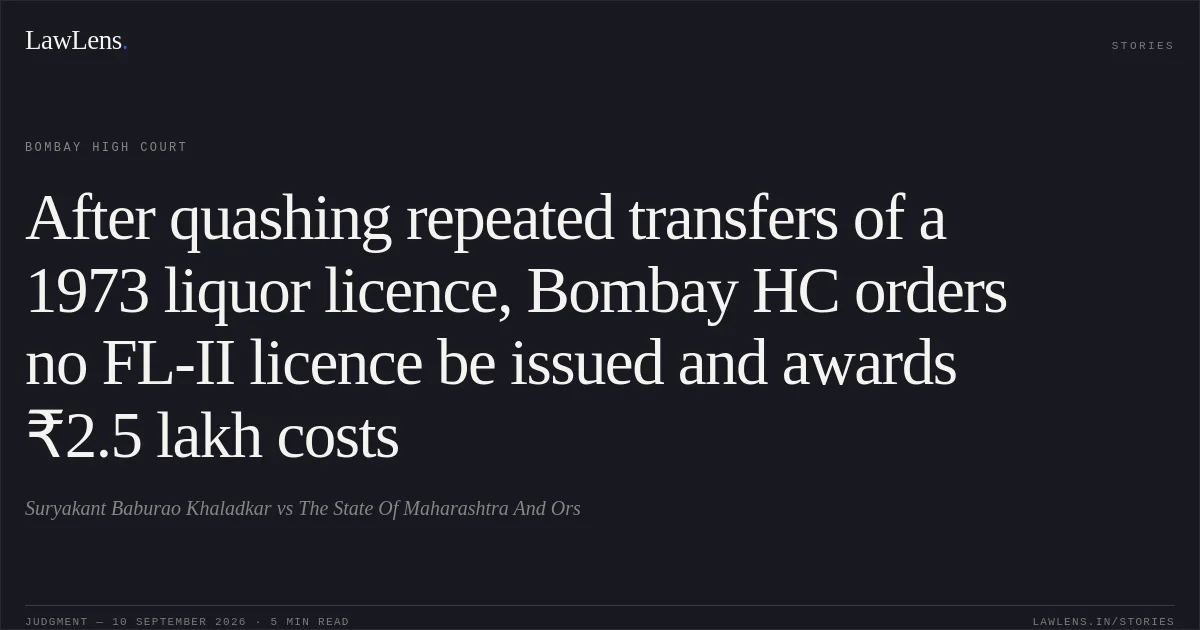
The Court quashed and set aside the Minister’s impugned order dated 26 October 2023 and rejected the repeated transfer of the expired FL-II licence to Shobha’s legal heirs.
It held that the State was required to proceed only under Rule 25, and that the later policy restrictions could not retrospectively nullify the Khaladkars’ recognised partnership interest.
Source reference: para. 120(A)–(F)Since the State maintained that no fresh FL-II licence could be issued, and because the Court could not itself direct a fresh licence in favour of either party or jointly in the 90:10 ratio, it directed that no FL-II licence be issued pursuant to the competing applications.
Source reference: para. 120(H)The State was left free to reconsider or mould its policy in the future, including by issuing a licence to both sides in the 10:90 ratio, if it chose to do so.
Source reference: para. 120(H)The State was also directed to pay Khaladkar costs of Rs. 2,50,000 within four weeks, and no stay was granted against the judgment.
Source reference: paras. 121–123Acts & Sections Cited
1 provisions across 1 statute referred to in this judgment. Each provision opens on LawLens.
Indian Partnership Act, 19321
Original Court PDF
Suryakant Baburao KhaladkarvsThe State Of Maharashtra And Ors
Click to open original judgment
Original judgment, available to read, download and summarize on LawLens.in