Facts
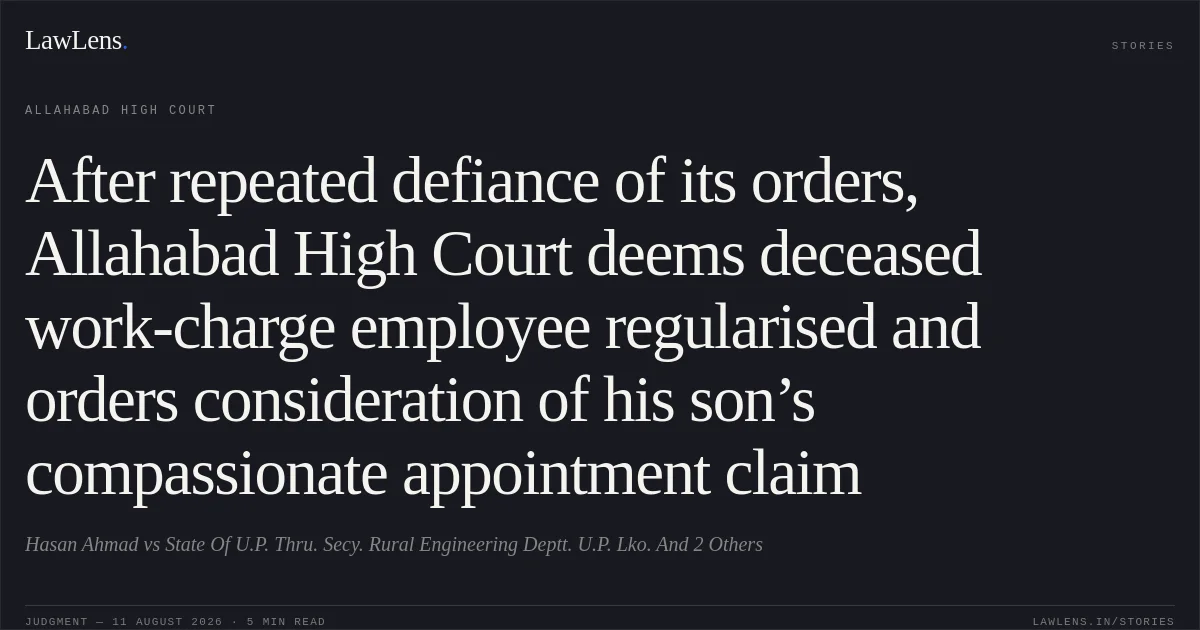
The petitioner’s father, Rifakat Hussain, was engaged as a Junior Assistant in the Work Charge Establishment of the Rural Engineering Department on 01 November 1985 and served for over 18 years until his death on 11 August 2012.
Source reference: paras. 4, 7His name appeared at serial no. 58 in the seniority list prepared for regularisation under the Uttar Pradesh Regularization of Daily Wages Appointment on Group-C Posts Rules, 1998.
Source reference: para. 5After the State sanctioned 172 Group-C posts by Government Order dated 21 June 2012, a Selection Committee initiated the regularisation process; records were called for on 14 August 2012, but the petitioner’s father died before the scheduled selection process could be completed.
Source reference: paras. 6–7The authority rejected the claim on 08 October 2018 solely on the grounds that the employee had died before completion of the regularisation process and that the 1974 Rules did not apply to Work Charge employees.
Source reference: paras. 10–12That order was set aside in Writ-A No. 3792 of 2019 on 27 January 2023, with a specific direction to reconsider the deceased employee’s regularisation if persons junior to him had been regularised, and thereafter consider the compassionate-appointment claim.
Source reference: para. 13Nevertheless, the authority passed the impugned order dated 17 March 2023, repeating substantially the same reasoning.
Source reference: para. 14Issues
Whether the right of a deceased Work Charge/daily-wage employee to be considered for regularisation survives his death and may be pursued by his legal heirs?
Source reference: paras. 8, 16, 30–36Whether the authority acted unlawfully by repeating grounds that had already been rejected by the High Court and by failing to comply with the specific directions issued in the earlier writ proceedings?
Source reference: paras. 15, 18, 24–28Whether, upon notional regularisation of the deceased employee, the petitioner’s claim for compassionate appointment could be considered under the 1974 Rules despite the general exclusion of daily-wage and Work Charge employees?
Source reference: paras. 23, 29–32, 45–48Whether the delay in seeking compassionate appointment could be relaxed by the State Government under the provisos to Rule 5(iii) read with Rule 10 of the 1974 Rules?
Source reference: paras. 45–48Law Applied
The Court applied the Uttar Pradesh Regularization of Daily Wages Appointment on Group-C Posts Rules, 1998, and the statutory regularisation principles reflected in Rule 4 of the Uttar Pradesh Regularisation of Daily Wages Appointments on Group ‘D’ Posts Rules, 2001, under which eligible employees are to be considered on the basis of seniority, service record and suitability.
Source reference: paras. 33, 39Relying on Secretary, State of Karnataka v. Umadevi (3), (2006) 4 SCC 115, the Court recognised the right of eligible long-serving daily-wage employees to consideration for regularisation under a lawful scheme.
Source reference: paras. 33, 39Under the general rule in Pawan Kumar Yadav v. State of U.P., daily-wage and Work Charge employees who do not hold a regular, substantive or temporary public post are not “Government servants” for purposes of the 1974 Rules and are ordinarily ineligible for compassionate appointment.
Source reference: paras. 23, 29However, the exception in State of U.P. v. Kuldeep Thakur, 2017 (4) ADJ 94 (DB), establishes that where the deceased employee’s claim for regularisation had crystallised or was actively under consideration, death does not extinguish that claim; the authority must first decide regularisation and then consider the dependent’s compassionate-appointment claim.
Source reference: paras. 30–32The Court also applied the doctrine of malice in law, as explained in Ratnagiri Gas and Power Pvt. Ltd. v. RDS Projects, (2013) 12 SCC 786, and West Bengal State Electricity Board v. Dilip Kumar Ray, (2007) 14 SCC 568, to administrative action taken without lawful justification or in disregard of binding legal obligations.
Source reference: paras. 25–28Rule 5(iii) of the 1974 Rules permits relaxation of the five-year limitation for compassionate appointment in cases of undue hardship, while Rule 10 empowers the State Government to remove difficulties.
Source reference: paras. 45–47Reasoning
The Court held that the deceased employee’s claim had matured well before his death: he had long service, figured in the regularisation seniority list, and was included in an active process following sanction of posts and constitution of the Selection Committee.
Source reference: paras. 5–7, 33, 36His death before formal completion of the process was a fortuitous circumstance and could not benefit the State or extinguish the accrued right to consideration.
Source reference: paras. 33, 36The authority’s repeated reliance on the employee’s death and on the general exclusion of Work Charge employees ignored the earlier binding direction to determine regularisation first and also disregarded the exception recognised in Kuldeep Thakur.
Source reference: paras. 15–18, 30–36The impugned order was therefore found to be in the teeth of the earlier judgment, prima facie contemptuous, and indicative of malice in law.
Source reference: paras. 18, 24–28Although Pawan Kumar Yadav ordinarily bars compassionate appointment to dependants of daily-wage or Work Charge employees, that bar would not apply if the deceased employee were found entitled to regularisation.
Source reference: paras. 38–44Since the respondents had repeatedly failed to undertake the legally mandated exercise and had not disclosed any valid impediment apart from the employee’s death, the Court declined to remand the matter again and directed that the deceased employee be treated as regularised from the date on which he became eligible.
Source reference: paras. 38–44The petitioner’s delayed claim was directed to be considered by the competent authority, with power to refer it to the State Government for relaxation under Rule 5(iii) and Rule 10.
Source reference: paras. 45–48Holding
The writ petition was allowed.
The Court held that the petitioner’s father’s right to consideration for regularisation survived his death and directed that he be treated as notionally regularised from the date of eligibility, with consequential monetary and other benefits payable to his legal heirs.
Source reference: paras. 43–44The second respondent was directed to consider the petitioner’s claim for compassionate appointment under the 1974 Rules; if the delay or any other aspect lay beyond the respondent’s authority, the matter was to be forwarded to the State Government for consideration under the provisos to Rule 5(iii) read with Rule 10.
Source reference: para. 48The entire exercise was ordered to be completed within two months of production of the certified copy of the judgment.
Source reference: no citationCosts of ₹50,000 were awarded to the petitioner, and the judgment was directed to be communicated to the concerned departmental authorities through the Registrar (Compliance).
Source reference: paras. 49–51Original Court PDF
Hasan AhmadvsState Of U.P. Thru. Secy. Rural Engineering Deptt. U.P. Lko. And 2 Others
Click to open original judgment
Original judgment, available to read, download and summarize on LawLens.in