01Facts
The petitioners challenged eviction notices dated 23 April 2026, issued under Section 250 of the Chhattisgarh Land Revenue Code, 1959, requiring them to remove encroachments from Khasra No. 55/1.
¶ 2They claimed that they had been allotted residential pattas over Government land in Khasra No. 74/1 and disputed that they occupied Khasra No. 55/1.
¶ 4–5Revenue authorities had earlier ordered their eviction from Khasra No. 55/1; the Board of Revenue affirmed those orders in 2018.
¶ 4, 8In a prior writ proceeding, the High Court held that the Board’s decision disclosed no perversity, illegality, or jurisdictional error, recorded that the petitioners did not press a claim to Khasra No. 55/1, rejected that claim, and separately directed demarcation of their patta land in Khasra No. 74/1.
¶ 6, 10–11The petitioners then challenged the 2026 notices, contending, among other things, that the required demarcation had not been conducted.
¶ 4–502Issues
i.Whether the petitioners could challenge the eviction notices concerning Khasra No. 55/1 after the High Court had rejected their claim to that land in the earlier writ proceedings.
¶ 10–13ii.Whether the direction in the earlier order to demarcate the petitioners’ patta land in Khasra No. 74/1 invalidated the notices concerning Khasra No. 55/1.
¶ 10–1103Law Applied
Section 250 of the Chhattisgarh Land Revenue Code, 1959, provides for removal of encroachment through revenue proceedings.
¶ 2, 10The doctrine of res judicata, grounded in public policy and the finality of litigation, prevents parties from re-litigating issues already decided; the doctrine may apply beyond the strict terms of Section 11 of the Code of Civil Procedure and to proceedings before administrative or quasi-judicial authorities (SEBI v. Ram Kishori Gupta, 2025 SCC OnLine SC 748, para 28; B.S. Lalitha v. Bhuvanesh, 2026 SCC OnLine SC 860, paras 35, 39, 42, quoted at paras. 14–15).
¶ 14–15The Court also cited Ahmedabad Municipal Corporation v. Nawab Khan Gulab Khan, (1997) 11 SCC 121, for the propositions that public property should be protected from encroachment and that courts must assess an encroacher’s rights and the appropriate procedure rather than deny judicial review solely because the claimant is an encroacher.
¶ 18Provisions in the judgment · 2 · Linked ones open on LawLens
Code of Civil Procedure, 1908 Section 11
Hindu Succession Act, 1956 Section 6
04Reasoning
The Court treated the earlier order as conclusive on the petitioners’ claim to Khasra No. 55/1: it had upheld the Board of Revenue’s decision and rejected the claim after the petitioners stated they did not wish to pursue it.
¶ 10–13The separate direction to demarcate Khasra No. 74/1 concerned only the patta land and did not reopen or qualify the determination concerning Khasra No. 55/1.
¶ 11Applying res judicata, the Court held that the petitioners could not use a fresh writ petition to re-agitate their claim to Khasra No. 55/1; the notices implementing the concluded eviction proceedings were therefore not shown to be unlawful.
¶ 12–16, 19–2005Holding
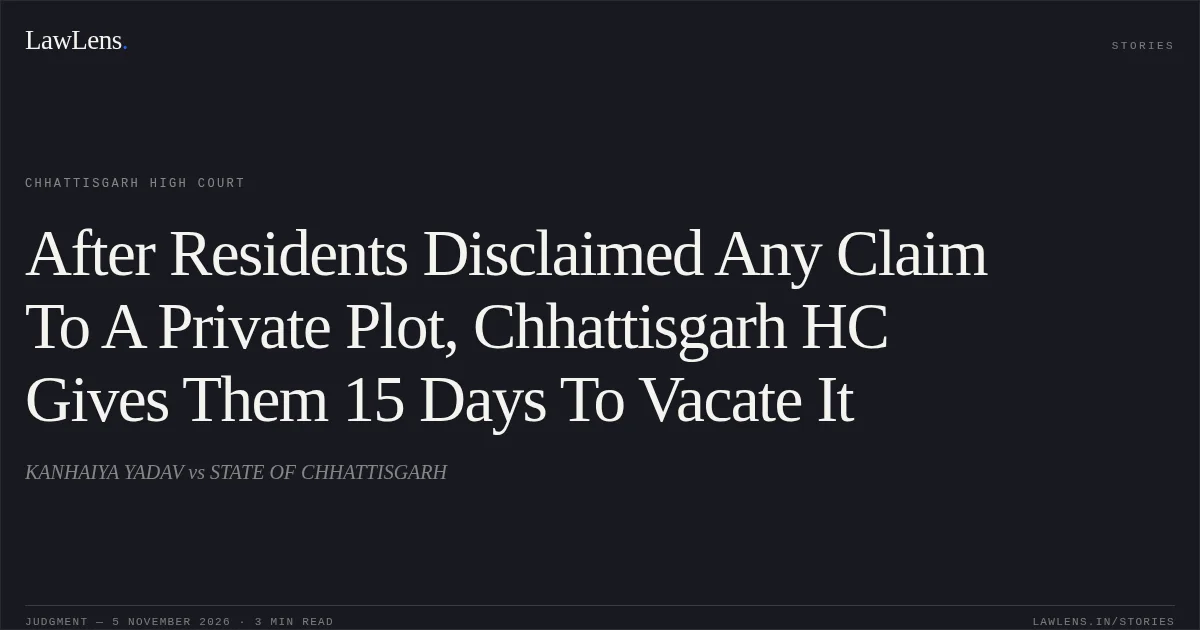
The Court dismissed both writ petitions, holding that the petitioners could not re-litigate their rejected claim to Khasra No. 55/1 and that the eviction notices were properly issued.
¶ 19–22It granted the petitioners 15 days from the order to remove the encroachments and directed the authorities, after that period, to execute the eviction in accordance with law.
¶ 21, 23No order as to costs was made.
¶ 22Original Court PDF
KANHAIYA YADAVvsSTATE OF CHHATTISGARH
Click to open original judgment
Original judgment, available to read, download and summarize on LawLens.in