01Facts
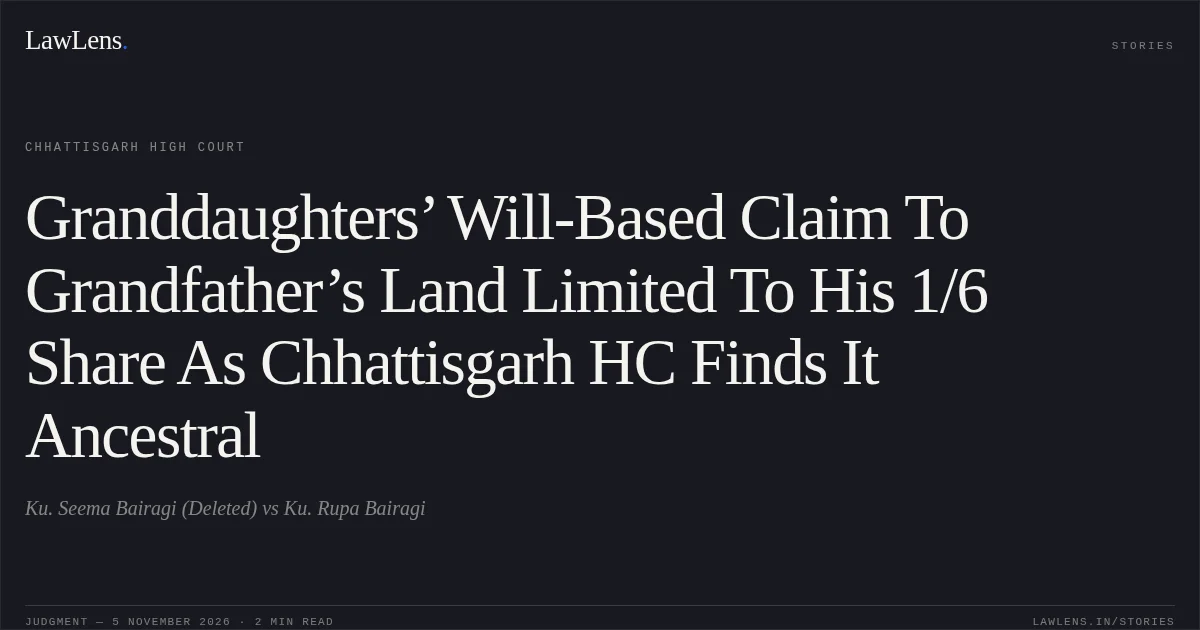
Kenaram Bairagi’s registered Will dated 25 January 2003 purported to bequeath his properties to his son, Sanjay. After Kenaram’s death, his daughters and Sanjay disputed succession to agricultural land at Village Nawagaon.
pp. 4–8Sanjay died in 2011, and his five minor daughters sued for declaration of title and permanent injunction, claiming through him under the Will.
pp. 4–8The trial court held the land to be Kenaram’s self-acquired property and decreed the suit. Kenaram’s daughters appealed, contending, among other things, that the land was acquired from ancestral-property proceeds and was not wholly available for bequest.
pp. 10–1102Issues
i.1. Whether the plaintiffs acquired title to the suit property through Sanjay under Kenaram’s registered Will, and whether the trial court was justified in granting declaration and injunction.
p. 9ii.2. Whether the trial court’s judgment and decree warranted interference on appeal.
p. 903Law Applied
Section 63 of the Indian Succession Act, 1925 requires due execution and attestation of an unprivileged Will; under Section 68 of the Indian Evidence Act, 1872, at least one available and competent attesting witness must be called to prove a Will.
pp. 12–13Registration alone does not prove due execution, though it may support genuineness.
p. 14The person alleging forgery or fraud bears the burden of proving that allegation (Daulat Ram v. Sodha, (2005) 1 SCC 40).
p. 16A Will must be construed as a whole, with the testator’s intention paramount (Gnambal Ammal v. T. Raju Ayyar, AIR 1951 SC 103; Sadaram Suryanarayana v. Kalla Surya Kantham, (2010) 13 SCC 147).
p. 17Section 6 of the Hindu Succession Act, 1956, as amended in 2005, gives daughters coparcenary rights equal to sons; a coparcener may bequeath only the share available to that coparcener.
pp. 20–21Provisions in the judgment · 3 · Linked ones open on LawLens
Code of Civil Procedure, 1908 Section 96
Indian Succession Act, 1925 Section 63
Hindu Succession Act, 1956 Section 6
04Reasoning
The Court upheld proof of the Will because an attesting witness testified to its execution and a daughter of the testator admitted that he had the Will prepared; the forgery allegation was unsupported. Reading the Will as a whole, the Court found that its general bequest covered the suit property despite the absence of an individual description.
pp. 13–17However, the plaintiffs’ own evidence and Sanjay’s statement in the revenue proceedings supported the conclusion that the land was acquired from proceeds traceable to ancestral property; the plaintiffs had not established that it was Kenaram’s self-acquired property.
pp. 18–20Applying amended Section 6, the Court treated Kenaram, Sanjay and Kenaram’s four daughters as each having a one-sixth share on notional partition. It therefore held that the Will could transfer only Kenaram’s one-sixth share.
pp. 20–21The judgment’s reasoning also states that Sanjay’s own share plus the bequest gave him a one-third share, but its final order limits the declaration based on the Will to Kenaram’s one-sixth share.
pp. 21–2205Holding
The appeal was partly allowed. The trial court’s decree was modified so that the plaintiffs’ declaration of title under Kenaram’s Will was confined to the one-sixth share Kenaram could bequeath.
p. 22The parties were ordered to bear their own costs.
p. 22Original Court PDF
Ku. Seema Bairagi (Deleted)vsKu. Rupa Bairagi
Click to open original judgment
Original judgment, available to read, download and summarize on LawLens.in