Facts
The parties had filed a joint petition for divorce by mutual consent under Section 13-B of the Hindu Marriage Act.
Source reference: para. 2–2.2Ravikant sought permission to give his statement through video conferencing because he was required to travel to Kenya for professional work.
Source reference: para. 2–2.2The Family Court rejected the request, relying on Santhini v. Vijaya Venkatesh, (2018) 1 SCC 1.
Source reference: para. 2–2.2Both parties then approached the High Court challenging that rejection; the High Court noted that it was unclear whether both had consented to video conferencing.
Source reference: para. 5, 8Issues
1. Whether the Family Court’s rejection of Ravikant’s request for video-conference testimony, based on Santhini, required reconsideration where both parties had approached the High Court challenging that order.
Source reference: para. 3, 7–82. Whether permission for video-conference testimony could be considered on a fresh application supported by the consent of both parties.
Source reference: para. 7–9Law Applied
Section 11 of the Hindu Marriage Act contemplates that matrimonial proceedings may be heard in camera.
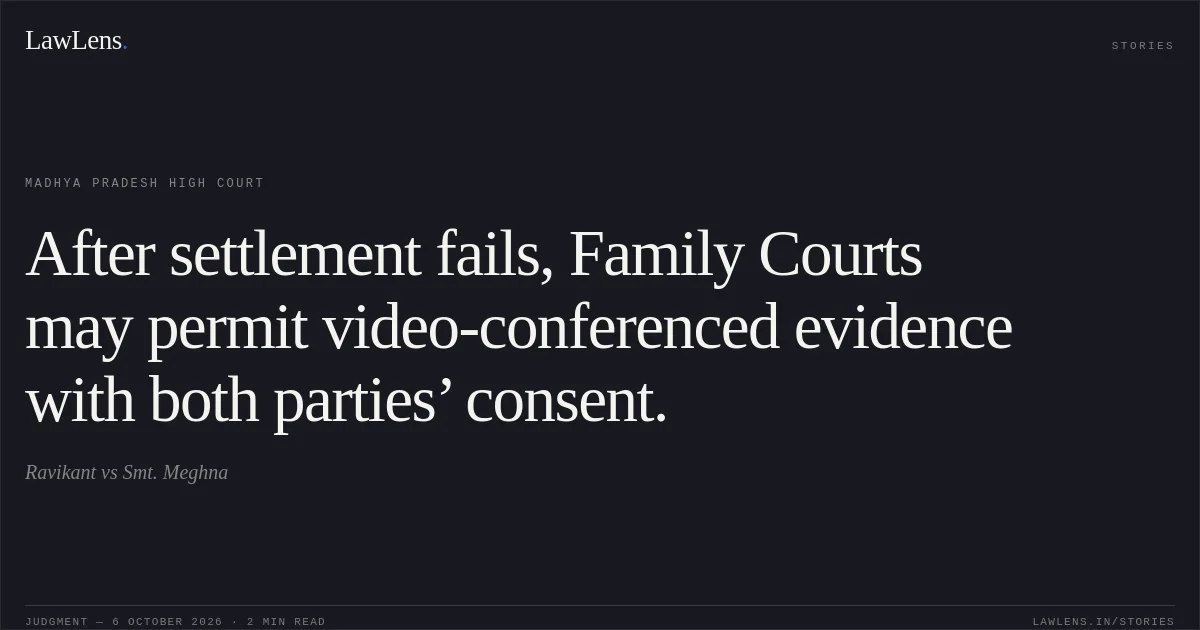
Source reference: para. 6In Santhini v. Vijaya Venkatesh, the Supreme Court held that, after settlement fails, a Family Court may exercise discretion to permit video-conference hearings where both parties jointly apply or submit consent memoranda; it may also direct video conferencing where, in the circumstances, doing so would serve the cause of justice.
Source reference: para. 6, quoting Santhini, para. 58.1–58.3Consent does not itself compel permission; the Family Court retains discretion.
Source reference: para. 6Reasoning
The High Court considered the Family Court’s reliance on Santhini and clarified that the decision permits video conferencing when both parties consent, subject to the Family Court’s discretion.
Source reference: para. 7–9Although both parties had joined in challenging the rejection, the record did not establish their consent to recording Ravikant’s statement by video conference.
Source reference: para. 7–9The High Court therefore did not grant permission directly, but held that the request warranted fresh consideration upon a properly supported application.
Source reference: para. 7–9Holding
The petition was disposed of with liberty to file a fresh application accompanied by both parties’ consent, if they wished to proceed by video conference.
The Family Court was directed to reconsider that application in light of Santhini, particularly paragraphs 58.2 and 58.3.
Source reference: para. 9No permission for video-conference testimony was granted by the High Court itself.
Source reference: para. 9Acts & Sections Cited
2 provisions across 2 statutes referred to in this judgment. Each provision opens on LawLens.
Hindu Marriage Act, 19551
Family Courts Act, 19841
Original Court PDF
RavikantvsSmt. Meghna
Click to open original judgment
Original judgment, available to read, download and summarize on LawLens.in