01Facts
The petitioners, accused Nos. 1, 2, 4 and 5, sought to quash proceedings arising from a complaint by accused No. 1’s wife.
pp. 3–4The prosecution alleged that, following the marriage, the accused subjected her to physical and mental harassment in connection with a dowry demand and, on 18 February 2018, abused and threatened her.
pp. 3–4A charge-sheet was filed for offences under Sections 498A, 323, 504 and 506 read with Section 149 of the IPC, and Sections 3 and 4 of the Dowry Prohibition Act.
pp. 3–4The petitioners relied on a mediation settlement under which the complainant agreed to cooperate in bringing the criminal proceedings to an end; the agreement also recorded payment of ₹5,00,000 as alimony and settlement of related disputes.
pp. 5–9The petition was brought under Section 482 CrPC.
p. 302Issues
i.1. Whether the criminal proceedings against the petitioners should be quashed under Section 482 CrPC in light of the parties’ settlement.
pp. 4–5, 10ii.2. Whether continuation of the proceedings after settlement would amount to an abuse of the process of law.
p. 1003Law Applied
Section 482 of the Code of Criminal Procedure, 1973 preserves the High Court’s inherent jurisdiction to make orders necessary to prevent abuse of the process of a court or otherwise secure the ends of justice.
p. 3The proceedings concerned alleged offences under Sections 498A, 323, 504 and 506 read with Section 149 of the IPC, and Sections 3 and 4 of the Dowry Prohibition Act.
pp. 3–4The Court applied the view that, where the parties have settled their dispute and the prospect of conviction is remote and bleak, continuing the criminal proceedings may serve no useful purpose and amount to an abuse of process.
p. 10No judicial precedent was cited in the order.
Provisions in the judgment · 10 · Linked ones open on LawLens
Code of Criminal Procedure, 1973 Section 482Section 125
Indian Penal Code, 1860 Section 323Section 504Section 506Section 149
Dowry Prohibition Act, 1961 Section 3Section 4
Code of Civil Procedure, 1908 Section 89
Hindu Marriage Act, 1955 Section 13
04Reasoning
The Court considered the mediation agreement and found that the complainant had agreed to cooperate in concluding the criminal case, alongside settlement of the parties’ marital and financial disputes.
pp. 5–9In light of that settlement, it assessed the possibility of conviction as remote and bleak and concluded that continuing the prosecution would serve no useful purpose and would amount to an abuse of process.
p. 1005Holding
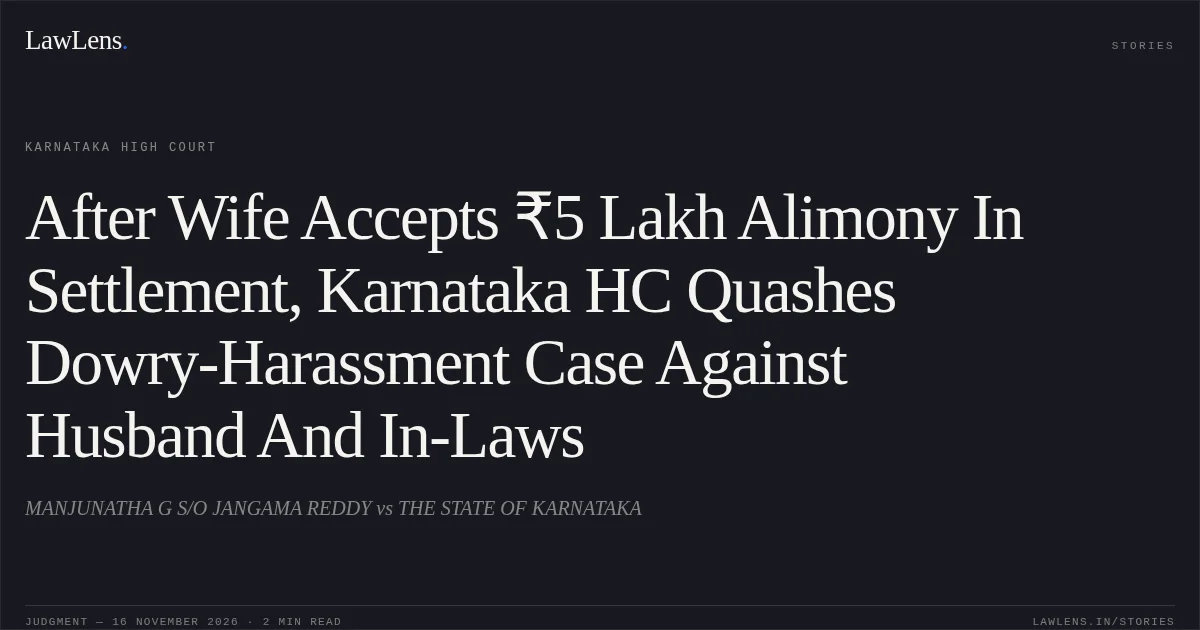
The Court allowed the petition and quashed the entire proceedings in Criminal Case No. 1936 of 2018, arising from Crime No. 79 of 2018, against the petitioners for the stated IPC and Dowry Prohibition Act offences.
pp. 10–11Pending interlocutory applications, if any, were dismissed.
p. 11Original Court PDF
MANJUNATHA G S/O JANGAMA REDDYvsTHE STATE OF KARNATAKA
Click to open original judgment
Original judgment, available to read, download and summarize on LawLens.in