Facts
The appellant was prosecuted for allegedly committing penetrative sexual assault upon “N”, a minor girl residing with her family on a footpath in Mumbai.
Source reference: paras. 2, 4An FIR was registered on 30 October 2014 under Section 376 of the IPC and Sections 4, 8 and 12 of the POCSO Act.
Source reference: paras. 2, 4The Special Court convicted the appellant under Section 6 of the POCSO Act and sentenced him to life imprisonment, with a fine of ₹1,000; no separate sentence was imposed under Section 376 IPC by virtue of Section 42 of the POCSO Act.
Source reference: paras. 1, 6The appellant was acquitted of the aggravated sexual assault charge under Section 10 read with Sections 9(l) and 9(m) of the POCSO Act.
Source reference: paras. 1, 6Issues
Whether the victim’s testimony was sufficiently reliable to sustain the conviction for penetrative sexual assault despite discrepancies regarding the circumstances and date of the incident?
Source reference: paras. 15–28, 38–45Whether the delay in registration of the FIR, absence of external injuries, negative forensic reports, and alleged investigative lapses created reasonable doubt regarding the prosecution case?
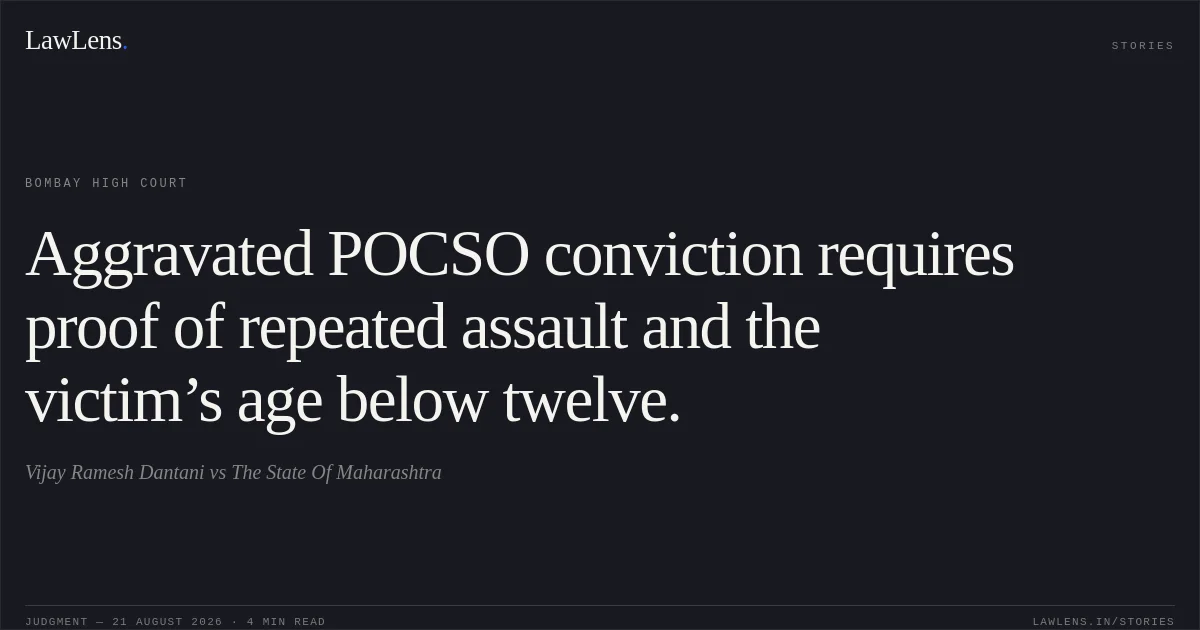
Source reference: paras. 24–31Whether the prosecution established that the penetrative sexual assault was committed “more than once or repeatedly” so as to attract Section 5(l) and the punishment under Section 6 of the POCSO Act?
Source reference: paras. 46–48Whether the prosecution proved beyond reasonable doubt that the victim was below twelve years of age so as to attract Section 5(m) of the POCSO Act?
Source reference: paras. 49–50What conviction and sentence should follow upon the failure to establish the aggravated circumstances under Sections 5(l) and 5(m) of the POCSO Act?
Source reference: paras. 51–55Law Applied
The Court applied Sections 3 and 4 of the POCSO Act concerning penetrative sexual assault and its punishment, and Sections 5(l), 5(m) and 6 concerning aggravated penetrative sexual assault and enhanced punishment.
Source reference: paras. 46, 52Section 42 of the POCSO Act was applied to avoid a separate sentence under Section 376 IPC, while Section 33(8) was applied to sustain the compensation awarded to the victim.
Source reference: paras. 1, 52, 55The Court reiterated that the sole testimony of a prosecutrix may sustain a conviction if it is reliable, inspires confidence and is not materially shaken in cross-examination; corroboration is a rule of prudence, not a mandatory requirement, as recognised in Vijay @ Chinee v. State of Madhya Pradesh , State of Himachal Pradesh v. Asha Ram and State of Punjab v. Gurmit Singh .
Source reference: paras. 15, 23, 43–44Minor discrepancies regarding peripheral details, particularly in the testimony of a child victim recounting a traumatic event, do not ordinarily discredit an otherwise credible account.
Source reference: paras. 18, 22Delay in reporting a sexual offence must be assessed in the social and factual context and is not, by itself, fatal to the prosecution.
Source reference: paras. 24–26Absence of semen or external injuries does not negate penetrative sexual assault where the ocular and other medical evidence support the prosecution case, as explained in Madan Gopal Kakkad v. Naval Dubey .
Source reference: paras. 28–29An ossification test provides only an approximate age and must be assessed with an appropriate margin of error; where the prosecution fails to establish the relevant age beyond reasonable doubt, the accused receives the benefit of doubt.
Source reference: paras. 49–50Reasoning
The Court found the victim’s evidence regarding the appellant’s identity and the act of penetrative sexual assault to be clear, consistent and substantially unshaken in cross-examination.
Source reference: paras. 16–17, 38The discrepancies concerning the presence of the victim’s parents, the material used to gag her, and the precise date of occurrence were treated as peripheral and natural variations that did not affect the core allegation.
Source reference: paras. 18–22, 25–26The victim’s prompt disclosure to P.W. 4, together with the medical evidence of a torn hymen and congestion consistent with forcible intercourse, provided additional assurance to her testimony.
Source reference: paras. 27–29, 42The Court held that the absence of external injuries and negative semen and blood reports did not displace the direct evidence of the victim.
Source reference: paras. 28–30Similarly, the failure to collect CCTV footage or examine further independent witnesses constituted investigative shortcomings but did not undermine an otherwise credible prosecution case.
Source reference: para. 31However, the Court distinguished proof of the assault from proof of the aggravated circumstances.
Source reference: paras. 46–48The victim expressly stated in cross-examination that the appellant had committed the act only once, and the remaining evidence did not establish repeated or multiple assaults; consequently, Section 5(l) was not proved.
Source reference: paras. 46–48Further, the medical assessment placed the victim’s age at approximately 11–12 years based on an ossification test, which was not conclusive and was subject to a margin of error.
Source reference: paras. 49–50The prosecution therefore failed to prove beyond reasonable doubt that she was below twelve years of age for purposes of Section 5(m).
Source reference: paras. 49–50Holding
The appeal was partly allowed.
The conviction under Section 376 IPC was maintained.
Source reference: para. 52The conviction and sentence under Section 5 read with Section 6 of the POCSO Act were set aside and modified to a conviction under Sections 3 and 4 of the POCSO Act, since repeated assault under Section 5(l) and the victim’s age being below twelve years under Section 5(m) were not proved beyond reasonable doubt.
Source reference: para. 52The sentence of life imprisonment was replaced with rigorous imprisonment for twelve years and a fine of ₹1,000, with one month’s simple imprisonment in default; no separate sentence was imposed under Section 376 IPC under Section 42 of the POCSO Act.
Source reference: para. 55; order clauses (ii)The direction to pay ₹25,000 compensation to the victim under Section 33(8) of the POCSO Act was maintained.
Source reference: order clause (iii)Acts & Sections Cited
17 provisions across 3 statutes referred to in this judgment. Each provision opens on LawLens.
Protection of Children from Sexual Offences Act, 2012
Indian Penal Code, 18604
Code of Criminal Procedure, 19733
Original Court PDF
Vijay Ramesh DantanivsThe State Of Maharashtra
Click to open original judgment
Original judgment, available to read, download and summarize on LawLens.in