Facts
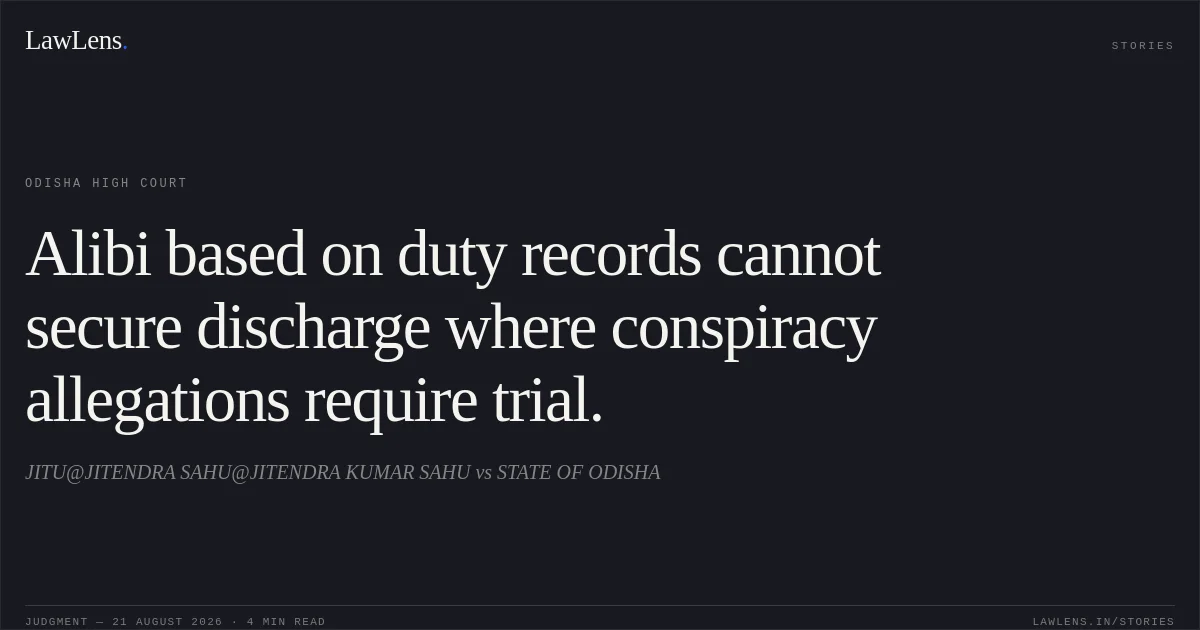
The petitioner challenged the order dated 20.01.2026 of the Additional Sessions Judge, Kodala, Ganjam, rejecting his application for discharge in Sessions Trial No. 126 of 2025 for offences under Sections 103(1), 3(5), and 61(2) of the Bharatiya Nyaya Sanhita, 2023 (“BNS”).
Source reference: p.1, para. 1The prosecution alleged that, on 30.03.2025, the deceased, Kuna @ Laxmi Narayan Paikray, was intercepted by armed assailants while travelling on a motorcycle and was shot dead; six accused were named in the FIR, but the petitioner was not among them.
Source reference: p.3, para. 4During investigation, the petitioner was alleged to have participated in a conspiracy arising from an earlier grudge, collected money for hiring the killers, and thereby facilitated the murder.
Source reference: pp.4, 9–10, paras. 5, 12The petitioner relied on ambulance duty records and RTI-obtained log-book material to contend that he was working as an ambulance driver at CHC, Kabisuryanagar, when the conspiracy was allegedly hatched, and therefore had been falsely implicated.
Source reference: pp.2, 5–6, paras. 2, 6The prosecution relied, inter alia, on the statement of C.S.W. No. 13 and other witness statements indicating the petitioner’s involvement in the conspiracy.
Source reference: p.10, para. 12Issues
Whether the petitioner was entitled to discharge when the prosecution alleged his participation in a conspiracy to commit murder, despite his not being named in the FIR and no overt act being attributed to him.
Source reference: pp.2–4, paras. 2–5Whether the petitioner’s reliance on ambulance duty records and RTI materials established an alibi of such sterling and unimpeachable quality that it excluded the possibility of his participation in the conspiracy at the pre-trial stage.
Source reference: pp.7–9, paras. 9–11-AWhether the materials collected during investigation disclosed sufficient prima facie involvement to justify continuation of the criminal trial.
Source reference: pp.9–10, paras. 12–13Law Applied
The Court applied the principles governing discharge laid down in State of Orissa v. Debendra Nath Padhi, (2005) 1 SCC 568, holding that the discharge question must be determined on the basis of the prosecution materials and the applicable threshold at the pre-trial stage.
Source reference: p.6, para. 7It considered the plea of alibi under Section 9 of the Bharatiya Sakshya Adhiniyam, 2023, concerning facts inconsistent with or rendering improbable a fact in issue, and the burden of proof under Section 104 of the BSA.
Source reference: p.6, para. 8Relying on Rajendra Singh v. State of Uttar Pradesh, (2007) 7 SCC 378, and Shaikh Sattar v. State of Maharashtra, (2010) 8 SCC 430, the Court stated that an alibi must be established so conclusively as to exclude the possibility of the accused’s presence at the relevant time.
Source reference: p.7, para. 9It further relied on Prashant Bharti v. State (NCT of Delhi), (2013) 9 SCC 293, Rajiv Thapar v. Madan Lal Kapoor, (2013) 3 SCC 330, Mirza Iqbal alias Golu v. State of Uttar Pradesh, (2022) 16 SCC 697, and Rahul v. State of Uttar Pradesh, 2026 SCC OnLine SC 1538, for the principle that unimpeachable defence material may justify interference at the pre-trial stage, although no inflexible rule governs the assessment of an alibi plea.
Source reference: pp.7–8, paras. 9–BThe Court also proceeded on the distinction between an alibi negating presence at the scene of occurrence and an alibi relied upon to negate participation in an earlier conspiracy.
Source reference: pp.8–9, para. 11Reasoning
The Court held that the petitioner’s duty chart and ambulance log-book did not possess such unimpeachable or sterling quality as to conclusively rule out his participation in the conspiracy.
Source reference: p.9, para. 12More importantly, the petitioner’s case concerned an alleged conspiracy formed before the murder, rather than his physical presence at the place where the deceased was shot. Consequently, evidence showing that he was performing ambulance-driving duties at the alleged time of the conspiracy did not, by itself, eliminate the possibility that he had participated in the conspiracy at another time or through other conduct.
Source reference: pp.8–9, paras. 10–11-AThe Court also found that the statement of C.S.W. No. 13 and other materials indicated that the petitioner had a prior grudge against the deceased, had allegedly planned the murder, and had collected money to engage the killers.
Source reference: p.10, para. 12These materials disclosed a prima facie case requiring examination at trial; the fact that the petitioner was not named in the FIR and that no overt act was attributed to him did not warrant discharge where conspiracy was the alleged mode of participation.
Source reference: pp.4, 9–10, paras. 5, 12–13Holding
The Court answered the issues against the petitioner. It held that the RTI records and ambulance duty materials did not conclusively establish his plea of alibi or demolish the prosecution case, and that the available witness statements and other materials prima facie indicated his involvement in the alleged conspiracy.
The criminal revision was accordingly dismissed as devoid of merit.
Source reference: p.11, para. 14The Court clarified that its observations were confined to the discharge application and would not amount to a final opinion on the petitioner’s guilt or complicity, which must be independently determined at trial.
Source reference: p.11, para. 15Acts & Sections Cited
7 provisions across 3 statutes referred to in this judgment. Each provision opens on LawLens.
Bharatiya Nagarik Suraksha Sanhita, 20232
Bharatiya Nyaya Sanhita, 20233
Bharatiya Sakshya Adhiniyam, 20232
Original Court PDF
JITU@JITENDRA SAHU@JITENDRA KUMAR SAHUvsSTATE OF ODISHA
Click to open original judgment
Original judgment, available to read, download and summarize on LawLens.in