Facts
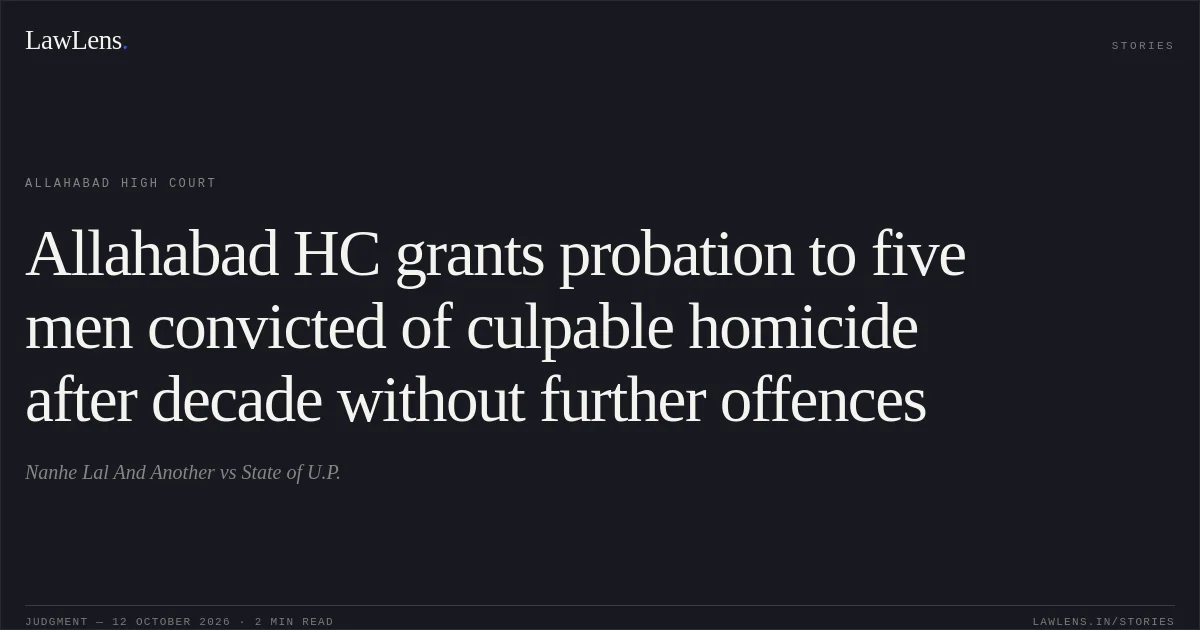
The appellants challenged their convictions for offences under Sections 147, 148, 304(1)/149, 325/149 and 323/149 IPC, but confined their appeals to seeking release under Section 4 of the Probation of Offenders Act, 1958; they did not contest the convictions.
Source reference: para. 2–3The District Probation Officer’s reports gave details of the appellants’ ages, occupations, families and residences and disclosed no adverse matter.
Source reference: para. 4–8The appellants were stated to be first offenders, and the State did not dispute this or identify any other criminal involvement.
Source reference: para. 15More than a decade had elapsed since sentence, with no further offence attributed to them.
Source reference: para. 17Issues
Whether the appellants’ convictions for offences not punishable with death or life imprisonment could be followed by release on probation under Section 4 of the Probation of Offenders Act, 1958
Source reference: para. 9–10, 16Whether, in the circumstances—including the probation reports, the appellants’ status as first offenders and the passage of more than a decade without further offending—the appellants should receive that benefit without being placed on probation for a further period
Source reference: para. 15–17Law Applied
Section 4 of the Probation of Offenders Act, 1958 empowers a court to release an offender found guilty of an offence not punishable with death or life imprisonment on a bond to keep the peace and be of good behaviour, after considering the circumstances of the case, including the offence and the offender’s character, and the probation officer’s report; the statutory conditions also include a fixed abode or regular occupation.
Source reference: para. 9Section 11 permits the High Court to make such an order when a case comes before it on appeal.
Source reference: para. 14State of Karnataka v. Muddappa, (1999) 5 SCC 732, establishes that Section 4 is not barred in a case under Section 304 Part II IPC where the offence is not punishable with death or life imprisonment.
Source reference: para. 10The Court also relied on Sunita Devi v. State of Bihar, 2024 SCC OnLine SC 984, and Chellammal v. State, 2025 SCC OnLine SC 870, for the principle that courts must consider the applicability of probation provisions; probation is not an entitlement, but where Section 4 applies, the court must consider it and give reasons if declining it.
Source reference: para. 12–13Reasoning
The offences of conviction were not punishable with death or life imprisonment, so Section 4 was available.
Source reference: para. 16The appellants were first offenders, the probation reports contained nothing adverse, and the State identified no other criminal case against them.
Source reference: para. 8, 15The Court further considered that more than a decade had passed since sentence without any reported further offence—a period exceeding Section 4’s maximum probation term of three years—and concluded that no further probation period was necessary.
Source reference: para. 17Holding
The appeals were disposed of by upholding the convictions and extending the appellants the benefit of the Probation of Offenders Act, 1958; the Court did not require them to undergo any further period of probation.
The appellants were directed to deposit the fines within two weeks.
Source reference: para. 18Acts & Sections Cited
12 provisions across 3 statutes referred to in this judgment. Each provision opens on LawLens.
Indian Penal Code, 18607
Code of Criminal Procedure, 19731
Probation of Offenders Act, 19584
Original Court PDF
Nanhe Lal And AnothervsState of U.P.
Click to open original judgment
Original judgment, available to read, download and summarize on LawLens.in