Facts
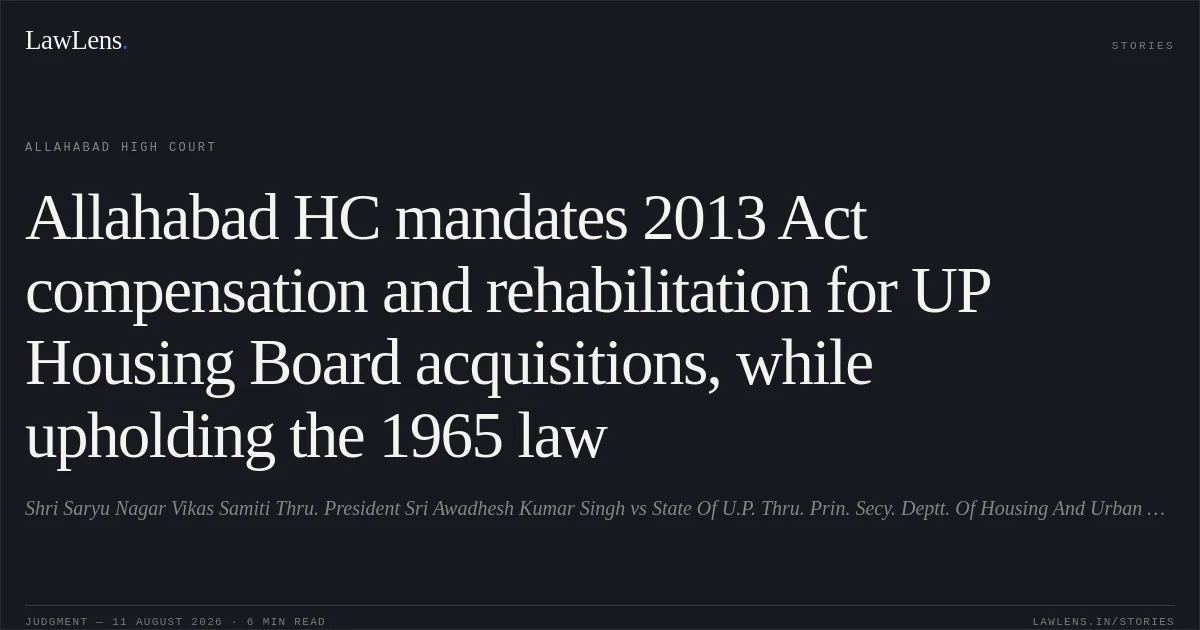
The petitions challenged compulsory land acquisition undertaken by the Uttar Pradesh Awas Evam Vikas Parishad/Board for three Ayodhya housing and development schemes under Sections 28, 31, 32 and 55 of the U.P. Awas Evam Vikas Parishad Adhiniyam, 1965 (“1965 Adhiniyam”), read with the Land Acquisition Act, 1894 (“1894 Act”).
Source reference: para. 6–14The acquisitions related to several villages, including Shahnawazpur Manjha, Baraita Manjha, Tihura Manjha, Shahnawazpur Uparhar and Kudakeshavpur, and had commenced between 2020 and 2023; awards had been made in respect of several areas, while other proceedings remained pending.
Source reference: para. 6–14The petitioners contended that the 1894 Act had been repealed by Section 114 of the Right to Fair Compensation and Transparency in Land Acquisition, Rehabilitation and Resettlement Act, 2013 (“2013 Act”), and that continued acquisition under the 1965 Adhiniyam read with the repealed enactment was illegal, arbitrary and violative of Articles 14, 19 and 300-A of the Constitution.
Source reference: para. 2–3The State and the Board maintained that the acquisition was valid under Section 55 of the 1965 Adhiniyam and that monetary compensation was being determined under the 2013 Act.
Source reference: para. 42–50A preliminary objection was also raised that the PIL was not maintainable because it allegedly espoused individual landowners’ grievances.
Source reference: para. 130Issues
1. Whether the PIL was maintainable when it raised the grievances of landowners affected by the acquisition schemes.
Source reference: para. 41–502. Whether Sections 28, 31(1), 32 and 55 of the 1965 Adhiniyam, read with the 1894 Act, were repugnant to the 2013 Act under Article 254 of the Constitution.
Source reference: para. 41, 51–963. Whether repeal of the 1894 Act by Section 114 of the 2013 Act invalidated acquisition proceedings under the 1965 Adhiniyam.
Source reference: para. 41, 97–1174. Whether the provisions of the 1965 Adhiniyam incorporating the 1894 Act stood impliedly repealed by the 2013 Act.
Source reference: para. 1185. Whether applying the 1894 Act, instead of the 2013 Act, resulted in arbitrary and hostile discrimination in compensation, rehabilitation and resettlement, violating Articles 14 and 300-A.
Source reference: para. 119–2226. Whether “compensation” included both monetary compensation and non-monetary benefits such as rehabilitation and resettlement.
Source reference: para. 169–1887. Whether the 2013 Act or, at least, its principles relating to compensation, rehabilitation and resettlement should be applied to acquisitions under the 1965 Adhiniyam to preserve its constitutionality.
Source reference: para. 223–2458. Whether the matter required reference to a Larger Bench in view of the coordinate Bench decision in Atul Sharma v. State of U.P.
Source reference: para. 257–2699. Whether the Board ceased to be a “local authority” for acquisition purposes after repeal of the 1894 Act.
Source reference: para. 270–27110. What relief the petitioners were entitled to, including whether the schemes and acquisition proceedings should be quashed.
Source reference: para. 273–274Law Applied
The Court applied Section 55 and the Schedule to the 1965 Adhiniyam, which incorporate the provisions of the 1894 Act, together with Section 21 of the 1965 Adhiniyam concerning rehabilitation schemes.
Source reference: para. 52–79Article 254 was held to apply only where both enactments substantially fall within the Concurrent List and are irreconcilably repugnant; the doctrine of pith and substance requires an enactment to be examined as a whole, and incidental encroachment is disregarded, as explained in Offshore Holdings Pvt. Ltd. v. Bangalore Development Authority and K.T. Plantation Pvt. Ltd. v. State of Karnataka .
Source reference: para. 52–79The Court relied on U.P. Avas Evam Vikas Parishad v. Jainul Islam , which treated the 1894 Act as incorporated into the 1965 Adhiniyam and applied the exception that prevents discriminatory and unworkable consequences.
Source reference: para. 97–116Following Nagpur Improvement Trust v. Vithal Rao , P. Vajravelu Mudaliar v. Special Deputy Collector and Vasant Rao v. State of Karnataka , the Court held that similarly situated landowners cannot receive different compensation merely because their lands are acquired under different statutes or by different authorities.
Source reference: para. 120–126Article 300-A was interpreted as requiring restitution or fair compensation, which may include monetary compensation, rehabilitation and other equivalent benefits, consistent with Shantilal Mangaldas v. State of Gujarat and Kolkata Municipal Corporation v. Bimal Kumar Shah .
Source reference: para. 175–185The Court also applied the principle of constitutional avoidance and construed Section 55 so that benefits under the 2013 Act, or at least its governing principles, would apply to compensation, rehabilitation and resettlement under the 1965 Adhiniyam.
Source reference: para. 223–244Reasoning
The Court held that the PIL was maintainable because the petitioner society was registered to pursue public causes, had been approached by affected landowners unable to bear the cost of litigation, and raised issues of wider constitutional and public importance.
Source reference: para. 43–50On legislative competence, the Court found that the 1965 Adhiniyam was, in pith and substance, a housing and development statute referable to Entries 5 and 18 of the State List; compulsory acquisition was merely incidental to implementation of its schemes.
Source reference: para. 80–96The repeal of the 1894 Act did not, by itself, extinguish the incorporated acquisition machinery under Section 55, and no implied repeal was established because the two enactments had different dominant purposes and could operate together.
Source reference: para. 97–118However, the Court found that the 2013 Act provided substantially superior monetary and non-monetary benefits, including multipliers, enhanced solatium, valuation of attached assets, rehabilitation awards, resettlement benefits, housing, employment or annuity, subsistence and transportation allowances, and infrastructural amenities.
Source reference: para. 131–168Applying the equality principle in Vithal Rao and Jainul Islam , the Court held that landowners constituted one class for purposes of restitution and fair compensation.
Source reference: para. 189–221Treating landowners acquired under the 1965 Adhiniyam less favourably than those covered by the 2013 Act lacked an intelligible differentia and rational nexus, and would violate Articles 14 and 300-A.
Source reference: para. 189–221Rather than invalidate Section 55 and its Schedule, the Court adopted a constitutionally harmonious construction.
Source reference: para. 223–244It directed that compensation, rehabilitation and resettlement under the 1965 Adhiniyam must be no less beneficial than the corresponding benefits under the 2013 Act.
Source reference: para. 223–244, 273Holding
The Court held that the PIL and connected writ petitions were maintainable.
Sections 28, 31(1) and 32 of the 1965 Adhiniyam were not unconstitutional, and Section 55 and its Schedule were not struck down; instead, they were constitutionally saved by requiring the application of the provisions, or at least the principles, of the 2013 Act relating to monetary compensation, rehabilitation and resettlement.
Source reference: para. 221, 244–245, 273(i)The Court declined to quash the three Ayodhya schemes or the acquisition proceedings, considering their advanced stage, the awards already made, the integrated nature of the schemes, and the wider public interest.
Source reference: para. 273(ii)It directed that monetary compensation be determined and paid in accordance with the 2013 Act; existing awards were to be revisited wherever necessary.
Source reference: para. 273(ii)(a)–(b)The Board was directed, within six months, to identify completely displaced landowners and frame and implement rehabilitation schemes under Section 21 of the 1965 Adhiniyam read with the relevant provisions and principles of the 2013 Act, unless the rehabilitation obligations could validly be quantified and paid in monetary form.
Source reference: para. 273(ii)(c)Future acquisitions under the 1965 Adhiniyam must extend compensation, rehabilitation and resettlement benefits on parameters no less beneficial than those under the 2013 Act.
Source reference: para. 273(iv)All petitions were accordingly disposed of.
Source reference: para. 274Acts & Sections Cited
49 provisions across 4 statutes referred to in this judgment. Each provision opens on LawLens.
Right to Fair Compensation and Transparency in Land Acquisition, Rehabilitation and Resettlement Act, 2013
General Clauses Act, 18971
Industries (Development and Regulation) Act, 19513
Original Court PDF
Shri Saryu Nagar Vikas Samiti Thru. President Sri Awadhesh Kumar SinghvsState Of U.P. Thru. Prin. Secy. Deptt. Of Housing And Urban Planning Lko. And 5 Others
Click to open original judgment
Original judgment, available to read, download and summarize on LawLens.in