01Facts
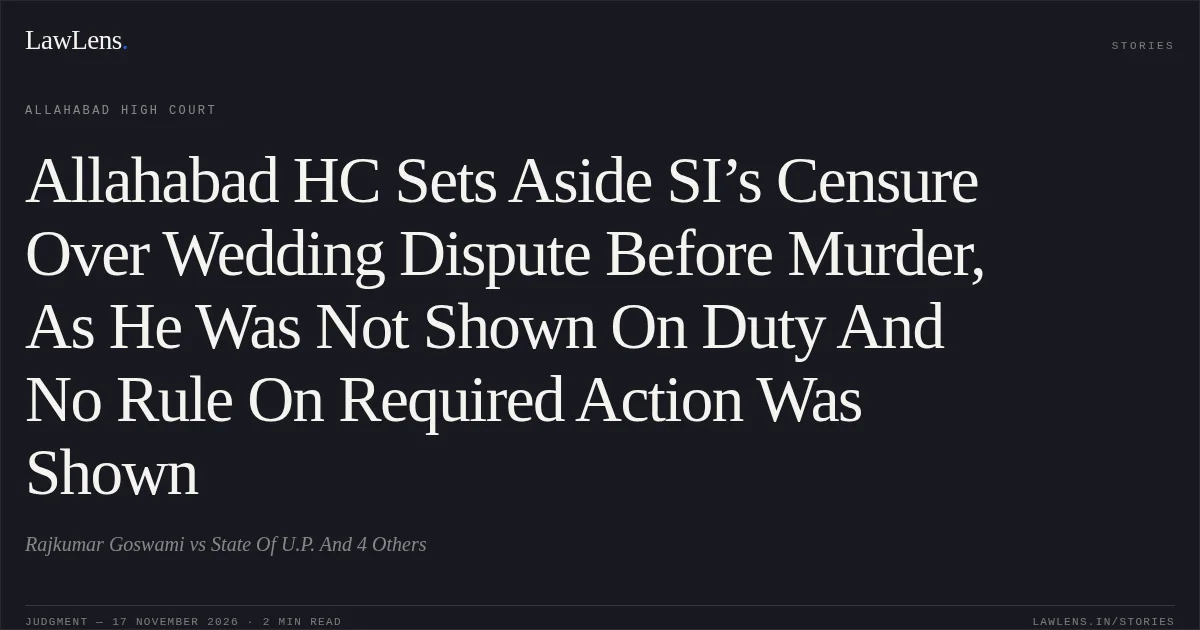
The petitioner, a Sub-Inspector and police outpost in-charge, received a censure entry for allegedly failing to take timely preventive or supervisory action after a dispute at a marriage ceremony on 26 March 2019.
¶ 2–3 · pp. 1–2The dispute was followed by a murder the next day.
¶ 2–3 · pp. 1–2The petitioner challenged the punishment, appellate and revisional orders, and the State Public Services Tribunal’s decision upholding the punishment.
¶ 2–3 · pp. 1–2The Tribunal relied, among other matters, on witness statements alleging that the petitioner was present at the ceremony and concluded that his vigilance and preventive supervision had been inadequate.
¶ 4 · pp. 2–302Issues
i.1. Whether the Tribunal’s decision upholding the censure entry was sustainable where the alleged failure to prevent the subsequent murder was not supported by material showing what action the petitioner was required or authorized to take.
¶ 4–5 · pp. 2–3ii.2. Whether Section 22 of the Police Act, 1861, made the petitioner liable for failing to act merely because a police officer is deemed always on duty.
¶ 5 · p. 303Law Applied
Section 22 of the Police Act, 1861 provides that a police officer is deemed always to be on duty and may be employed anywhere in the general police district.
¶ 5 · p. 3The Court held that this provision did not, by itself, establish that the petitioner had a specific duty to take a particular action in the circumstances.
¶ 5 · p. 3The Court also stated that police can act to prevent crime but can act only on information; no precedent was cited.
¶ 5 · p. 3Provisions in the judgment · 8 · Linked ones open on LawLens
Indian Penal Code, 1860 Section 307Section 323Section 506Section 147Section 148Section 149Section 302
Police Act, 1861 Section 22
04Reasoning
The Court considered the Tribunal’s finding that the petitioner had failed to show adequate vigilance, including its reliance on statements placing him at the marriage ceremony.
¶ 4 · pp. 2–3It held that Section 22 could not, on its own, support the punishment.
¶ 5 · p. 3There was no material showing that the petitioner was authorized to make an arrest and failed to do so, and no rule or regulation had been identified specifying what action he was required to take—particularly if he was attending the ceremony but was not shown to have been on duty or requisitioned for duty.
¶ 5 · p. 3The Court also observed that arresting an accused would not necessarily have prevented the subsequent murder.
¶ 5 · p. 305Holding
The Court allowed the exemption application and disposed of the writ petition.
¶ 6–7 · pp. 3–4It quashed the Tribunal’s judgment and the punishment order, holding that the censure entry could not stand on the material and legal basis presented.
¶ 6–7 · pp. 3–4The petitioner was held entitled to the consequential service benefits.
¶ 6–7 · pp. 3–4Original Court PDF
Rajkumar GoswamivsState Of U.P. And 4 Others
Click to open original judgment
Original judgment, available to read, download and summarize on LawLens.in