01Facts
The petitioner, a 24-year-old married woman, sought a mandamus directing the Chief Medical Officer, Bhadohi, to arrange termination of her pregnancy.
¶ 12–23She alleged that her husband and in-laws had subjected her to cruelty and assault, causing mental distress, and that she lacked the financial means to raise the child.
¶ 12–23Her husband denied the allegations, maintained that the dispute was a misunderstanding, and offered to support her and the child.
¶ 30–33The petitioner’s request for termination was before the High Court under Article 226
¶ 2, 1802Issues
i.Whether the petitioner’s alleged cruelty, marital discord and resulting mental distress established a statutory basis for termination of pregnancy under the Medical Termination of Pregnancy Act, 1971
¶ 39–43, 46–53ii.Whether an estranged relationship or other change in marital circumstances could fall within Rule 3B(c), beyond the stated examples of widowhood and divorce
¶ 7–8, 34, 37iii.Whether the Court should direct termination under Article 226 on the material before it, notwithstanding the absence of foetal abnormality and the husband’s offer of financial support
¶ 54, 59, 63–7003Law Applied
Section 3(2) of the Medical Termination of Pregnancy Act, 1971 permits termination subject to its gestational limits and the prescribed medical opinion where continuation of pregnancy would risk the woman’s life or cause grave injury to her physical or mental health, or where there is a substantial risk of serious foetal abnormality;
¶ 5, 46–48Section 3(3) makes the woman’s actual or reasonably foreseeable environment relevant to assessing injury to health, and Section 3(2B) addresses termination beyond the usual limits where substantial foetal abnormality is diagnosed by a Medical Board
¶ 5, 46–48Rule 3B(c) of the Medical Termination of Pregnancy Rules, 2003 identifies a change in marital status during pregnancy, with widowhood and divorce given as examples, as a category eligible for termination up to 24 weeks.
¶ 7Relying on X v. Principal Secretary, Health and Family Welfare Department, the Court recognised that mental health is broader than the absence of diagnosed mental illness and that reproductive autonomy is protected under Article 21, but held that termination must remain within the statutory scheme
¶ 29, 35–36, 48–5204Reasoning
The Court accepted that persistent, aggravated cruelty could be relevant to a woman’s mental health and, in an appropriate case, could support termination; however, it considered the allegations here unsubstantiated by sufficiently cogent material and found no evidence establishing the grave injury required by Section 3
¶ 10, 52–53, 67–68It held that ordinary marital discord or an estranged relationship does not, without circumstances equivalent to permanent abandonment or a similarly profound change, amount to a change in marital status under Rule 3B(c)
¶ 34, 37The Court noted that no domestic-violence proceedings had been initiated, the petitioner was residing with her parents, no foetal abnormality had been detected, and her husband had offered financial and medical support
¶ 44, 54, 63–65On that record, the Court found that the statutory grounds for termination had not been established
¶ 59, 64–7005Holding
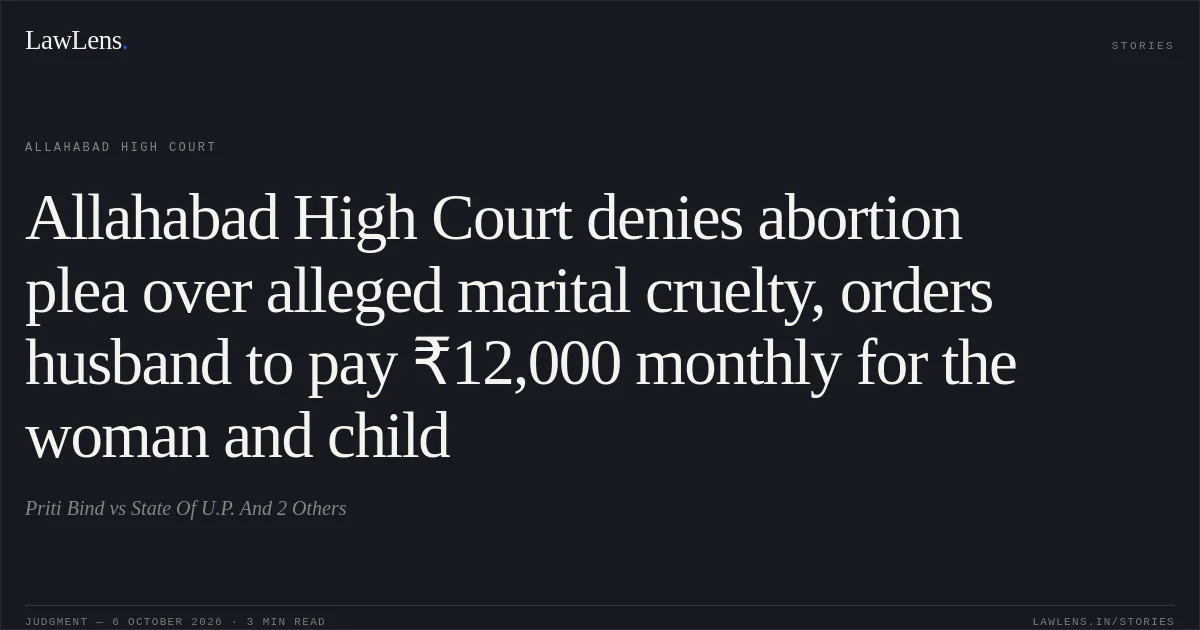
The Court declined to direct medical termination and dismissed the writ petition
¶ 71It directed the Chief Medical Officer, Bhadohi, to arrange marital counselling for the petitioner without cost and to ensure that any major medical expenditure was met by a government hospital
¶ 72It also directed the Superintendent of Police, Ghazipur, to arrange deduction of ₹12,000 per month from the husband’s salary for remittance to the petitioner, subject to her providing her bank details
¶ 63, 73Original Court PDF
Priti BindvsState Of U.P. And 2 Others
Click to open original judgment
Original judgment, available to read, download and summarize on LawLens.in