Facts
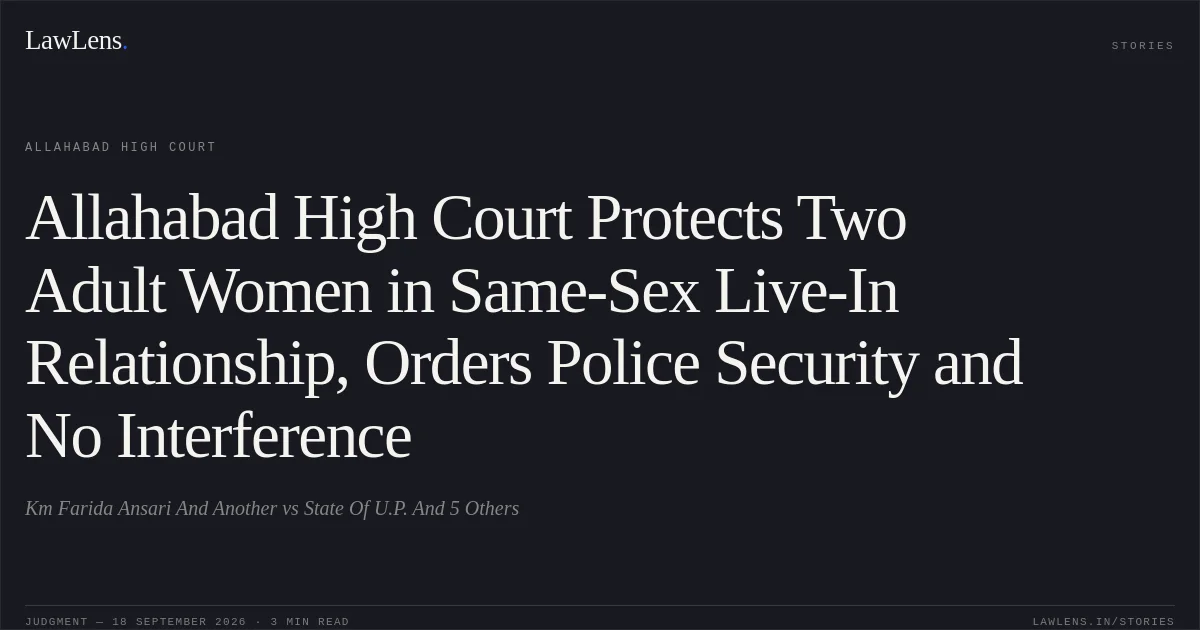
The two petitioners, Farida Ansari and Pragati Kushwaha, both adult women, claimed to be in a consensual same-sex live-in relationship.
Source reference: paras. 1, 3–8They produced their high-school mark sheets to establish their ages and appeared personally before the Court pursuant to an earlier direction.
Source reference: paras. 1, 3–8Both stated that they had voluntarily chosen to live together without coercion, fear, or undue influence.
Source reference: paras. 1, 3–8They alleged that private respondents, including family members, were threatening and interfering with their peaceful life and sought a writ of mandamus directing the State authorities to provide them protection under Article 226 of the Constitution.
Source reference: paras. 1, 3–8The State opposed the petition on the basis that same-sex relationships lacked social acceptance, while conceding that an individual’s choice of partner is protected under Article 21, although same-sex marriage had no legislative recognition.
Source reference: para. 6Issues
1. Whether two consenting adults in a same-sex live-in relationship possess a constitutionally protected right under Article 21 to live together peacefully without interference from family members, private individuals, or society.
Source reference: paras. 4–5, 9–122. Whether the petitioners were entitled to police protection against alleged threats and interference with their life and personal liberty.
Source reference: paras. 8, 12–153. Whether the absence of statutory recognition of same-sex marriage or civil union deprives the petitioners of constitutional protection for their consensual relationship.
Source reference: paras. 9–10Law Applied
The Court applied Articles 14, 21, and 226 of the Constitution.
Source reference: no citationArticle 21 protects life, personal liberty, privacy, dignity, autonomy, and the freedom to choose one’s partner and form consensual relationships.
Source reference: no citationRelying on Navtej Singh Johar v. Union of India, (2018) 10 SCC 1, the Court recognised sexual orientation as an intrinsic aspect of liberty, dignity, privacy, and personal autonomy, and emphasised constitutional morality over social morality.
Source reference: para. 5It further relied on Supriyo @ Supriya Chakraborty v. Union of India, 2023 SCC OnLine SC 1348, particularly paragraph 149(iv), which holds that queer and LGBTQ+ persons have a right under Article 21 to form unions or relationships—mental, emotional, or sexual—flowing from privacy, choice, and autonomy, although there is no unqualified fundamental right to statutory recognition of marriage or civil union.
Source reference: paras. 9–10The Court also applied the principle that the absence of legal recognition of same-sex marriage does not authorise third parties or State authorities to interfere with the life, dignity, or physical security of consenting adults.
Source reference: paras. 10–12Reasoning
The Court personally examined both petitioners and found them to be adults capable of understanding the consequences of their decision.
Source reference: para. 7Their statements established that they had voluntarily chosen to live together in a same-sex relationship and were not acting under pressure, fear, or undue influence.
Source reference: para. 7Applying Navtej Singh Johar and Supriyo, the Court distinguished between the absence of a statutory right to have a same-sex marriage or union legally recognised and the existence of a constitutional right to maintain a consensual relationship.
Source reference: paras. 10–13Since the petitioners’ decision fell within the protection of privacy, autonomy, dignity, and personal liberty under Article 21, family members or other persons had no legal entitlement to threaten or obstruct their peaceful cohabitation.
Source reference: paras. 10–13The alleged social or traditional disapproval of same-sex relationships could not override constitutional morality or justify interference with their fundamental rights.
Source reference: paras. 10–13Holding
The petition was allowed.
The Court held that the petitioners, being consenting adults, were constitutionally entitled to live together peacefully in a same-sex live-in relationship, and that no family member or other person could interfere with their relationship, threaten them, or violate their physical liberty.
Source reference: paras. 12–14If any obstruction occurred, the petitioners were directed to approach the concerned Police Commissioner, Senior Superintendent of Police, or Superintendent of Police with a certified copy of the order.
Source reference: para. 15Upon verifying that they were adults and were voluntarily living together, the police authorities were directed to provide immediate protection.
Source reference: para. 15The private respondents were left at liberty to seek recall of the order if the documents relied upon by the petitioners were proved to be forged or fabricated.
Source reference: para. 16Original Court PDF
Km Farida Ansari And AnothervsState Of U.P. And 5 Others
Click to open original judgment
Original judgment, available to read, download and summarize on LawLens.in