Facts
The petitioners were LPG distributors appointed by various Oil Marketing Companies (“OMCs”), many of whom had operated for several years and developed substantial customer bases through investment in infrastructure, personnel and customer enrolment.
Source reference: paras. 5–8On 21 February 2025, the OMCs notified the Policy on Customer Transfer—Market Restructuring and the Policy on Customer Transfer Based on Area of Operation.
Source reference: para. 15The new policies permitted transfer of customers from existing “donor” distributors to newly commissioned or other “recipient” distributors, while retaining the donor distributor at the applicable refill-ceiling limit.
Source reference: paras. 29–30, 59–60The petitioners challenged the policies as vague, arbitrary, retrospective and contrary to their contractual and legitimate expectations, particularly because customers developed by them could be transferred without their consent.
Source reference: paras. 29–37Issues
Whether the OMCs’ policies dated 21 February 2025 permitting transfer of LPG customers from existing distributors to other or newly commissioned distributors were arbitrary, vague, mala fide or otherwise liable to be quashed under Article 226 of the Constitution?
Source reference: paras. 29–30, 49, 96–101Whether the absence of a specific definition of “new/recipient distributor” rendered the twelve-month calculation and customer-transfer formula under the new policy uncertain and legally unenforceable?
Source reference: paras. 29–30, 59–63Whether the petitioners possessed a vested or legitimate expectation to retain customers enrolled by them, notwithstanding the terms of their letters of intent, distributorship agreements and LPG Manual?
Source reference: paras. 31–37, 80–94Whether the earlier Bombay High Court judgment invalidating the 2018 policy precluded the OMCs from introducing and enforcing the 2025 policies?
Source reference: paras. 32–34, 64–78Whether Clauses 4.4 and 4.6 of the LPG Manual, read with the distributorship agreements and letters of intent, authorised the OMCs to transfer or reduce customers and alter the distributors’ area of operation?
Source reference: paras. 64–81Law Applied
The Court applied the Unified Guidelines for Selection of LPG Distributorship, particularly Clauses 1.13 and 1.14 defining “area of operation” and “ceiling limit”, and Clause 2.4.1.1.1 prescribing market refill-ceiling and viability limits.
Source reference: paras. 53–58It relied on the contractual terms permitting the OMCs to alter the distributorship territory, appoint additional distributors and require surrender or transfer of customers, including Clause 2 of the letter of intent, Clauses 4.4, 4.6 and 4.7 of the LPG Manual, and Clauses 1(b)(ii), 1(b)(iii), 1(b)(v) and 11 of the distributorship agreement.
Source reference: paras. 65–75, 84, 100On legitimate expectation, the Court relied on Union of India v. Hindustan Development Corporation, (1993) 3 SCC 499, and Ram Pravesh Singh v. State of Bihar, (2006) 8 SCC 381, holding that legitimate expectation must be founded upon law, an express promise or an established and consistent official practice and does not ordinarily create a vested right.
Source reference: paras. 85–89In reviewing the policy, the Court applied the principle that courts do not substitute their judgment for that of the executive in economic or policy matters and may interfere only where the policy is unconstitutional, contrary to statute, beyond delegated power, manifestly arbitrary, discriminatory or mala fide, relying on State of M.P. v. Nandlal Jaiswal, (1986) 4 SCC 566, Directorate of Film Festivals v. Gaurav Ashwin Jain, (2007) 4 SCC 737, and DDA v. Joint Action Committee, (2008) 2 SCC 672.
Source reference: paras. 96–99Reasoning
The Court held that the new policies served a legitimate public purpose: expanding LPG penetration after the Ujjwala Yojana, ensuring viable distributorships, improving supply and protecting consumers from the health and environmental consequences of traditional cooking fuels.
Source reference: para. 52The challenge based on vagueness failed because Clause 1(viii)(c) prescribed a method for calculating the number of customers to be transferred using the distributor’s average refill sales and per-capita consumption over the preceding twelve months, and the petitioners could not demonstrate that the formula was irrational or inaccurate.
Source reference: paras. 59–61In any event, Clause 1(ii) protected donor distributors by ensuring retention at 100% of the applicable refill-ceiling limit.
Source reference: paras. 59, 63The Court distinguished the Bombay High Court decision, reasoning that the earlier judgment had not considered the relevant provisions of the letters of intent, LPG Manual and distributorship agreements which expressly permitted customer transfer and alteration of the area of operation.
Source reference: paras. 64–78Since customers were enrolled by distributors on behalf of the OMCs and the OMCs retained liberty to service customers through any distributor, the petitioners had no proprietary or vested right over the customers they had enrolled.
Source reference: paras. 69, 75, 90–93The Court further held that Clauses 4.4 and 4.6 operated independently: Clause 4.4 concerned alteration of the area of operation to ensure viability and service, while Clause 4.6 specifically authorised customer transfers in accordance with prevailing policy guidelines.
Source reference: para. 81Applying the limited standard of judicial review of policy decisions, the Court found no arbitrariness, mala fides, discrimination or violation of law.
Source reference: paras. 94–103Holding
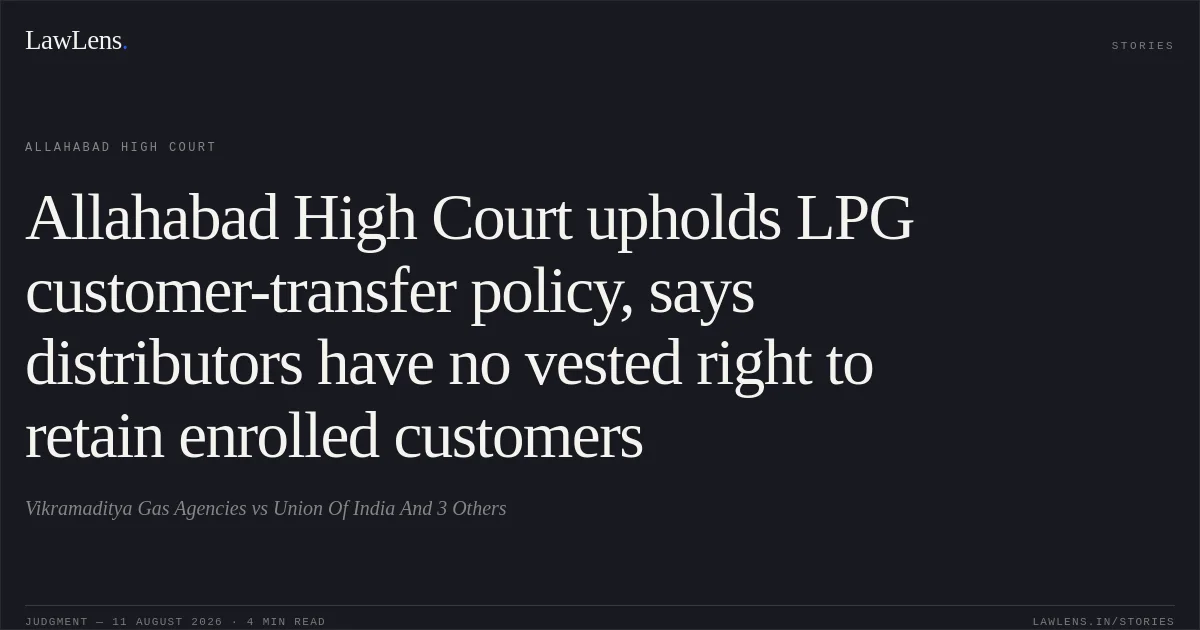
The Allahabad High Court upheld the OMCs’ policies dated 21 February 2025 and rejected the petitioners’ claims of vagueness, retrospectivity, legitimate expectation and contractual protection against customer transfers.
It held that the OMCs were contractually and administratively authorised to alter areas of operation and transfer customers, that the petitioners had no vested right to retain customers enrolled by them, and that the policies were neither arbitrary nor mala fide.
Source reference: paras. 76–81, 89–101All connected writ petitions were accordingly dismissed, with no order as to costs.
Source reference: para. 104Original Court PDF
Vikramaditya Gas AgenciesvsUnion Of India And 3 Others
Click to open original judgment
Original judgment, available to read, download and summarize on LawLens.in