Facts
The appellants, Anil Kumar and Dinesh, claimed title over adjoining plots forming part of a 300-square-yard parcel allegedly purchased from Ashok Solanki through registered GPA, Will, Agreements to Sell and Receipts dated 11 December 1998.
Source reference: pp. 3–4, paras. 2–6Dinesh subsequently claimed to have purchased Plot No. 56 from Narender Kumar on 7 April 2003, while Anil Kumar retained Plot No. 55.
Source reference: pp. 3–4, paras. 2–6The appellants alleged that Sushila Devi and Balwan Singh unlawfully entered the plots, demolished the boundary walls and raised construction thereon.
Source reference: pp. 4–7, paras. 7–12They discovered the alleged encroachment on 14 June 2014 and thereafter complained to the police regarding trespass, forgery and unauthorized construction.
Source reference: pp. 4–7, paras. 7–12Sushila Devi had earlier filed Civil Suit No. 183/2014, claiming ownership on the basis of documents dated 8 October 2013 and tracing title through documents dated 27 December 1989.
Source reference: pp. 5–6, paras. 12–13The appellants undertook before the Civil Court on 16 September 2014 not to dispossess the defendants without due process of law.
Source reference: pp. 5–6, paras. 12–13An FIR was registered, and the documents relied upon by the defendants were sent to the FSL.
Source reference: p. 6, paras. 14–17The FSL report dated 28 September 2016 allegedly found that the 1989 documents were executed on stamp papers printed in 1994 and contained forged signatures.
Source reference: pp. 6, 13–14, paras. 14–17, 53–54In January 2023, the appellants instituted suits seeking possession, declaration that the defendants’ title documents were null and void, permanent and mandatory injunctions, damages and mesne profits.
Source reference: pp. 7–8, paras. 22–26The Additional District Judge dismissed the suits under Order VII Rule 11 CPC, holding that the declaratory relief was governed by Article 58 of the Limitation Act and was instituted beyond three years from the accrual of the cause of action.
Source reference: p. 10, para. 38The appellants’ review applications were dismissed, leading to the present appeals under Section 96 CPC.
Source reference: pp. 10–11, paras. 39–40Issues
1. Whether the appellants, being non-executants of the impugned title documents, were required to seek cancellation of those documents or could properly seek a declaration that they were invalid and non-binding?
Source reference: pp. 14–16, paras. 58–622. Whether a composite suit for declaration and possession was governed by the three-year limitation period under Article 58 of the Limitation Act or the twelve-year period under Article 65 applicable to possession based on title?
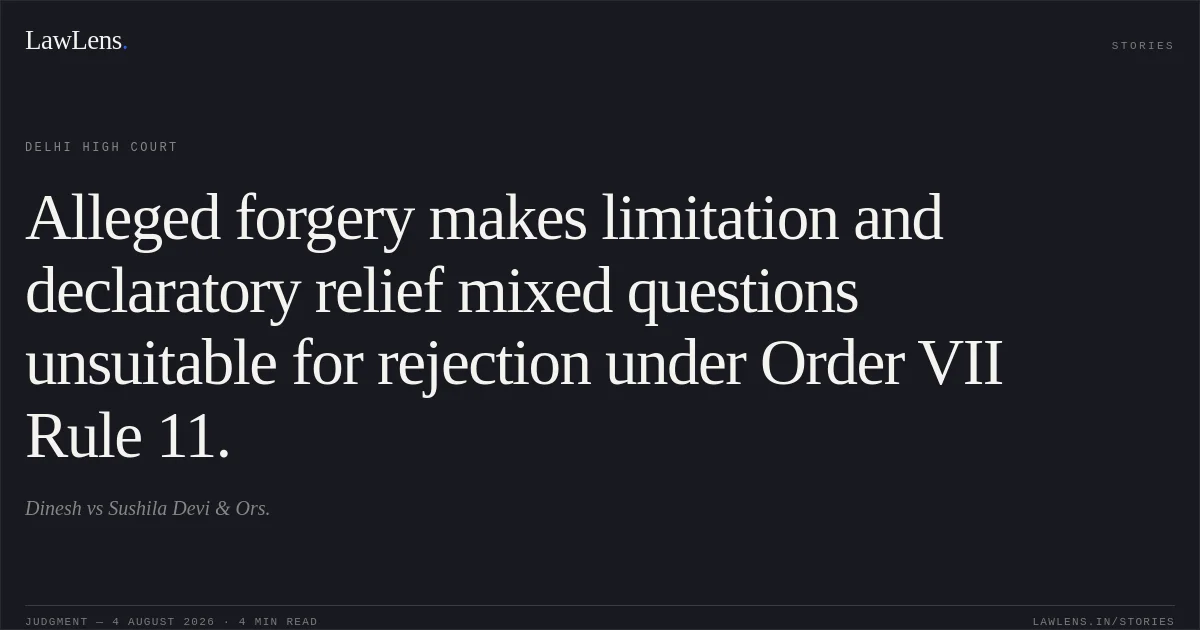
Source reference: pp. 16–21, paras. 63–743. Whether the alleged forgery and invalidity of the defendants’ documents constituted mixed questions of fact and law which could not be conclusively determined at the stage of an application under Order VII Rule 11 CPC?
Source reference: pp. 24–27, paras. 80–92Law Applied
The Court applied Section 96 CPC and Order VII Rule 11 CPC, holding that rejection of a plaint at the threshold is permissible only where the bar of limitation or another statutory defect is apparent from the plaint and does not require adjudication of disputed facts.
Source reference: pp. 16–17, para. 64Under Articles 58 and 59 of the Limitation Act, declaratory or cancellation claims ordinarily attract a three-year limitation period, whereas Article 65 prescribes twelve years for possession of immovable property based on title from the date when the defendant’s possession becomes adverse.
Source reference: pp. 16–17, para. 64Relying on Suhrid Singh v. Randhir Singh, Vellayya Konar v. Ramaswami Konar and Hussain Ahmed Choudhury v. Habibur Rahman, the Court held that a non-executant seeks a declaration that the instrument is invalid or non-binding, rather than cancellation.
Source reference: pp. 14–16, paras. 59–62Under Anathula Sudhakar v. P. Buchi Reddy, where possession is lost and title is clouded, the appropriate remedy is declaration with possession.
Source reference: pp. 17–19, paras. 65–67However, Prem Singh v. Birbal, State of Maharashtra v. Pravin Jethalal Kamdar, Kewal Krishnan v. Rajesh Kumar, N. Thajudeen v. Tamil Nadu Khadi & Village Industries Board and Shanti Devi v. Jagan Devi establish that a void or forged instrument is non-est and need not be formally cancelled; a possession suit based on title is then governed by Article 65.
Source reference: pp. 23–27, paras. 79–89Conversely, where the instrument is merely voidable and cancellation or declaration is the substantive relief, Article 58 or Article 59 may apply, depending on the relief sought and the applicable statutory provision.
Source reference: pp. 20–23, paras. 68–78Reasoning
The Court distinguished between a valid or voidable document whose cancellation is the substantive relief and a forged or void document which is legally non-existent.
Source reference: no citationAlthough the appellants had sought declarations concerning the defendants’ documents, they pleaded that the documents were forged and relied upon the FSL report supporting that allegation.
Source reference: pp. 13–14, paras. 53–54If the documents were ultimately proved forged, they would be void ab initio and the appellants’ principal remedy would be possession based on title, attracting the twelve-year period under Article 65.
Source reference: pp. 25–27, paras. 84–91If, however, the documents were found valid or merely voidable, the limitation applicable to the declaratory relief would arise for consideration.
Source reference: pp. 25–27, paras. 84–91Determining which category the documents fell into required examination of the FSL report, signatures, title chain and other evidence.
Source reference: pp. 26–27, paras. 90–92The limitation question was therefore a mixed question of fact and law and could not be decided solely from the plaint under Order VII Rule 11 CPC.
Source reference: pp. 26–27, paras. 90–92Holding
The High Court held that the suits could not have been rejected as time-barred at the threshold.
Whether the impugned documents were forged and void, or valid and merely voidable, required a trial.
Source reference: pp. 26–27, paras. 90–92If they were void, the possession claims would be governed by Article 65; if valid or voidable, the appropriate limitation provision would be determined after adjudication.
Source reference: pp. 26–27, paras. 90–92The impugned orders dated 6 October 2023 were set aside, and both suits were remanded to the Additional District Judge for trial on merits.
Source reference: p. 28, paras. 93–95The Court clarified that its observations were confined to the Order VII Rule 11 applications and did not decide the merits of the parties’ title or possession claims.
Source reference: p. 28, paras. 93–95The parties were directed to appear before the Additional District Judge on 18 August 2026.
Source reference: p. 28, para. 95Original Court PDF
DineshvsSushila Devi & Ors.
Click to open original judgment
Original judgment, available to read, download and summarize on LawLens.in