Facts
Smt. Parvathamma complained that, after a Revenue Inspector and others took her to the Sub-Registrar’s office, a Will was cancelled and a gift deed was registered in favour of Geetha, who was not related to her. She alleged that she had not been informed of the document’s contents and that the accused had conspired to deceive her. Police registered Crime No. 152/2022 for offences under Sections 406, 420 and 465 read with Section 149 of the Indian Penal Code (IPC).
Source reference: para. 3.1–3.3The accused petitioned to quash the FIR. Parvathamma had also pursued proceedings under the Maintenance and Welfare of Parents and Senior Citizens Act, 2007; those proceedings were quashed by a coordinate bench, and a civil suit seeking cancellation of the gift deed was pending.
Source reference: paras. 5–8Issues
Whether the complaint and FIR disclosed the ingredients of offences under Sections 406, 420 and 465 IPC, read with Section 149 IPC, against the petitioners
Source reference: paras. 9–15, 27–32Whether continuation of the criminal investigation and proceedings, in light of the allegations and the pending civil dispute, amounted to an abuse of process warranting quashing
Source reference: paras. 9–12, 21, 26–32Law Applied
The petitions were brought under Articles 226 and 227 of the Constitution of India read with Section 482 of the Code of Criminal Procedure, 1973, invoking the High Court’s power to quash criminal proceedings.
Source reference: no citationThe alleged offences were Sections 406 (criminal breach of trust), 420 (cheating), and 465 (forgery) IPC, read with Section 149 IPC (unlawful assembly/common object).
Source reference: no citationThe Court’s reasoning turned on whether the complaint’s allegations disclosed the ingredients of those offences and whether the FIR’s continuation constituted an abuse of process. No judicial precedents were cited in the order.
Source reference: no citationReasoning
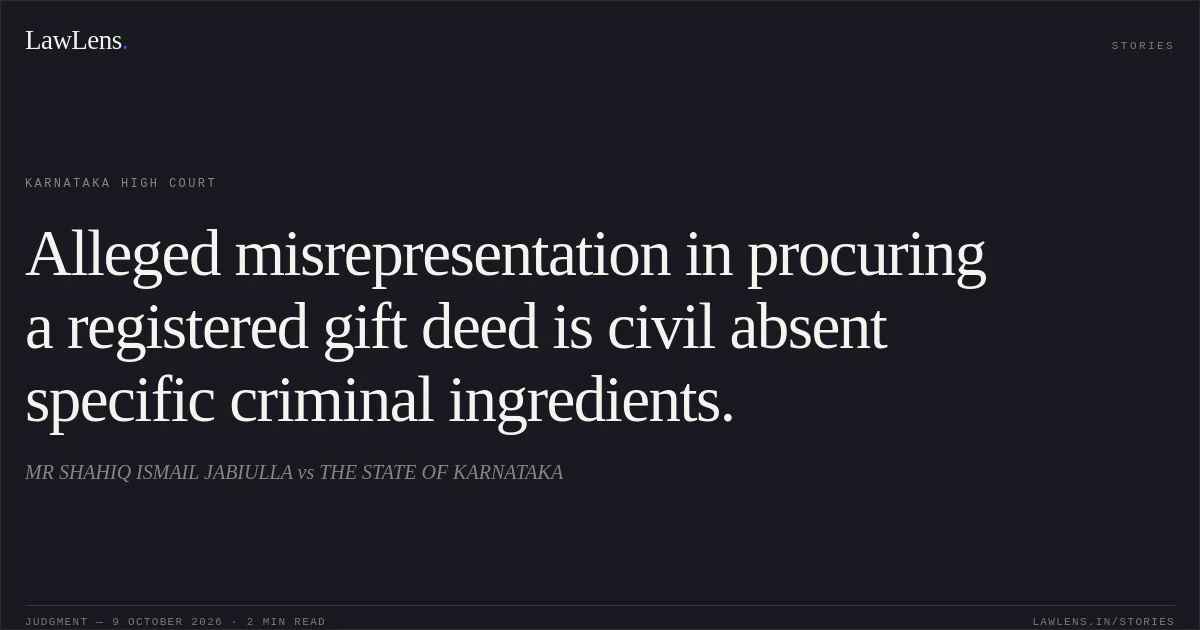
The Court found that the complaint alleged misrepresentation and that Parvathamma was unaware of the gift deed’s contents, but did not allege impersonation or otherwise set out facts establishing the ingredients of the charged offences.
Source reference: paras. 18–20, 27–29The deed bore her photograph and thumb impression, and the Court noted that the registering authority had taken registration-related precautions; it also found that the complaint’s account of the timing of her visit to the Sub-Registrar’s office was inconsistent with the recorded registration times.
Source reference: paras. 17, 20–22In the Court’s view, any dispute over whether she intended to execute the deed could be addressed in the pending civil suit. The complaint also failed to identify the unlawful object or explain when and how the accused shared it, so the allegation under Section 149 IPC was not made out.
Source reference: paras. 26, 30–32Holding
The Court allowed all four writ petitions and quashed the FIR in Crime No. 152/2022 of Santhebennur Police Station.
It directed that its observations would not affect the applicant’s rights in the pending civil suit or the defence raised there by Geetha and the other defendants.
Source reference: para. 33(iii)Acts & Sections Cited
5 provisions across 2 statutes referred to in this judgment. Each provision opens on LawLens.
Code of Criminal Procedure, 19731
Indian Penal Code, 18604
Original Court PDF
MR SHAHIQ ISMAIL JABIULLAvsTHE STATE OF KARNATAKA
Click to open original judgment
Original judgment, available to read, download and summarize on LawLens.in