Facts
The dispute arose from the Petitioner’s 1989 bonus issue. Although 85 base shares were subsequently registered in the name of Mr. Prakash Chand Baid, the corresponding 85 bonus shares were issued in the names of the original shareholders because they were the registered holders on the record date.
Source reference: paras. 5(a)–(j), pp. 3–5The bonus shares were thereafter kept in abeyance, and the Respondent No. 2 later asserted entitlement to the shares and related corporate benefits on the basis of his alleged status as Mr. Baid’s broker and an alleged power of attorney.
Source reference: paras. 5(a)–(j), pp. 3–5After correspondence extending over several years, Respondent No. 2 filed complaints before various securities-market entities, including complaints on SEBI’s SCORES Portal and subsequently multiple complaints under SEBI’s Online Dispute Resolution (“ODR”) framework introduced by the Master Circular dated 31 July 2023.
Source reference: paras. 5(n)–(p), pp. 6–7The latest complaint was allotted to the Metropolitan Stock Exchange (“MSE”) through the ODR Portal’s round-robin mechanism. Conciliation failed, and the Conciliation Officer recorded that the complaint was time-barred. MSE thereafter called upon the Petitioner to participate in arbitration and pay the applicable arbitral fees.
Source reference: paras. 5(q)–(t), pp. 7–8The Petitioner approached the High Court under Article 226, contending principally that MSE lacked jurisdiction because the Petitioner’s securities were neither listed nor traded on MSE, and also raising objections based on limitation, locus, maintainability, repeated proceedings, res judicata, abuse of process and non-arbitrability.
Source reference: paras. 6–14, pp. 8–10Issues
1. Whether the initiation and continuation of arbitration against the Petitioner under the SEBI ODR framework, following allocation of the complaint to MSE, disclosed a patent lack of jurisdiction warranting interference under Article 226 of the Constitution.
Source reference: para. 17, p. 112. Whether MSE was competent to administer the dispute under paragraph 16 of SEBI’s Master Circular when the Petitioner’s securities were admittedly not listed on MSE.
Source reference: paras. 23–24, pp. 13–143. Whether the Petitioner’s objections based on limitation, locus, maintainability, repeated complaints, res judicata, abuse of process and the alleged non-arbitrable nature of the dispute justified quashing the ODR/arbitral proceedings at the threshold.
Source reference: paras. 17–19, pp. 11–12; paras. 27–32, pp. 15–164. Whether paragraph 20(b) of the Master Circular required the Petitioner to participate in the arbitration and pay the applicable fees despite its jurisdictional and maintainability objections.
Source reference: paras. 25–26, pp. 14–15Law Applied
The Court applied Article 226 of the Constitution, under which writ interference with an ongoing alternative dispute-resolution process is limited and is justified only where the impugned action is demonstrably without authority or suffers from a patent jurisdictional defect.
Source reference: paras. 18–19, pp. 11–12It applied SEBI’s Master Circular dated 31 July 2023: paragraph 14 requires disputes under the ODR mechanism to be initiated within the applicable limitation period; paragraph 16 provides for allocation through a round-robin mechanism subject to the requirement that disputes concerning a listed company be referred to the ODR institution empanelled by the relevant Stock Exchange; and paragraph 20(b) requires the market participant to participate in arbitration after unsuccessful conciliation and comply with applicable fee and deposit obligations.
Source reference: paras. 21–26, pp. 12–15The Court further held that participation in arbitration does not amount to an admission of the claim or waiver of objections concerning jurisdiction, limitation, maintainability, locus, res judicata, abuse of process or arbitrability.
Source reference: para. 26, p. 14Reasoning
The Court held that the Petitioner’s objections were substantial but did not establish, on the material before it, a patent absence of jurisdiction.
Source reference: para. 22, p. 14Limitation depended on applying paragraph 14 of the Master Circular to the facts of the claim; similarly, the objections regarding locus, prior complaints, res judicata, abuse of process and the nature of the relief required examination of the pleadings, prior proceedings and disputed entitlement, and were therefore matters for the arbitral forum rather than the writ court.
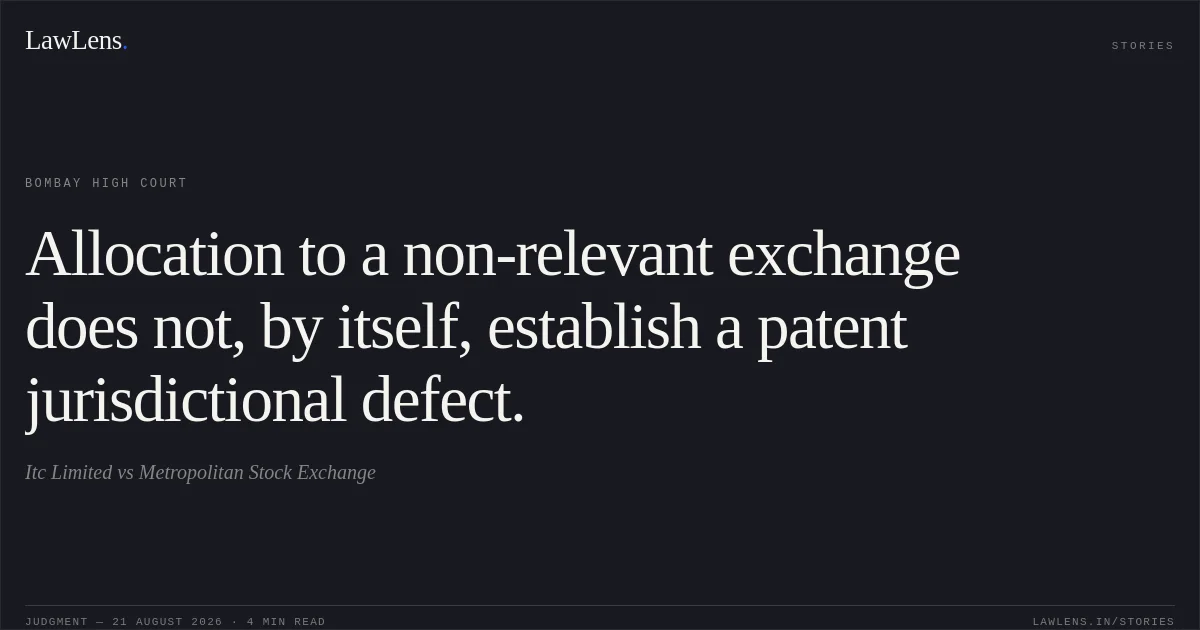
Source reference: paras. 22, 27–32, pp. 14–16Although the Court recognised that paragraph 16(a) required consideration of the relevant Stock Exchange and that the Petitioner’s objection regarding MSE was serious, the mere fact that the Petitioner’s securities were not listed on MSE did not conclusively establish that MSE lacked all authority, particularly where the complaint had been allotted through SEBI’s prescribed ODR mechanism and had proceeded through conciliation.
Source reference: paras. 23–24, 33–34, pp. 13–17Paragraph 20(b) consequently obliged the Petitioner to participate and pay the applicable fees once the dispute had entered the ODR framework and conciliation had failed, without preventing the Petitioner from raising all its objections before the arbitral forum.
Source reference: paras. 25–26, pp. 14–15Holding
The High Court dismissed the writ petition, holding that the impugned communications dated 24 October 2024 and 26 November 2024 were not shown to be ex facie void or issued without authority.
The Petitioner was directed to comply with the applicable ODR requirements, including payment of arbitral fees, within 14 days of uploading of the order.
Source reference: para. 38, p. 18The arbitration was to proceed under the Master Circular and applicable ODR rules.
Source reference: para. 38, p. 18Compliance was expressly made without prejudice to the Petitioner’s right to raise objections concerning jurisdiction, allocation to MSE, limitation, locus, maintainability, res judicata, abuse of process and arbitrability before the arbitral forum.
Source reference: para. 38, p. 18There was no order as to costs.
Source reference: para. 39, p. 19Acts & Sections Cited
1 provisions across 1 statute referred to in this judgment. Each provision opens on LawLens.
Companies Act, 20131
Original Court PDF
Itc LimitedvsMetropolitan Stock Exchange
Click to open original judgment
Original judgment, available to read, download and summarize on LawLens.in