01Facts
The petitioners, LPG distributors, were held guilty of a major irregularity under clause 2.1.5 of the Marketing Discipline Guidelines, 2022 for an alleged difference or diversion of 472 cylinders of 14.2 kg LPG, by order dated 23.10.2026.
¶ 2On 12.07.2026, a technical glitch in the respondent's servers and the CDCMS Portal prevented OTP generation and the uploading of delivery details.
¶ 4The petitioners reported the failure in a WhatsApp group maintained by the respondents.
¶ 5The petitioners contend the cylinders were delivered and the shortage is a paper shortage caused by the system failure.
¶ 6A show cause notice dated 11.08.2026 alleged unaccounted sales.
¶ 7The petitioners replied on 15.09.2026, explaining the portal failure and seeking permission to upload delivery details.
¶ 7The respondent issued the impugned order without considering that reply and without a personal hearing.
¶ 8The petitioners also relied on a representation dated 15.07.2026 and WhatsApp messages.
¶ 15, 19The respondent opposed the writ as not maintainable because an appellate remedy existed and the dispute was factual.
¶ 1202Issues
i.1. Whether the writ petition is maintainable under Article 226 despite the availability of an alternative statutory appellate remedy against the impugned order.
¶ 12–14, 16ii.2. Whether the impugned order, passed without considering the petitioners' representation and without a personal hearing, violates the principles of natural justice, even though the Marketing Discipline Guidelines, 2022 do not expressly provide for a hearing.
¶ 8, 11, 15, 1703Law Applied
The Court relied on the principle that the existence of an alternative remedy does not oust Article 226 jurisdiction, and that a writ lies where there is a violation of natural justice, as recognised in Whirlpool Corporation v. Registrar of Trade Marks (1998) 8 SCC 1.
¶ 16The Court referred to Indian Oil Corporation v. Soumyajit Roy Chowdhury, 2025 SCC OnLine Cal 2197, which restates the Whirlpool exceptions, namely enforcement of fundamental rights, violation of natural justice, lack of jurisdiction, or challenge to vires.
¶ 13The petitioners' authority, State Bank of India v. Rajesh Agarwal (2023) 6 SCC 1, quoting Mangilal v. State of M.P., holds that where a statute is silent, the principles of natural justice are presumptively read in where substantial rights are affected, and that a litigant's defence must not be excluded.
¶ 10The judgment in Bimala Gas Agency was distinguished on facts and the question of law was left open.
¶ 1404Reasoning
The respondent's objection was that the petitioners had an appellate remedy and that the dispute was factual. The Court held that the second Whirlpool exception applied because the petitioners alleged a breach of natural justice.
¶ 12, 16The Court found a prima facie case because the impugned order appeared to ignore the representation dated 15.07.2026 and denied a hearing despite a specific prayer.
¶ 15On the second issue, the Court accepted that the Guidelines are silent on personal hearing. Under Rajesh Agarwal and Mangilal, that silence did not exclude the duty to hear, because the order carried serious adverse consequences affecting the petitioners' substantial rights.
¶ 10–11The Court therefore treated the impugned order as arbitrary, illegal, and passed in breach of natural justice. It expressly did not examine the merits of the allegation of diversion.
¶ 17, 2205Holding
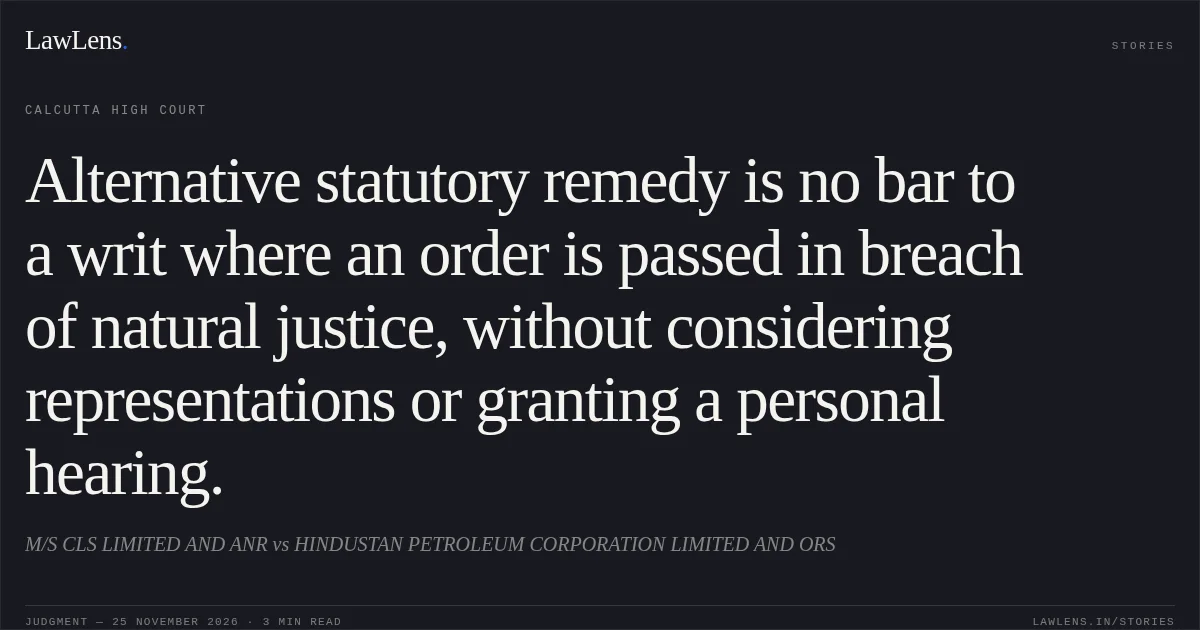
The writ petition is maintainable notwithstanding the alternative remedy, because the impugned order violates the principles of natural justice.
¶ 15–16The order dated 23.10.2026 is quashed and set aside. The respondent No. 3 is directed, with the assistance of respondent No. 5, to revisit the issue and pass a reasoned, speaking order within six weeks of receipt of the order, after granting a personal hearing to the petitioners and other stakeholders. The decision must be communicated within one week thereafter. The respondent must mandatorily consider the representation dated 15.07.2026 (P9), the reply dated 15.09.2026 (P12), and the WhatsApp messages (P7). If the petitioners succeed, the oil company may take lawful steps. The concerned respondent must decide independently and without influence from the Court's observations, and the petitioners must not seek unnecessary adjournments. All contentions on merits are left open before the respondent.
¶ 17–22Original Court PDF
M/S CLS LIMITED AND ANRvsHINDUSTAN PETROLEUM CORPORATION LIMITED AND ORS
Click to open original judgment
Original judgment, available to read, download and summarize on LawLens.in